IBI Discount for Solar Panels in Spain: How Property Owners Can Reduce Their Local Taxes
September 15, 2026
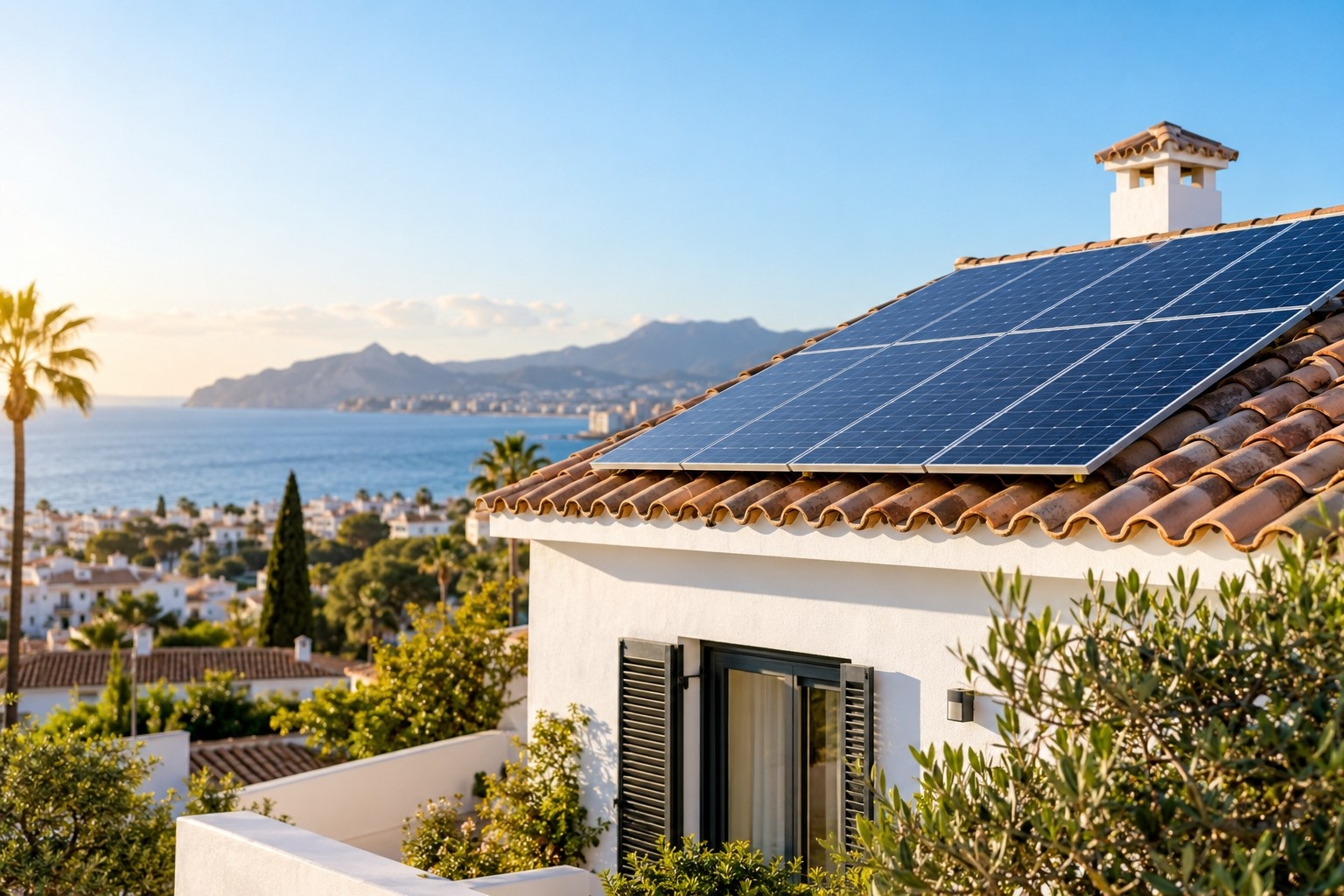
If you have installed solar panels on a property in Spain — or are considering doing so — the savings may go beyond your electricity bill.
Depending on where your property is located, your local council may offer a substantial reduction in the Impuesto sobre Bienes Inmuebles (IBI), Spain's annual municipal property tax.
There may also be a separate tax benefit for the installation itself through the Impuesto sobre Construcciones, Instalaciones y Obras (ICIO).
For property owners living outside Spain, however, these incentives are particularly easy to miss. They are not automatically applied nationwide, the rules vary between municipalities and, in many cases, you need to actively apply within a specific deadline.
Here is what you need to know.
Quick answer
Spanish law allows municipalities to offer:
- an IBI reduction of up to 50% for properties with qualifying solar-energy installations; and
- an ICIO reduction of up to 95% for qualifying construction or installation works involving solar-energy systems.
However, these are optional municipal tax benefits.
This means that installing solar panels does not automatically give every property owner in Spain a 50% reduction in IBI. Each local council decides whether to offer the incentive and determines the percentage, duration, eligibility criteria and application procedure.
What is the IBI?
The Impuesto sobre Bienes Inmuebles (IBI) is the annual local property tax paid by owners of Spanish real estate.
Unlike the Modelo 210, which is a national tax return filed with the Agencia Tributaria, the IBI is administered locally by your municipality or by the organisation responsible for tax collection in your area.
The amount normally depends on your property's cadastral value (valor catastral) and the tax rate established by the municipality.
If you own a Spanish property as a non-resident, paying IBI does not replace your obligation to file the Modelo 210. They are separate taxes.
You can look up other Spanish property-tax terms in our Spanish tax glossary.
Can solar panels reduce your IBI?
Potentially, yes.
Article 74.5 of Spain's Local Tax Law allows municipalities to introduce an IBI discount of up to 50% for properties where qualifying systems for the thermal or electrical use of solar energy have been installed.
The legislation establishes the maximum available benefit, but leaves the detailed rules to each municipality.
As a result, two otherwise identical properties located in different Spanish municipalities could receive very different tax treatment.
One council might provide a 50% reduction for five years. Another could offer 15% for three years. And another municipality may provide no solar-related IBI discount at all.
This is why checking the local ordenanza fiscal del IBI is essential.
How much could you save?
Imagine that your annual IBI bill is €900.
If your municipality granted a 50% solar-energy discount, your annual saving would be:
€900 × 50% = €450
If that reduction applied for five years, the total potential saving would be:
€450 × 5 = €2,250
However, municipalities may impose maximum limits linked to the installation cost or establish different percentages and durations.
The headline percentage therefore does not always tell you exactly how much you will save.
Examples: the rules are not the same across Spain
The differences between municipalities are significant.
Madrid
Madrid currently provides a 50% IBI reduction for qualifying solar installations during the five tax periods following registration of the installation.
The application must generally be submitted during the same year in which the installation is entered in the relevant register.
Madrid also establishes limits linked to the installation cost and contains specific rules for properties forming part of a community of owners.
If energy-storage systems such as batteries are subsequently installed, the city also provides for an extension of the benefit in certain circumstances.
Málaga
Málaga currently provides a 15% IBI reduction for qualifying properties whose principal cadastral use is residential.
The benefit can apply for a maximum of three years, starting with the tax period following the installation.
The amount discounted in each year cannot exceed 33% of the total cost of the installation.
Applications made before 1 February may take effect for that year, while later applications are generally considered for the following year, subject to the remaining eligibility period.
These examples illustrate why you should never assume that the rules applying in another Spanish town also apply to your property.
Do non-resident property owners qualify?
Being a non-resident does not, in itself, prevent you from benefiting from an IBI solar discount.
IBI is linked to the property and the taxpayer liable for the local property tax rather than to Spanish income-tax residence.
What matters is whether you meet the requirements established by the municipality in which the property is located.
Depending on the council, these may include:
- being the person liable for the IBI;
- having a qualifying solar installation;
- obtaining the required technical certification;
- registering the installation correctly;
- having no outstanding municipal debts;
- submitting the application within the required period; and
- satisfying any minimum-power or other technical requirements contained in the local ordinance.
Always check the current municipal rules before relying on a particular tax saving.
If you bought the property recently, our guide to your first Modelo 210 after buying a property in Spain covers your wider tax obligations as a new owner.
Is the IBI discount automatic?
Usually not.
This is one of the most important points for property owners.
Installing solar panels does not normally mean that your next IBI bill will automatically be reduced.
In municipalities offering the benefit, the owner generally has to apply for the discount and provide supporting documentation.
If you live outside Spain, this is particularly easy to overlook: the installer may complete the technical installation without dealing with the owner's subsequent municipal tax application.
What documents might you need?
Requirements vary from one municipality to another, but councils commonly request documents such as:
- the application form;
- your NIE or identification details;
- property details and cadastral reference;
- installation invoice;
- proof of payment;
- technical installation certificate;
- proof that the installation has been registered where required;
- building licence or declaración responsable, where applicable;
- confirmation that the equipment meets the required technical standards; and
- authorisation if someone is submitting the application on your behalf.
For a property belonging to a community of owners, additional documentation may be necessary to establish which owners participated in and paid for the installation.
What if the solar panels were compulsory?
This is another point that owners should check before assuming that they qualify.
Municipalities may exclude solar installations that were compulsory under applicable building regulations rather than voluntarily installed by the property owner.
For example, both Madrid and Málaga expressly restrict their benefits where the solar system was mandatory under the applicable regulations.
This can be particularly relevant with newer buildings.
What is the ICIO solar-panel discount?
IBI is not the only municipal tax you should investigate.
When construction or installation work is carried out in Spain, the municipality may charge the Impuesto sobre Construcciones, Instalaciones y Obras (ICIO).
Spanish law allows municipalities to grant a discount of up to 95% of the ICIO for works incorporating qualifying solar-energy systems.
Again, this does not mean that every solar installation in Spain receives a 95% reduction.
The municipality must have introduced the benefit into its own tax ordinance and may establish additional requirements.
IBI and ICIO: what is the difference?
The two incentives relate to different taxes.
IBI is the recurring annual property tax. An IBI solar discount can therefore reduce your annual property-tax bill for the period established by the municipality.
ICIO, on the other hand, is associated with the construction or installation work itself. A qualifying ICIO reduction therefore normally provides a one-off saving connected with carrying out the solar installation.
Depending on your municipality, you may potentially benefit from both.
Check the tax incentives before installing the panels
If you are still planning the solar installation rather than applying retrospectively, check the municipal rules first.
There can be important deadlines.
For example, some benefits may have to be requested alongside the building or installation procedure, while others must be requested during the year in which the installation is registered.
Waiting until you receive your next IBI bill could mean losing part — or occasionally all — of the available benefit.
Before beginning the project, check:
- whether your municipality offers an IBI solar discount;
- the percentage and number of years for which it applies;
- whether there is an ICIO reduction;
- whether the installation must exceed a minimum size or capacity;
- whether the system must be officially registered;
- which certificates your installer must provide;
- whether the installation must be voluntary rather than legally required; and
- the deadline for submitting each application.
What if the panels are already installed?
Do not automatically assume that it is too late.
Some municipalities allow applications after the installation has been completed, although you may lose the benefit for earlier years. Others establish stricter time limits.
You should check:
- the installation date;
- the current municipal ordinance;
- when the installation was registered;
- whether the maximum benefit period is still running; and
- whether retrospective applications are accepted.
For example, Málaga states that if more than three years have elapsed from the year following installation, its solar IBI benefit will no longer apply.
What if the property belongs to a community of owners?
Solar installations in apartment buildings are increasingly common, but the tax treatment can be slightly more complicated.
A shared installation does not necessarily mean that every property owner in the building receives the same tax reduction automatically.
The local ordinance may require proof that an individual owner participated in the installation and contributed towards its cost.
Madrid, for example, specifically provides rules for properties under horizontal-ownership regimes and limits the benefit to owners participating in the shared installation.
If your community of owners has installed solar panels, ask the administrator or president for copies of the installation documentation and a breakdown of the costs allocated to your property.
For the wider filing rules that apply when a property has more than one owner, see do both co-owners of a Spanish property have to file a Modelo 210?
Is the solar IBI discount the same everywhere in Spain?
No.
There is no single nationwide percentage, application form or duration.
Spanish national legislation gives municipalities the power to establish the incentive, but the local council determines how it operates in practice.
For this reason, articles listing solar IBI discounts by city can become outdated relatively quickly.
The most reliable approach is always to check the latest version of the municipal tax ordinance before submitting an application.
Does receiving an IBI discount affect Modelo 210?
The solar discount does not eliminate your Modelo 210 obligations.
If you are a non-resident owner of Spanish property, you may still need to file Modelo 210 for:
- imputed income, when the property is available for your own use;
- rental income, when the property is rented; or
- capital gains, when the property is sold.
IBI and Modelo 210 are separate taxes administered by different authorities.
For rented properties, the IBI actually paid may also be relevant when calculating deductible rental expenses where the taxpayer is entitled to claim them.
A lower cadastral-value base can also reduce your imputed income tax, and if you are unsure which return applies to your situation, see which Modelo 210 do I need to file?
How can I check whether my property qualifies?
Start with the municipality where the property is located.
Look for the current Ordenanza Fiscal del Impuesto sobre Bienes Inmuebles and search for terms such as:
- bonificación energía solar;
- aprovechamiento térmico o eléctrico;
- autoconsumo;
- IBI placas solares.
You should also check the municipal ICIO ordinance separately.
If the rules are unclear, contact the local tax office before assuming that you are entitled to the reduction.
Frequently asked questions
For a broader look at non-resident property tax obligations in Spain, see our 25 questions foreign property owners ask about Spanish tax.
Can I get a 50% IBI discount anywhere in Spain?
No. Spanish law allows municipalities to establish a solar-related IBI discount of up to 50%, but each council decides whether to offer it and under what conditions.
How long does the solar IBI discount last?
It depends entirely on the municipality. Some councils provide the reduction for several years, while others use a shorter period or provide no solar-related IBI benefit.
Can a non-resident apply?
Generally, tax residence is not the determining factor. The relevant question is whether you are the taxpayer responsible for the IBI and satisfy the conditions established by the municipality.
Do I have to apply for the discount?
In most cases, yes. You should not assume that your local authority will identify your solar installation and automatically reduce your IBI.
Can I receive both an IBI and an ICIO discount?
Potentially, yes. They are different taxes and Spanish legislation allows municipalities to establish separate incentives for each. You must check the applicable municipal ordinances.
I installed solar panels several years ago. Can I still apply?
Possibly, but it depends on the municipality and the date of installation. Some councils allow later applications while limiting the remaining years of the benefit.
Does my solar IBI discount reduce my Modelo 210?
No. The IBI and Modelo 210 are separate taxes. Receiving an IBI reduction does not remove your Spanish non-resident income-tax obligations.
You can use our non-resident tax calculator to estimate your annual Modelo 210 liability.
Managing local property taxes from abroad
IBI may look straightforward, but for owners living outside Spain it can be surprisingly easy for a payment, change of ownership, direct debit or municipal notice to be missed.
This becomes even more important when local tax benefits, different municipal authorities and application deadlines are involved.
If you own property in Spain as a non-resident, IberianTax can help you manage your Spanish tax obligations online, alongside your annual Modelo 210.
Own property in Spain? Keep your Spanish taxes organised from wherever you live.
If you would rather have a specialist review your municipality's rules and handle the paperwork for you, our local property tax service can help.