Bought a property in Spain? All you need to know about your tax obligations
September 24, 2026
Buying a property in Spain comes with taxes you pay at completion: transfer tax or VAT, notary fees, Land Registry costs. But there's one obligation that arrives much later and catches many owners off guard: the Modelo 210 non-resident income tax return.
Even if you've never rented out your property, only used it for holidays, or left it empty since purchasing it, you may still be required to file a Modelo 210. This guide explains when your first return is due, how the tax is calculated, and what to watch out for.
Quick answer: Your first Modelo 210 covers the period from your acquisition date to 31 December of that year. Non-rented days are declared as imputed income; rented days are declared separately as rental income. Imputed income is filed the following year — for example, a 2026 purchase is filed between 1 April and 31 December 2027.
What is the Modelo 210?
Modelo 210 is the tax return used by non-residents to declare Spanish-source income. For property owners, it is used to report three different types of income:
- Imputed income when the property is used personally or remains unoccupied.
- Rental income when the property is rented out.
- Capital gains when the property is sold.
The type of Modelo 210 you need to file depends on how the property was used. Each type of income is declared separately, using its own tax return and following its own filing rules and deadlines.
This article focuses primarily on the first two situations during the year in which the property is purchased.
Each owner is treated as an individual taxpayer, so co-owned properties require a separate Modelo 210 for each owner.
Do you need to file Modelo 210 if you do not rent the property?
Yes, in most cases.
Spanish tax law attributes a notional or imputed income to urban properties that are owned by non-resident individuals and are available for their personal use.
This does not mean that the Spanish Tax Agency believes you have actually received rent. Instead, the law treats the ability to use the property as an economic benefit and calculates a small taxable amount by reference to its cadastral value.
The obligation normally applies when the property is:
- Used by you or your family.
- Used as a holiday home.
- Kept empty.
- Available for your personal use.
- Rented during only part of the year, in respect of the remaining non-rented days.
It is therefore possible to owe non-resident income tax even though the property has not generated any money.
The fact that you paid taxes when purchasing the property does not remove this annual obligation.
When does the obligation begin?
Your obligation begins on the date you legally acquire the property — normally the date on the public purchase deed signed before the notary, not the reservation date, preliminary contract, or mortgage approval.
For example, if you signed a reservation agreement in June but completed the purchase before the notary on 15 September, the Modelo 210 calculation would normally begin on 15 September.
The tax is calculated proportionally from that date, reduced according to how many days you actually owned the property during the year.
When is the first Modelo 210 deadline after buying a property?
If the property isn't rented, you declare imputed income for the days it was available for your personal use. Imputed income is always declared the year after the tax year it relates to — so income relating to 2026 is filed during 2027, never within the same year.
This distinction is important:
- The tax year is the year in which you owned the property (period covered).
- The filing year is normally the following calendar year.
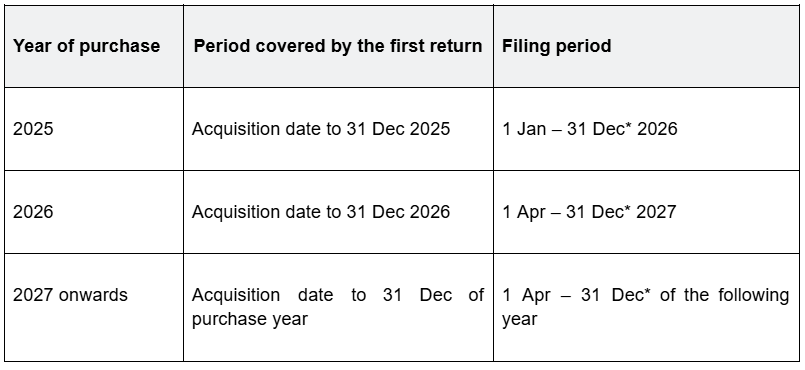
* If you pay by direct debit, the filing deadline is a few days earlier than the general deadline (typically 23 December).
These dates apply to imputed income only — if the property was rented, rental income has its own separate deadline, covered below.
How is the first year imputed income tax calculated?
The calculation combines five factors:
- the property's cadastral value,
- the applicable imputed percentage
- the days it was available to you
- your ownership share
- the tax rate for your country of residence.
Formula: Cadastral value × imputed percentage × [days available ÷ days in the year] × ownership share × tax rate
The cadastral value
The cadastral value or “valor catastral” is an administrative value assigned by the Spanish Cadastre. It is not the purchase price, market value, or insured value. You can usually find it on the property's IBI (property tax) receipt or in the Cadastral Descriptive and Graphic Certificate (Certificación Catastral Descriptiva y Gráfica) attached to the final pages of your purchase deed (escritura de compraventa).
If you haven't received an IBI bill yet (which is common during the first year of ownership), the latest receipt may still be in the seller's name. That's perfectly fine, as the cadastral value relates to the property itself, not its owner.
The cadastral value may also appear in the property's deed of sale, usually on a page titled "Certificación catastral descriptiva y gráfica," typically near the end of the document. This certificate includes the cadastral reference, the property's address, floor area, and the cadastral value assigned at the time of sale.
For a step-by-step guide on where to find the cadastral value, see our article: What Is the Cadastral Value and How to Find It?
The imputed percentage
To calculate the taxable base, the cadastral value is multiplied by an imputed percentage: 1.1% — if the municipality's cadastral values were revised within the last ten years, or 2% — otherwise. This depends only on when the municipality last updated its valuations—not on the property's condition, rental potential, or your nationality.
The number of days you owned the property and it was available for your use
The annual imputed amount must be reduced where you owned the property for only part of the year.
For example, if you acquired the property on 15 September 2026 and it was not rented, the relevant period would run from 15 September to 31 December = That represents 108 days.
The calculation should therefore reflect:
108 ÷ 365
You do not pay a full year of imputed income merely because you were the owner on 31 December.
Also, the property is considered available for your use whether you actually used it or not. This includes periods when:
- You remained in another country.
- No one visited the property.
- Friends or family stayed in the property free of charge.
- You did not have time to use it.
- It was being advertised for sale.
- It was kept empty while you decided what to do with it.
Your ownership percentage
Where a property has several owners, each owner calculates the tax according to their legal ownership share. Examples include:
- One owner with 100%.
- Two owners with 50% each.
- Two owners with 70% and 30%.
- Three owners with 33.33% each.
The ownership percentage should generally be taken from the purchase deed or other document through which the property was acquired.
It should not be assumed that a married couple owns the property 50/50. The deed and the applicable matrimonial property arrangements must be checked.
The tax rate
The tax due depends on your tax residency. The applicable tax rate is 19% for EU/EEA residents (including Iceland, Norway, and Liechtenstein) and 24% for residents of all other countries, including the UK, the US, and Canada. What matters is your tax residence—not your nationality. For example, a German citizen living in the UK is taxed at 24%, while a British citizen who is tax resident in Germany is taxed at 19%.
Worked example
Sophie, a UK tax resident, buys an apartment in Mallorca on 15 September 2026 for personal use. Cadastral value: €100,000. Imputed rate: 1.1%. Days owned: 108.
Annual imputed income: €100,000 × 1.1% = €1,100
Adjusted for days owned: €1,100 × 108 ÷ 365 = €325.48
Tax at 24%: €78.12
If Sophie were a tax resident in Germany instead, the same €325.48 would be taxed at 19%, giving €61.84 — same property, same dates, different result based purely on residence.
If she bought the property jointly with her husband (50/50), each would file separately for €39.06 — paying from a joint account doesn't merge the two returns into one.
What if the property was rented during the year of purchase?
A property rented partway through the year creates two separate returns for the same year: one for rental income, one for imputed income on the remaining days. For example, if David buys a property on 1 July and rents it for 31 days in August, he declares rental income for those 31 days and imputed income for the other 153 days — never combined.
Rental income for 2026 (under annual grouping) is filed between 1–20 April 2027, with a 15 April direct debit deadline — earlier and separate from the imputed income deadline.
Rental expenses (IBI, community fees, insurance, mortgage interest, etc.) cannot be deducted from imputed income under any circumstances — the calculation is based on the cadastral value, not your actual costs.
Modelo 210 vs. IBI: not the same thing
- IBI, or Impuesto sobre Bienes Inmuebles, is a local property tax charged by the municipality or the relevant local collection authority. It is linked to ownership of the property and is generally billed annually.
- Modelo 210 is a national tax return filed with the Spanish Tax Agency.
Paying IBI does not satisfy all your tax obligations — this is one of the most common misunderstandings among new owners, since the IBI receipt is often the only tax document that arrives automatically. The Tax Agency doesn't send a Modelo 210 reminder; identifying and filing the obligation is the owner's responsibility.
Does each property unit need its own return?
Yes — garages, parking spaces, and storage rooms with their own cadastral reference are treated as separate properties. A couple who jointly owns an apartment, a parking space, and a storage room (each 50/50) could end up filing six separate returns for one purchase.
What information you'll need to file
- Personal: full name, NIE (Spanish tax identification number), date and country of birth, address and country of tax residence.
- Purchase: public deed, acquisition date, ownership percentage, co-owner details
- Property: cadastral reference and value, address, any separate garage/storage references
- Usage: the date ownership began, days rented vs. available, days it was available for personal use
- Payment: bank details compatible with your chosen payment method
Common first-year mistakes
- Waiting twelve months from completion — the return follows the calendar year, not your purchase anniversary.
- Using the purchase price instead of the cadastral value for the standard calculation.
- Paying for a full year instead of prorating by days owned.
- Assuming that no return is required because the property is not rented or used.
- Filing only one return for a couple — each owner must file individually.
- Ignoring the non-rented days when the property was rented for only part of the year.
- Using nationality instead of tax residence to determine the 19%/24% rate.
- Assuming IBI covers the obligation — it doesn't.
- Forgetting separately registered garages or storage rooms with their own cadastral reference.
How IberianTax helps with your first Modelo 210
The first year is often the most confusing because the owner must combine information from the purchase deed, IBI documentation and the property’s use during a partial calendar year.
With IberianTax, you enter the relevant information through a guided online process, including:
- The tax year.
- The acquisition date.
- The cadastral reference and value.
- Your ownership percentage.
- Your country of tax residence.
- The days the property was rented or available.
- The applicable payment method.
The platform calculates the tax according to the ownership period and submits the Modelo 210 directly to the Spanish Tax Agency.
Where there is more than one owner or more than one cadastral unit, IberianTax helps identify the separate returns required.
After the first filing, eligible owners can also activate automatic filing for future imputed-income returns, reducing the risk of missing the annual obligation.
Bought a property in Spain and need to file your first Modelo 210? Complete the process online, in your own language — IberianTax handles the calculation and submission for you.
Frequently asked questions
I bought a property this year. Do I file immediately?
No — imputed income is filed the following year. For a 2026 purchase, that's between 1 April and 31 December 2027.
Do I still have to file if I bought in December?
Yes. The tax is prorated by days owned, even if that's just a handful.
I already pay IBI — do I still need Modelo 210?
Yes. IBI is a local tax; Modelo 210 is a separate national return.
Why do I owe tax if I never rented the property?
Spanish law imputes notional income to properties available for personal use, based on the cadastral value — not actual rent received.
Do both spouses need to file separately?
Yes, if both are registered owners. Marriage doesn't allow a joint imputed-income return.