Non-Resident Tax in Spain 2026: What’s New and the New Deadlines
September 24, 2026

Non-resident property owners in Spain must file the Modelo 210 every year. Whether you rent out your property or not — even if it stays empty — you are required to declare it through the Modelo 210 annually.
This guide gives a complete overview of non-residents’ tax obligations in Spain for the 2026 tax year (to be filed in 2027), including the new deadlines and the new form introduced by Order HAC/623/2026, as well as the other legal changes affecting non-resident property owners.
Who must file the non-resident tax return (Modelo 210)?
All non-residents in Spain who earn income in Spanish territory must declare it through the Modelo 210.
- If you receive employment income but are not a property owner, check the Double Taxation Treaty between Spain and your country of residence to avoid paying tax twice before filing your Modelo 210.
- If you own a property, all non-resident owners must file at least one Modelo 210 per year for imputed income, even if the property is empty or used only occasionally. If you rent out your property, whether short-term or long-term, an additional annual return for rental income is required.
- If you receive dividends from a Spanish company and a withholding rate higher than that set out in the double taxation treaty between Spain and your country of tax residence has been applied, you can claim a refund of that excess through the Modelo 210. The window to request it opens on 1 February of the year following the dividend payment.
- Finally, if you sell your property in Spain, you must declare the resulting capital gain or capital loss within four months of the sale, also through the Modelo 210.
The Modelo 210 must be filed independently and separately for each tax year, for each type of income and, in the case of property, for each owner and each property, since each of these elements requires a separate return to the Agencia Tributaria.
Filing deadlines for the 2026 tax year (to be filed in 2027)
With Order HAC/623/2026 now in force, the deadlines have changed significantly compared to previous years.
These are the dates to keep in mind for the 2026 tax year:
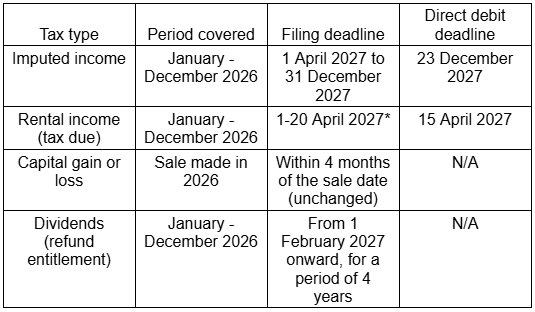
*The April deadline applies when there is tax due. If the result is zero or negative, or if a refund is due, the deadline varies; we explain this in the next section.
This change of dates is one of the year’s main developments: up to and including the 2025 tax year, both imputed income and rental income could be filed from January. From 2026 onward, both deadlines shift.
Tax changes affecting non-resident property owners in 2026
The most significant change for the 2026 tax year comes with Order HAC/623/2026 (BOE, 23 June 2026), which amends both the filing deadlines and the Modelo 210 form itself.
New deadlines for rental income, depending on the result of your return
The exact date no longer depends only on the tax year and type of income, but also on whether your return results in tax due, a zero result, or a refund:
- If tax is due: the new April deadline applies, from 1 to 20 April 2027. If you pay by direct debit, the direct debit window is 1 to 15 April.
- If your deductible expenses exceed your income and the result is zero or negative: the previous deadline is kept, 1 to 20 January 2027. For this purpose, only repair and maintenance expenses, as well as interest on loans taken out to acquire the let property, will be taken into account.
- If the result is a refund, common when withholding tax has been applied at source (for example, on rental income from commercial premises), the window opens on 1 February 2027.
Imputed income: the window opens in April, not January
The final deadline remains 31 December of the following year, but from 2026 onward (to be filed in 2027), the filing window does not open until 1 April, instead of 1 January. If you pay by direct debit, the deadline remains 23 December.
A new Modelo 210 form from January 2027
From 1 January 2027, any Modelo 210 return filed — regardless of which tax year it relates to — must use the new version of the form.
Here’s what’s new:
- Days of ownership or rental, and ownership percentage: the form will ask how many days the property was rented out (or available for your personal use) and what percentage of the property you own.
- Cadastral reference indicator: a new field confirms whether the property has a cadastral reference, making it easier for the Agencia Tributaria to cross-check it against Catastro data.
- New annex for deductible rental expenses: expenses will no longer be declared as a single total figure. From 2027 they must be broken down by category (interest and repairs, community fees, utilities, insurance, IBI, depreciation, among others).
If you file your Modelo 210 with IberianTax, there’s nothing to worry about. We take care of automatically adapting your data to this new format.
New annex for dividends: grouping and breakdown
The order also introduces changes for non-residents who request a refund of withholding tax applied to dividends. Until now, if you grouped together in your return all the dividends received from the same company during the year, there was no way to identify which part of the withholding corresponded to each individual payment, which made it harder for Hacienda to review these requests.
From now on, when you choose to group dividends from the same company in your Modelo 210, you will need to complete a new dividend breakdown annex that identifies which amount corresponds to each payment within the tax year. This annex mainly applies to securities traded on official secondary markets (Spanish, EU, or other countries). In practice, this gives the Agencia Tributaria greater visibility into the exact origin of each declared dividend, which speeds up — but also tightens — the review of refund requests.
Legal developments that could affect you in the future
In addition to the regulatory changes already approved, there are two open legal fronts that could affect your taxation in the coming years: one is being decided in the Spanish courts, the other pits Spain against the European Commission.
The deduction of rental expenses is being debated in the Supreme Court
Non-resident owners in Spain who reside within the EU/EEA can deduct rental expenses (utilities, repairs, community fees, mortgage interest) when declaring their income on the Modelo 210.
Owners from outside the EU/EEA still cannot do so. However, the case is now before the Supreme Court, following the favourable ruling by the Audiencia Nacional in 2025. A final ruling is expected in 2026; if it confirms that the difference in treatment is discriminatory, owners from outside the EU/EEA will be able to claim deductions and retroactive refunds, provided valid documentation exists and the statute-of-limitations period has not expired.
IberianTax offers a service to claim these expenses before the final ruling, to prevent them from becoming time-barred. Don’t leave it until the last moment.
At EU level: the European Commission versus Spain
At the same time, the European Commission currently has two separate procedures open against Spain over the tax treatment of non-resident property owners.
The first concerns imputed income. The Commission takes issue with non-residents being taxed on their empty or personal-use properties, while residents are exempt for their main home. Opened in 2025, it is still ongoing.
The second concerns the tax reduction on renting out a main residence. In June 2026, the Commission reactivated a 2019 procedure. The problem, according to Brussels, is that residents who rent out a property for use as the tenant’s main home can apply a reduction on the net income obtained (a reduction that has gone from 60% to 50% for contracts signed after May 2023, and which since 2025 can reach up to 90% depending on the case), while non-residents, taxed under the IRNR, cannot apply this reduction under any circumstances, whether or not they are EU/EEA residents. For the Commission, this difference in treatment may breach the free movement of capital.
Spain has a deadline, usually two months, to respond. If the response is not satisfactory, the Commission can issue a reasoned opinion and, later, refer the case to the Court of Justice of the EU.
Important to note: for now there is no change to Spanish law, nor any automatic right to a refund on either front — each case must be assessed individually. In the meantime, non-residents should continue filing their Modelo 210 as normal.
The Supreme Court strikes down the NRA: what changes for short-term rentals
In a ruling handed down on 21 May 2026 (Ruling 620/2026), the Supreme Court struck down the national short-term rental registry (NRA), created by Royal Decree 1312/2024. The reason: creating a national registry in parallel with the existing regional tourism registries exceeded the powers of the central Government, since this matter falls under the competence of the autonomous communities.
Here’s what changes in practice:
- If you had not applied for the NRA, you no longer need to. The obligation to obtain this number, and to file the annual activity return linked to it, has disappeared. So there is nothing to file next February 2027.
- If you already had an NRA, the national registry under which it was issued has been annulled. Keep your regional tourism registration number (VFT, VUT, HUT, or whichever applies in your region), which is now the valid reference.
- If your listing was removed from platforms such as Airbnb or Booking for not having an NRA, this ruling removes the legal basis for that removal. Platforms can no longer require the NRA, and they are expected to update their processes to request the corresponding regional tourism registration instead.
What doesn’t change: the obligation to hold the regional tourism licence (VUT, VFT, or equivalent) remains fully in force in the regions that require it. The ruling removes the national layer added on top of the regional registries, not the registries themselves. Nor does it affect in any way your obligation to declare rental income through the Modelo 210, which is an entirely separate legal framework.
What does this mean for non-resident property owners in 2027?
- If you’re filing rental income or imputed income for 2026, keep the new April deadlines in mind, and check whether your return results in tax due, a zero/negative result, or a refund, since the exact date varies in each case.
- Start recording and keeping receipts for your rental expenses by category, in anticipation of the mandatory annex required by the new version of the Modelo 210 from January 2027.
- If you request a refund of withholding tax on dividends and group several payments from the same company, be prepared to complete the new breakdown annex.
- Non-resident owners from outside the EU/EEA can use IberianTax’s expense reclaim service to try to recover deductible expenses from previous years before the four-year time limit expires.
- If you rent out short-term, check your regional tourism licence obligation; the national NRA no longer applies.
- While the procedures opened by the European Commission are being resolved, non-residents should continue filing their Modelo 210 every year.
What happens if I miss a deadline or don’t file the Modelo 210?
Missing a tax deadline in Spain can result in surcharges, interest, and penalties.
- Voluntary late filing: if you file before Hacienda sends you a notice, a surcharge of 1% of the tax due may apply for the first month, plus 1% for each additional month, up to 15% after 12 months. Interest only starts accruing after one year.
- After notice from the Agencia Tributaria: if Hacienda issues a notice, penalties of 50% to 100% of the tax owed may apply, plus interest.
Staying on top of deadlines is crucial to avoid costly fines and complications.
Can I file the Modelo 210 myself, or do I need help?
You can file your Modelo 210 on the Agencia Tributaria website, but you need a Spanish digital certificate and the site is not very intuitive. That’s why thousands of non-residents leave this in the hands of experts like IberianTax.
With IberianTax you can:
- File your Modelo 210 online in minutes from home.
- Save money: from €34.95 per return, compared to €200 or more from a traditional gestoría.
- Have peace of mind: your non-resident taxes are filed correctly, on time, and directly with the Agencia Tributaria, always using the correct form.
- Receive automatic reminders with updated deadlines every year.
- Choose automatic filing so your taxes are submitted every year without lifting a finger.
- Calculate your taxes instantly and check everything is correct with our free calculators.
- Get expert support in English, German, French, or Spanish whenever you need it.
Additional services for non-resident property owners
Agencia Tributaria notifications
Living abroad? We can manage letters and notifications from the Spanish Agencia Tributaria on your behalf.
Digital certificate
We offer a service to obtain a digital certificate that allows you to carry out secure transactions through Spanish government portals.
Management of local taxes
Set up direct debit for your IBI and rubbish collection fee and forget about the annual payment. We make sure they are paid correctly and on time.
Deductible expenses reclaim
If you are a non-resident owner from outside the EU/EEA, you can request the reclaim of rental expenses you were unable to deduct in previous tax years, before the four-year time limit expires.
Nota Simple
Get the official Land Registry excerpt (Nota Simple) with up-to-date information about your property.
Payment assistance
IberianTax can also help you verify and ensure your taxes are paid correctly and on time.
At IberianTax, we make filing your non-resident taxes easy, secure, and completely transparent, so you can enjoy your property without worrying about taxes. Through our imputed income, rental income, and capital gains forms, we help thousands of non-residents every year meet their Spanish tax obligations without stress or surprises.
File your Modelo 210 in minutes with IberianTax.