What is the Cadastral Value In Spain? Everything you need to know
September 24, 2026
What is the Cadastral Value?
The cadastral value (Valor Catastral in Spanish) is an administrative value assigned to all Spanish properties. It is used to determine the amount of local tax bills that each property owner is required to pay (such as Property Tax), and to calculate the tax liability that non-residents must meet via Form 210 in the case of unlet properties. The legal definition of the cadastral value is:
The cadastral value is an objectively determined administrative value for each property resulting from the application of the valuation criteria established in the valuation of the municipality concerned.
How is the Cadastral Value Calculated?
To determine the cadastral value of a property, the following components are essentially taken into account:
- The location of the property, the urban planning conditions affecting the land and its suitability for production.
- The execution costs of the construction, the quality and age of the building and the historical-artistic character or other conditions of the buildings.
- The conditions and values of the market, the value of the land, the value of the construction and the production costs and profits of the construction activity.
In general, the cadastral values may not exceed the market value of the real estate. To this end, a ministerial decree established a market reference coefficient of 0.5 at the time of approval and entry into force of the cadastral valuation. In the case of real estate with an administratively limited sale price, the cadastral value may not exceed this price under any circumstances.
The website Catastro is an administrative register under the Ministry of Finance that manages and publishes cadastral values. These values may be updated periodically by applying coefficients set out in the General State Budget Laws, which are approved each year by the Congress of Deputies.
Once the cadastral values have been established, they are forwarded to local authorities (provincial councils, town councils, etc.), which use them to calculate local taxes (such as Property Tax).
How can I find out the cadastral value of my Spanish property?
The cadastral value can be found on the Property Tax (IBI) bill issued by the provincial council or the body responsible for administering and collecting this tax.
Depending on the area where the property is located, Property Tax matters may be handled by various local authorities or provincial councils. This also affects how the bills are issued and how you can access the cadastral value information.
To make this process easier, we have prepared some specific guides explaining step-by-step how to check the cadastral value and download the IBI bill depending on the province:
- Alicante (SUMA): how to check the cadastral value and download the IBI bill.
- Balearic Islands (ATIB): how to obtain the IBI bill and find the cadastral value.
- Málaga (Patronato de Recaudación): guide to downloading the IBI bill and finding the cadastral value.
- Murcia (ATRM): how to obtain the IBI bill and find the cadastral value.
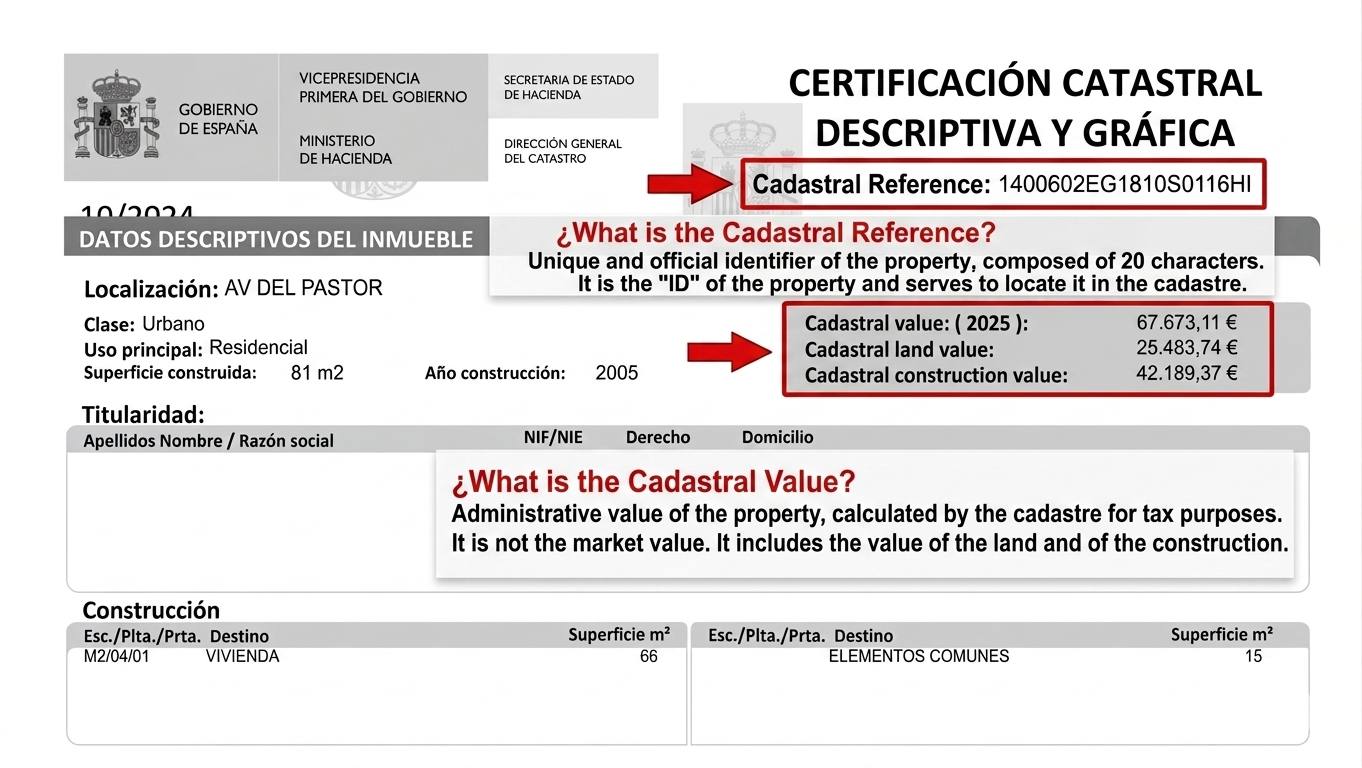
The cadastral value may also appear in the property’s deed of sale. This information is usually set out on a specific page entitled ‘Certificación catastral descriptiva y gráfica’, which is typically found towards the end of the deed.
This certificate contains relevant details of the property, such as the cadastral reference, the property’s address, the floor area and the cadastral value assigned at the time of the sale.
However, it is important to bear in mind that the cadastral value appearing in the deed may be out of date, particularly if several years have passed since the property was purchased or if the Catastro has carried out subsequent revisions.
In the image below, you can see a real-life example of where to find the cadastral value within a Spanish deed of sale:
Finally, cadastral values can also be accessed online via the Catastro website, provided the owner has a valid Spanish digital certificate or the NIE number and the "número de soporte".
How is the non-resident tax (Modelo 210) calculated?
For the non-resident tax return, the cadastral values are used to calculate the imputed income for non-rented properties by multiplying this value by the corresponding imputed percentage (1.1% or 2% depending on the municipality and tax year).
€480 (Tax Liability)
How IberianTax can help
IberianTax is always up-to-date and in line with Spanish tax legislation. Therefore, by using our online tax filing service, you can be sure that your non-resident tax return is done right and that the calculation is 100% accurate. What’s more, if you’d like to estimate your tax liability before filing your return, you can use our free tax calculator, which is always up to date.
If you have any queries, you can also contact our support team, who will be happy to answer any questions you may have to help you submit your Form 210 correctly.