How to find your cadastral value and download your IBI receipt in the Balearic Islands
September 24, 2026
If you own a property in the Balearic Islands and need to file your non-resident tax return in Spain (Form 210), one of the most important details you will usually need is the cadastral value of your property. In most cases, the simplest way to find this information is on your IBI receipt (Property Tax). This guide explains:
- Where to locate the cadastral value on your IBI receipt.
- How to download your IBI receipt in the Balearic Islands.
- Why this document is essential for completing your non-resident tax return correctly.
Where to find your cadastral value in the Balearic Islands (ATIB)
If you already have your IBI receipt, check it first before trying to download a new copy. In most cases, the document already contains the information you need.
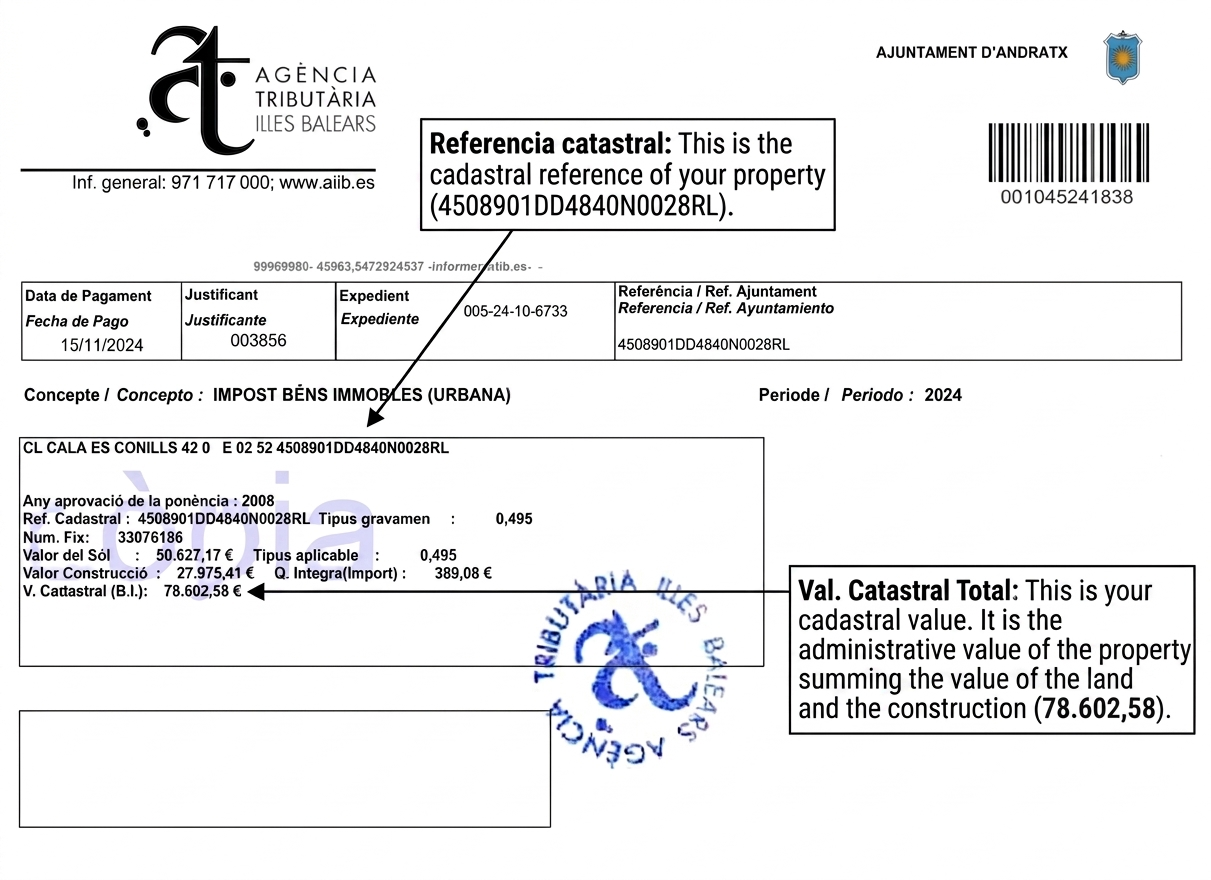
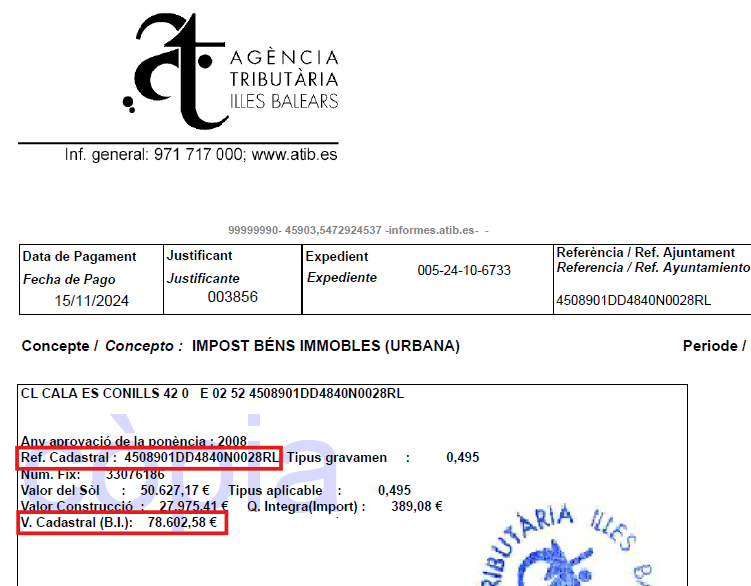
When you open the receipt, look for the field: Valor catastral.
This is your cadastral value and is one of the key pieces of information required to complete your Form 210.
Why your IBI receipt is important
Your IBI tax receipt (Property Tax) contains important information about your property.
For non-resident owners, this document is particularly useful as it usually includes:
- The cadastral value.
- The cadastral reference.
- Basic details regarding the property and its taxation.
These details are often needed to prepare your Modelo 210 correctly.
For this reason, having your IBI receipt to hand can save time when completing the form and help to avoid errors in your tax return.
What is the ATIB?
The ATIB (Agència Tributària de les Illes Balears) is the administrative body responsible for managing and collecting regional and many local taxes in the Balearic Islands.
For property owners, this means that taxes such as IBI (Council Tax), waste collection fees, and other municipal charges are often managed and collected through ATIB, rather than directly by each town hall.
Municipalities served by ATIB
ATIB collaborates with a large number of municipalities across the islands. Among them are:
- Son Servera
- Capdepera
- Santa Margalida
- Artà
- Muro
- Sa Pobla
- Palma
- Calvià
- Marratxí
- Llucmajor
- Manacor
- Inca
- Alcúdia
- Formentera
- Algaida
- Andratx
- Esporles
- Sóller
- Bunyola
- Campos
- Ses Salines
- Santa Maria del Camí
- Pollença
- Ciutadella de Menorca
- Santanyí
- Felanitx
- Binissalem
- Lloseta
- Sant Llorenç des Cardassar
- Sant Antoni de Portmany
If your property is located in one of these municipalities, it is very likely that your IBI receipt and other local taxes can be accessed through the ATIB system.
How to download your IBI receipt in the Balearic Islands
The ATIB does not usually send IBI receipts by post, especially when the tax is paid by direct debit.
However, in many cases, property owners can download the receipt online using the information shown on their bank statement.
To download your IBI receipt, you will need to have your bank statement to hand, showing the direct debit for the IBI payment.
Below, we explain in detail how to download your property tax bill from the ATIB using your bank statement:
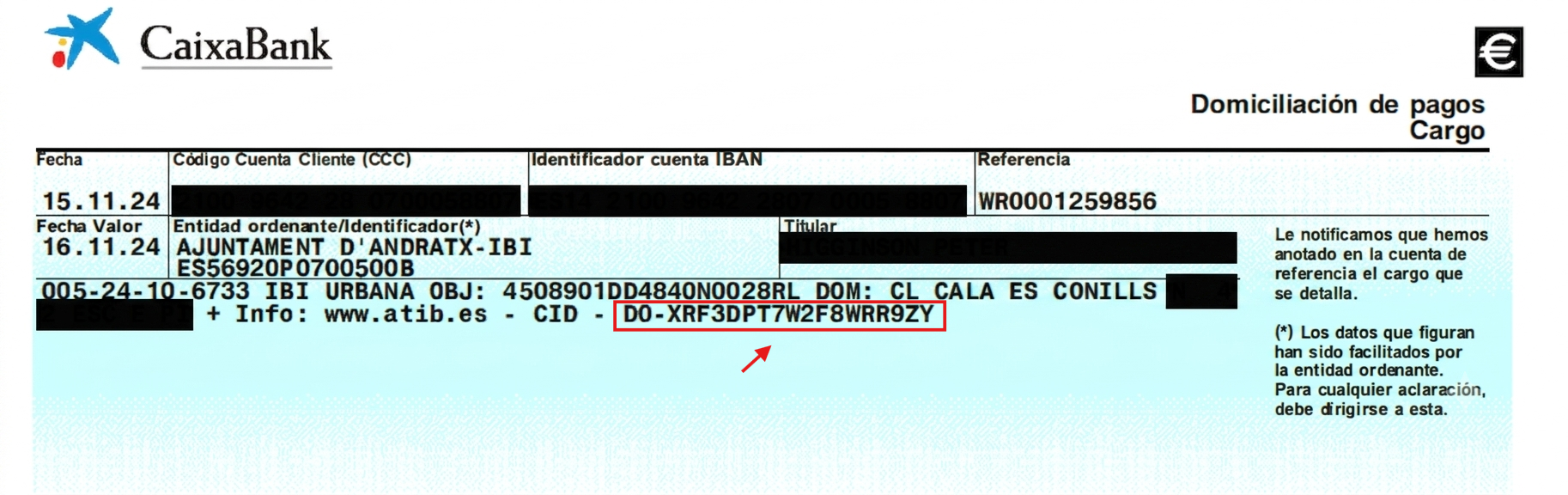
STEP 1. Find the "DO" code on your bank statement.
First of all, you will need to identify the document code. This code begins with the letters ‘DO’. This code serves as a unique identifier for your IBI receipt:
STEP 2. Go to the Tax Agency of the Balearic Islands (ATIB) website here.
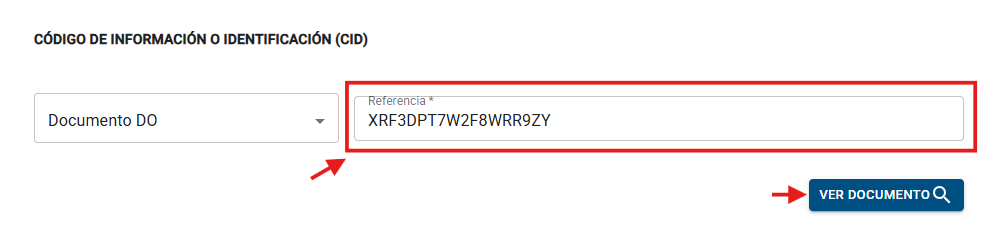
STEP 3. Enter the required information (Code ‘DO’) and click on ‘Ver documento’.
STEP 4. Download your IBI receipt
Once the information has been entered, the details of your receipt will be displayed along with a link to download it.
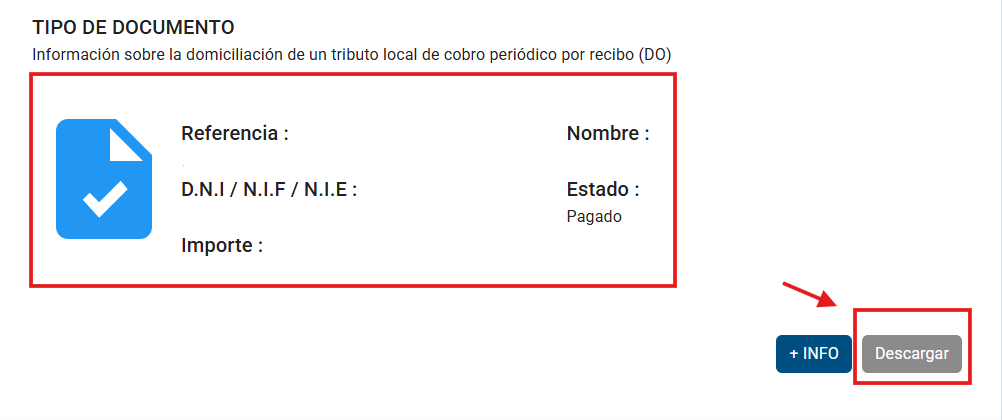
STEP 5. Check the cadastral value and the cadastral reference of your property.
Once downloaded, you can access the necessary data from the receipt, such as the cadastral value and reference for completing the Imputed Income form (210).
Common questions
I already have the IBI receipt. Do I need anything else?
In many cases, no.
If your IBI receipt shows the main characteristics of the property, you may already have all the information you need to complete your tax return.
In some receipts, the cadastral value may appear as:
- Valor catastral.
- Base imponible or Base liquidable.
Depending on the format of the receipt, the wording may vary.
I have the receipt, but I do not know what I am looking at
Look for the section showing the property value.
In many cases, you will see:
- Valor catastral = cadastral value.
- Referencia catastral = cadastral reference.
However, on some IBI receipts, the cadastral value may instead appear as:
- Base imponible.
- Base liquidable.
If your receipt shows a breakdown between land and building values, please note that the cadastral value is the sum of:
- Valor catastral del suelo.
- Valor catastral de la construcción.
In other words:
Cadastral value = land cadastral value + building cadastral value.
This is important because some property owners only look at one of the two figures, when the correct cadastral value is the total of both.
I cannot find the IBI payment on my bank statement
Try checking:
- Older bank statements.
- The period when local property taxes are usually charged.
- Or entries shown under the local tax authority or ATIB.
If the payment was made from another person’s account, you may need access to that bank statement instead.
I no longer have access to the bank account used for payment
If you no longer have access to the account details, downloading the receipt online may be more difficult.
If possible, check whether you still have:
- An old PDF copy of the receipt.
- A saved email with the document.
- Or previous property tax records.
Alternatively, you can find the cadastral value in your purchase deed (Escritura) and through the Catastro website (a digital certificate is needed).
Why this matters for non-resident taxes in Spain
In addition to Property Tax (IBI), non-residents who own a property in Spain may also need to file Form 210.
If the property is for personal use only, regardless of whether it is occupied or vacant during the year, you must file Form 210 for imputed income.
This tax must be declared by 31 December of the year following the tax year.
If you rent out your property, you must file Form 210 for rental income.
In that case, the return must be filed between 1 and 20 January of the following year.
This is one of the reasons why the IBI receipt is so important: it helps you locate the cadastral value and other property details needed to prepare the tax return correctly.
File your Modelo 210 easily with IberianTax
At IberianTax, we have simplified the filing of Form 210 with the Spanish tax authorities, with prices starting from €34.95.
Our online platform allows you to prepare and file both:
- Imputed Income Tax return.
- Rental Income Tax return.
- Capital Gains Tax return.
You simply complete the questionnaire with step-by-step guidance, and we then review your submission and file it with the authorities for you.
If you already have your IBI receipt, you are one step closer to completing your tax return correctly.
Start your Modelo 210 filing with IberianTax today.