Which Modelo 210 do I need to file?
September 24, 2026
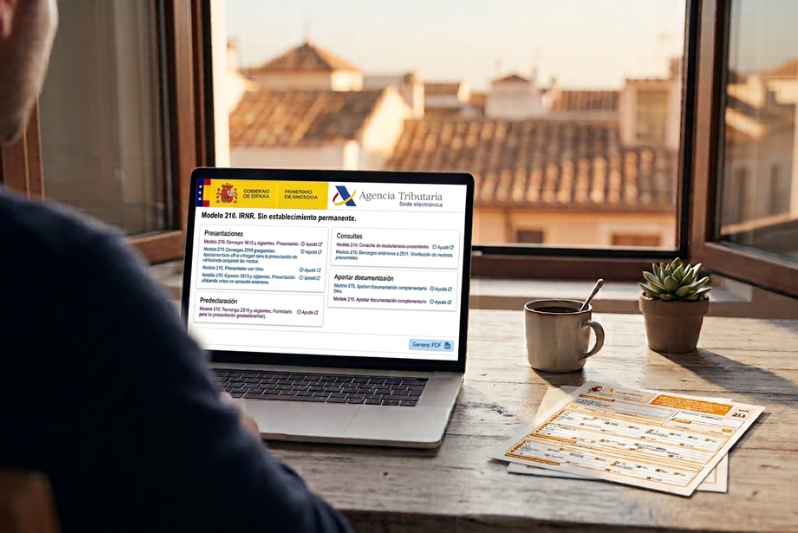
Modelo 210 is not one single tax return. It is a form used for several different tax obligations, and which version applies to you depends entirely on how your property was used during the year.
If you are not sure whether you need to declare imputed income, rental income, capital gains, or more than one of these, this guide will help you identify your exact situation. You will also find a simple decision table to check your case in seconds.
Quick answer
- The type of Modelo 210 you need depends on how the property was used: personal use, left empty, rented out, or sold.
- There are three main types: imputed income, rental income, and capital gains tax.
- It is common to need more than one Modelo 210 in the same year, for example if you rented the property for part of the year and used it personally for the rest.
Overview of Modelo 210 types
Non-resident property owners in Spain may need to file one or more of these returns:
- Imputed income tax: applies when the property is not rented and is available for personal use, even if you never actually visit it.
- Rental income tax: applies when the property is rented out, short-term or long-term.
- Capital gains tax: applies when the property is sold.
Each of these is filed using the same Modelo 210 form, but with different sections, deadlines, and tax treatment.
If property was not rented
If your property sat empty for personal use, or was simply available to you and not rented out, the Spanish Tax Office (Agencia Tributaria) assumes it generates a notional income. This is called imputed income, and it must be declared annually.
- Taxable base: 2% of the property's cadastral value, or 1.1% if the municipality has undergone a general cadastral valuation review within the last 10 years (including cadastral values revised and effective from 2012 onwards).
- Deadline: from the 2026 tax year onwards (declared in 2027) the deadline is between April 1 - December 31 of the following year (December 28 if paying by direct debit).
This applies even if you only used the property for part of the year, in which case the tax is calculated proportionally to the days it was at your disposal.
If property was rented
If you rented out your property, short-term or long-term, you must declare the rental income earned during the year.
- EU/EEA residents can deduct expenses directly linked to the rental activity, such as IBI, insurance, and maintenance costs.
- Non-EU/EEA residents currently cannot deduct these expenses, although this may change in the near future.
- Deadline: from the 2026 tax year onwards (filed in 2027), the deadline depends on the result of the tax return: if the result is tax payable, it must be filed between April 1 and April 20 of the following year; if the result is zero (no tax due), the filing period is from January 1 to January 20 of the following year; and if the result is a refund, it can be filed from February 1 of the following year.
If the property was rented for only part of the year, you will also need to declare imputed income for the remaining days it was not rented, as a separate filing.
If property was sold
If you sold your property, any profit is subject to capital gains tax.
- The buyer must withhold 3% of the sale price and pay it to the Agencia Tributaria on your behalf, using Modelo 211.
- You are required to declare this 3% withholding when filing your own capital gains tax return (Modelo 210). If applicable, you may request a refund of any excess amount withheld.
- Deadline: within 4 months of the sale date.
If you owned the property before the sale, you will also need a separate imputed income (or rental income) filing for the period before the sale took place.
Other situations
A few less common cases also affect which Modelo 210 you need:
- Multiple properties or units: each property with its own cadastral reference (a garage, a storage room, a separate plot) requires its own Modelo 210, even if it belongs to the same owner.
- Co-owned properties: each owner must file their own Modelo 210 based on their ownership percentage, even for the same property.
- Interest, dividends, or other Spanish-sourced income: these may also require a separate non-resident tax declaration, depending on the type of income.
Other property taxes: don't confuse Modelo 210 with IBI
Many non-resident owners assume that if they pay IBI every year, they've already covered their tax obligations in Spain. That's not the case: IBI and Modelo 210 are two completely different taxes, and paying one does not replace the other.
IBI (Impuesto sobre Bienes Inmuebles) is a local tax charged by the town hall where your property is located. It's based on the cadastral value and you owe it every year simply for owning the property, whether it's rented, empty, or used personally. In most cases, the local council bills you directly, often through direct debit.
Modelo 210, on the other hand, belongs to the income tax return. It's a self-assessment that you (or your tax representative) must file to declare income tax as a non-resident: imputed income for personal use, rental income, or capital gains, depending on your situation. Nobody sends you a bill for this one. Filing it is your responsibility, and it's owed simply because you own a property in Spain, regardless of whether you rented it out or generated any actual income.
In short: IBI is a local property tax you pay every year; Modelo 210 is a national income tax return you must file yourself.
Mixed scenarios
Many owners assume they only need to file one Modelo 210 per year. In practice, several situations can apply to the same property within the same tax year.
Real example: Anna, a German resident, owns an apartment in Alicante. She uses it herself for 3 months, rents it out for 9 months, and sells a separate parking space (with its own cadastral reference) that she never rented.
What Anna needs to file:
- Rental income tax for the 9 rented months of the apartment.
- Imputed income tax for the 3 months of personal use of the apartment.
- Imputed income tax for the parking space, up to the date of sale.
- Capital gains tax for the sale of the parking space, within 4 months of the sale date.
Four separate Modelo 210 filings, from a single owner in a single year.
Simple decision guide
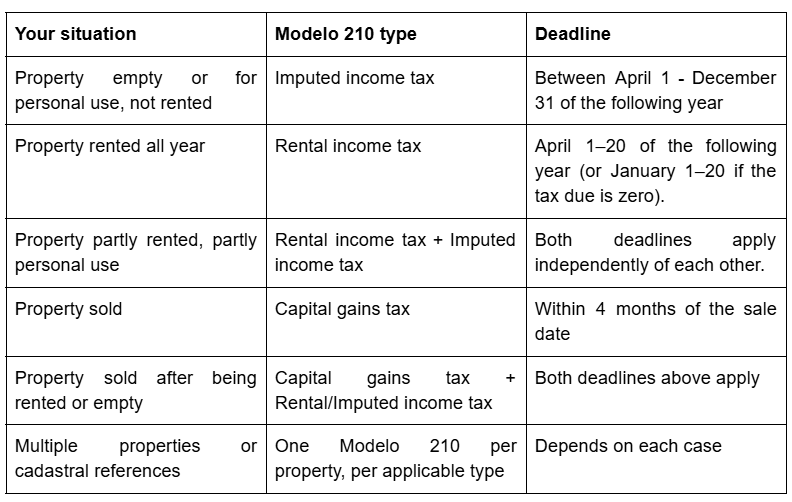
Use this table to quickly check which Modelo 210 applies to your situation:
Deadlines shown apply to the 2026 tax year onwards (filed in 2027).
Common mistakes
- Filing only one Modelo 210 when several apply. Owners often file just one return, forgetting that renting for part of the year still requires a separate imputed income declaration for the remaining period.
- Confusing imputed income with rental income. These are two different taxes with different rules and deadlines, even though they use the same form.
- Treating a sale as the only obligation for the year. If the property generated income before the sale, that period still needs its own filing.
- Assuming one filing covers all properties. Each cadastral reference needs its own Modelo 210, even for properties owned by the same person.
- Confusing imputed income with local taxes such as IBI. Imputed income is a national tax declared through Modelo 210 (self-assessment), while IBI is a local property tax managed by the municipality, which may be charged directly by the local council, for example through direct debit.
Not sure which filing you need?
If your situation involves more than one property, a mix of rental and personal use, or a sale during the year, it is easy to miss a filing. IberianTax helps you identify exactly which Modelo 210 types apply to your case, so you file everything correctly the first time.
FAQ
Do I need to file Modelo 210 if my property was empty all year?
Yes. Even if the property was never rented and you never visited it, the Agencia Tributaria assumes a notional income based on the cadastral value. This must be declared as imputed income.
Can I combine rental income and imputed income in the same Modelo 210?
No. They are filed as separate returns, each covering a different period and with a different deadline, even though both are declared using the same form.
What if I co-own the property with someone else?
Each owner must file their own Modelo 210, declaring only their share of the income, expenses, and ownership percentage.
Does a garage or storage room need its own filing?
Yes, if it has its own cadastral reference (referencia catastral) and its own IBI receipt, it is treated as a separate property for tax purposes.
What happens if I sold my property but also rented it earlier in the year?
You will need two filings: a rental income tax return for the rented period, and a capital gains tax return for the sale, within 4 months of the sale date.
File the Right Modelo 210 with IberianTax
Working out which Modelo 210 applies to your situation does not have to be complicated. With IberianTax, you can file online in minutes, from as little as €34.95 per filing, with automatic deadline reminders and expert support in your own language. .
Create your free account today and file the right return for your situation, without the guesswork.