Spain Tax Calendar 2027 for Non-Resident Holiday Rental Owners
November 20, 2026
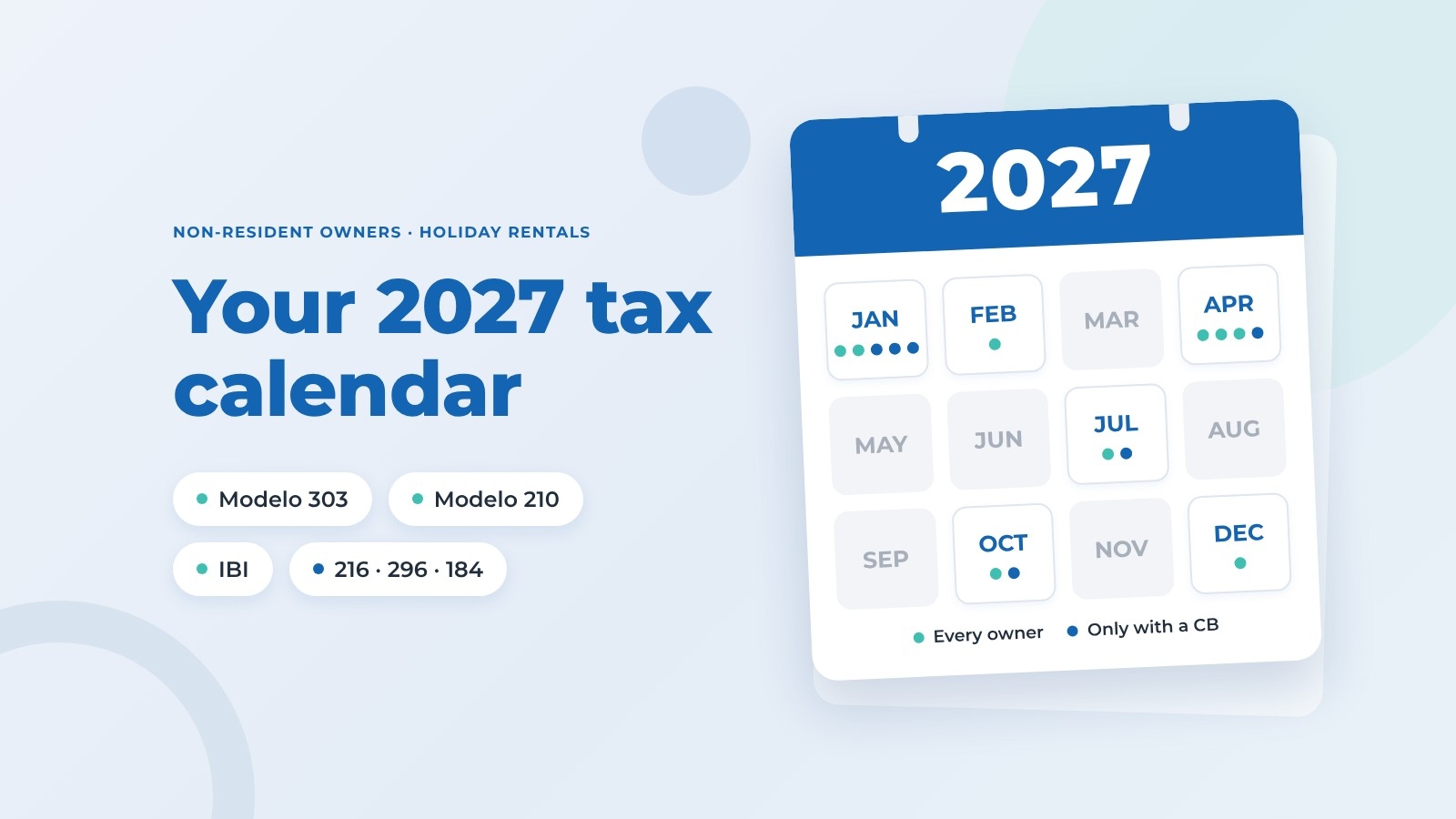
If you own a home in mainland Spain or the Balearic Islands and rent it out for stays of 30 nights or less, 2027 is the first full year in which you have to keep track of two taxes at once: VAT, which applies to short-term holiday rentals from 1 December 2026, and the non-resident income tax return (Modelo 210), whose deadlines also change in 2027. Add the local property tax (IBI) and, if you rent through a co-ownership (comunidad de bienes, CB), three more returns.
This page puts every 2027 date in one place, organised by form. Bookmark it: we will keep it updated throughout the year.
2027 tax calendar by form
We have split the deadlines into two tables: the first one applies to all owners and the second one only if you rent through a CB. When a deadline falls on a Saturday, Sunday or public holiday, it moves to the next working day, and the tables already show the adjusted date.
For all owners
| Form | What you declare | Filing deadline |
|---|---|---|
| Modelo 303 (VAT) | Q4 2026 (December only) | 1 January to 1 February 2027 |
| Modelo 303 (VAT) | Q1 2027 (January to March) | 1 to 20 April 2027 (direct debit 1 to 15) |
| Modelo 303 (VAT) | Q2 2027 (April to June) | 1 to 20 July 2027 (direct debit 1 to 15) |
| Modelo 303 (VAT) | Q3 2027 (July to September) | 1 to 20 October 2027 (direct debit 1 to 15) |
| Modelo 303 (VAT) | Q4 2027 (October to December) | 1 to 31 January 2028 |
| Modelo 210 (rental income) | 2026 rental income with tax to pay | 1 to 20 April 2027 (direct debit 1 to 15) |
| Modelo 210 (rental income) | 2026 rental income with a nil result | 1 to 20 January 2027 |
| Modelo 210 (rental income) | 2026 rental income with a refund | From 1 February 2027 (up to 4 years) |
| Modelo 210 (imputed income) | Days in 2026 when the home was not rented (own use or empty) | 1 April to 31 December 2027 (direct debit until 23 December) |
| IBI | 2027 local property tax bill | Set by each town hall |
Each owner files their own Modelo 210 (if you rent through a CB, see below). Modelo 303 is filed by whoever is registered for VAT.
Only if you rent through a co-ownership
| Form | What you declare | Filing deadline |
|---|---|---|
| Modelo 303 (VAT) | Filed by the CB instead of each co-owner | Same deadlines as in the table above |
| Modelo 216 | Q4 2026 | 1 to 20 January 2027 |
| Modelo 216 | Q1 2027 | 1 to 20 April 2027 |
| Modelo 216 | Q2 2027 | 1 to 20 July 2027 |
| Modelo 216 | Q3 2027 | 1 to 20 October 2027 |
| Modelo 216 | Q4 2027 | 1 to 20 January 2028 |
| Modelo 296 | 2026 annual summary | 1 January to 1 February 2027 |
| Modelo 296 | 2027 annual summary | 1 to 31 January 2028 |
| Modelo 184 | 2026 information return | 1 January to 1 February 2027 |
| Modelo 184 | 2027 information return | 1 to 31 January 2028 |
Dates based on the deadlines published by the Spanish Tax Agency (AEAT) and in the BOE (see official sources at the end). We will check them again against the AEAT 2027 taxpayer calendar as soon as it is published.
The returns every owner has to file
Modelo 303: quarterly VAT return
Since 1 December 2026, renting a furnished home for stays of 30 nights or less is subject to 10% VAT. In practice, you add that 10% to the price your guest pays and, every quarter, you pay it to the Spanish Tax Agency with Modelo 303, after deducting the VAT on rental expenses invoiced in your name (cleaning, management, utilities, repairs).
The year is divided into four quarters, and each one is declared in the month after it ends:
- Q1 (January, February and March): 1 to 20 April.
- Q2 (April, May and June): 1 to 20 July.
- Q3 (July, August and September): 1 to 20 October.
- Q4 (October, November and December): 1 to 30 January of the following year.
Once you are registered for VAT, you must file Modelo 303 every quarter, even if you had no bookings. Your first return, for Q4 2026, only covers December, and because 30 January 2027 is a Saturday, the deadline moves to Monday 1 February 2027.
If you are not yet registered, read our guide to VAT registration and the formal obligations for holiday rentals and our article on VAT invoices for holiday rentals.
Modelo 390: annual VAT summary
As a general rule, owners whose only activity is renting out property do not have to file the annual VAT summary, so it does not appear in the calendar. We explain the details in our article on the Modelo 390 for holiday rentals.
Modelo 210: non-resident income tax
VAT does not replace your non-resident income tax. Each owner still files their own Modelo 210 on what they earn from the rental (if you rent through a CB, see below), and in 2027 the deadlines change following Order HAC/623/2026. The deadline for your 2026 rental income depends on the result of the return:
- Tax to pay (the most common case): 1 to 20 April 2027, with direct debit from 1 to 15 April.
- Nil result: when your deductible expenses equal or exceed your income and there is no tax to pay. Only EU and EEA residents can deduct expenses. Filed from 1 to 20 January 2027.
- Refund: when more tax has already been paid than you actually owe. The typical example is commercial premises rented to a company or a self-employed professional: every month, the tenant withholds 19% (EU and EEA residents) or 24% (other residents) of the rent and pays it to the Spanish Tax Agency on your behalf. If you live in the EU or the EEA and can deduct expenses (IBI, community fees, insurance, mortgage interest, depreciation), your final tax is usually lower than what was withheld, and you get the difference back with a Modelo 210 refund return. Filed from 1 February 2027, and you have up to 4 years to claim the refund.
Your Modelo 210 declares your rental income without VAT: the 10% you charge your guest is not your income, but a tax you hand over to the Spanish Tax Agency with Modelo 303.
For the days your home was not rented (own use or empty), you declare imputed income. For 2026 it is filed between 1 April and 31 December 2027, with direct debit available until 23 December.
You do not have to wait for the filing window to open. If you do not expect any more rental income in what is left of 2026, you can already fill in the rental income form in your IberianTax account, and we will file it as soon as the official window opens in 2027. If you still have bookings in the last months of the year, you can prepare it in January, once all your income is in. Your 2026 imputed income return can also be prepared in your IberianTax account from January 2027.
All the changes are explained in our article on the new Modelo 210 rules for 2026 and 2027.
IBI: local property tax
IBI is not paid to the Spanish Tax Agency but to the town hall (or the body that collects on its behalf), and each one sets its own payment period, so there is no single national date. The easiest way not to miss it is to check your municipality's tax calendar or to set up a direct debit for the bill. Our local tax management service can help you with this.
Keep in mind that Royal Decree-law 29/2026 allows town halls in stressed residential market areas to charge a surcharge of up to 50% of the IBI on homes used as tourist accommodation (higher for owners of several), if they approve it in their tax by-laws. Check whether your municipality has done so.
If you rent through a co-ownership (CB)
Some co-owners choose to operate the rental through a comunidad de bienes. It is not compulsory, but if you have one, the following returns are added to your calendar.
Modelo 303 filed by the CB
When there is a CB, the quarterly VAT return is filed by the CB, not by each co-owner. The deadlines are the same: one Modelo 303 per quarter for the whole property.
Modelo 216: quarterly payments on account
When a CB has non-resident co-owners, the law requires it to pay the Spanish Tax Agency, every quarter, the non-resident income tax that each co-owner owes on their share of the rental income. As guests do not withhold any tax, the CB itself makes this payment, known as a payment on account (ingreso a cuenta), with Modelo 216. It is filed from 1 to 20 April, July, October and January, for the previous quarter.
The payment on account is 19% (co-owners resident in the EU or the EEA) or 24% (other residents) of each co-owner's share of the income, and it is calculated on the gross income, without deducting any expenses.
Once Modelo 216 has been filed, the co-owner no longer has to file a Modelo 210 for that rental income: the tax has already been paid through the CB.
Modelo 296: annual summary of payments on account
Nothing is paid with Modelo 296. It is an information return in which the CB tells the Spanish Tax Agency, at the end of the year, how much it paid through the four Modelo 216 returns and on behalf of which co-owner. With this information, the Tax Agency knows how much tax each co-owner has already paid and can take it into account if they later claim a refund. The 2026 return is due by 1 February 2027.
Modelo 184: annual information return of the CB
Modelo 184 is the information return of entities under the income attribution regime, such as a CB. It tells the Spanish Tax Agency the income and expenses the CB had during the year and how they are split among the co-owners. There is nothing to pay with it either, and it is also filed in January: for 2026, by 1 February 2027.
What about Modelo 210 if you have a CB?
With a CB, the rental income Modelo 210 is no longer compulsory, but it is still useful in one case: when the co-owner is entitled to get part of what was paid back.
- EU and EEA residents: they can deduct rental expenses (IBI, community fees, insurance, utilities, mortgage interest, depreciation), but Modelo 216 is calculated without them. Once expenses are taken into account, the real tax is usually lower than what the CB has already paid, and the difference is recovered by filing a Modelo 210 refund return, from 1 February of the following year and within 4 years.
- Residents outside the EU and the EEA: they cannot deduct expenses, so the tax paid with Modelo 216 matches the final tax and, as a rule, they do not have to file anything else.
For the days the home is not rented (own use or empty), each owner still declares imputed income in their Modelo 210, with the deadlines in the table.
Where this calendar does not apply
This calendar covers mainland Spain and the Balearic Islands. The Canary Islands (IGIC instead of VAT), Ceuta, Melilla, the Basque Country and Navarre have their own tax systems and deadlines.
Never miss a deadline with IberianTax
With IberianTax you do not need to keep this calendar on your fridge. As a registered collaborator of the Spanish Tax Agency, we take care of your VAT registration, your quarterly Modelo 303 returns and your Modelo 210 returns, and if you have a CB, of the Modelo 216, 296 and 184 as well. We remind you before each deadline and file on time.
Find out how our VAT service for holiday rentals works or contact our team.
Frequently asked questions
When is my first VAT return for my holiday rental due?
If you registered for VAT from 1 December 2026, your first Modelo 303 covers December 2026 only. The deadline is 30 January 2027, but as that day is a Saturday, it moves to Monday 1 February 2027.
Do I have to file Modelo 303 if I had no bookings in a quarter?
Yes. Once you are registered for VAT, you must file Modelo 303 every quarter, even if the result is zero.
When do I declare my 2026 rental income?
It depends on the result. If there is tax to pay (the most common case), from 1 to 20 April 2027. If your deductible expenses cancel out your income and the result is nil, from 1 to 20 January 2027. And if more tax was paid than you owe (for example, through the withholdings made by the tenant of commercial premises) and the return results in a refund, from 1 February 2027. If you do not expect any more income this year, you can already prepare the form in your IberianTax account.
Does registering for VAT change my Modelo 210?
No, because they are two different taxes. VAT is a 10% charge your guest pays on the price of the stay: you collect it and hand it over to the Spanish Tax Agency every quarter with Modelo 303, so it is not your income. Modelo 210 taxes what you earn from the rental: you declare your income without VAT, as you did before. And for the days the home was not rented, you still declare imputed income.
Do I need a CB to rent out a home I own with someone else?
No, it is not compulsory. A CB can simplify VAT (one Modelo 303 per quarter), but it also adds Modelo 216, 296 and 184, and the non-resident tax on the rental income is then paid every quarter through the CB. We can help you decide which option suits you best.
Official sources
- Order HAC/623/2026 (BOE): new Modelo 210 deadlines.
- AEAT: changes to Modelo 210 deadlines.
- AEAT: VAT changes in Royal Decree-law 29/2026.
- AEAT: Modelo 216 instructions.
- AEAT: Modelo 296 deadlines and Modelo 184 deadlines.
This article is for information purposes only and does not replace personalised advice. Deadlines may change if the Spanish Tax Agency publishes new rules or calendar adjustments.