Modelo 210 Changes for 2026 and 2027: New Deadlines and a New Form
September 24, 2026

Spain has introduced important changes to the Modelo 210, the tax return that non-resident property owners use to declare income from property located in Spain. Published in the Official State Gazette (BOE) on 23 June 2026 under Order HAC/623/2026, the new rules extend filing deadlines and introduce an updated tax return form.
Here's what changes, when the new rules take effect, and what non-resident owners need to do.
Quick answer: what is changing?
- The rental income filing deadline moves from 1–20 January to 1–20 April, from the 2026 tax year onwards (so 2026 income, filed in 2027).
- The imputed income filing window now opens on 1 April instead of 1 January, also from the 2026 tax year.
- A new version of the Modelo 210 form applies to every return filed from 1 January 2027.
- Tax rates, bases, and capital gains deadlines are unchanged.
What is the Modelo 210 and who is affected?
The Modelo 210 is the official Spanish tax return for non-residents who own property in Spain. If you are not tax-resident in Spain — broadly, if you spend fewer than 183 days a year in the country and your main economic interests are elsewhere — and you own a property here, you are generally required to file a Modelo 210 each year. That applies whether you rent the property out, use it as a holiday home, or leave it empty.
The changes introduced by Order HAC/623/2026 affect all non-resident property owners who file a Modelo 210 for rental income or imputed income.
New filing deadlines: what changes and when
The most immediate change concerns when you must file. The new deadlines apply from the 2026 tax year — meaning income earned in 2026 and filed in 2027 will follow the new rules.
For 2025 income (filed in 2026), the old deadlines still apply.
Rental income: the deadline moves to April
Under the old rules, if you rented out your Spanish property, you had to file your annual Modelo 210 tax return during the first 20 days of January of the following year.
Starting with the 2026 tax year, the filing deadline has been moved to the first 20 days of April of the following year if tax is due. In practice, the return for the 2026 tax year must be filed between 1 and 20 April 2027, giving you until the end of March to finish your income and expense records. If you pay by direct debit, the payment window runs from 1 to 15 April.
That said, the exact date depends on the outcome of your declaration — and there are three possible scenarios.
- If tax is due, the new April deadline applies: 1 to 20 April.
- If your expenses exceed your rental income and the result is nil or negative, the original January window still applies: you must file between 1 and 20 January of the following year
- A third scenario applies where a refund is owed — typically in cases where withholding tax was already deducted at source, such as income from commercial properties. In that case, the filing window opens on 1 February of the following year.
Imputed income: the window now opens on 1 April
If you own a property you do not rent out, you pay imputed income tax — a notional tax based on the cadastral value of your property. The deadline to file remains 31 December of the following year, but the window now opens on 1 April instead of 1 January. For 2026 imputed income, you will be able to file between 1 April and 31 December 2027. If you pay by direct debit, the closing date is 23 December.
Filing deadlines: before vs after
The table below shows the old and new deadlines side by side.
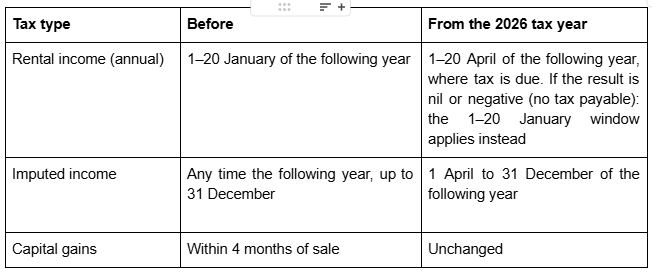
In practice, this means: if you need to declare rental income or imputed income for 2025, the old deadlines apply — you have until 20 January 2026 for rental income and until 31 December 2026 for imputed income.
From the 2026 tax year onwards, both types shift. Rental income earned in 2026 must be filed by 1-20 April 2027, and imputed income for 2026 can only be filed from 1 April 2027.
A new version of the Modelo 210 Form from January 2027
From 1 January 2027, every Modelo 210 submitted — regardless of which tax year it covers — must use the updated form. Even if you are filing for a prior year, you will need to use the new version.
The key additions to the form are:
Days and ownership share. The form now asks how many days the property was rented out (for rental income) or at your personal disposal (for imputed income), and your percentage of ownership. This matters because a property rented only part of the year is still subject to imputed income tax for the days it was not rented.
Until now, when filing through IberianTax, we already requested this information in order to calculate the correct pro-rata allocation of expenses. From 2027, however, it will become a mandatory declared field in the Modelo 210, giving the Spanish Tax Agency (Agencia Tributaria) direct visibility over the number of days a property has been rented. This change will make it significantly easier for the Tax Office to cross-check rental income returns against imputed income obligations.
Cadastral reference indicator. a new specific field confirming whether the property has a cadastral reference number. This helps the Spanish Tax Agency accurately identify the property and link the declaration to official cadastral records, reducing discrepancies and improving data matching across tax filings.
A detailed expense breakdown for rental income. Until now, rental expenses were reported to the Agencia Tributaria as a single total figure on the Modelo 210.
From 2027, they must be itemised in a dedicated annex. The annex breaks deductible costs into specific categories, broadly:
- Interest on capital invested in the property, plus repair and conservation costs (these two share a four-year carry-forward and are capped at your gross rental income)
- Community fees
- Contract formalisation costs
- Legal costs
- Other services provided by third parties
- Utilities (electricity, water, gas, internet)
- Insurance premiums
- Local taxes and charges (such as IBI)
- Bad debts
- Depreciation of furniture and appliances (10% per year)
- Depreciation of the property (3% per year)
- Depreciation of improvements (3% per year)
- Other deductible expenses
A subtle but useful point: repairs are deducted in full as an expense, while improvements are capitalised and depreciated over time — and from 2027 they sit on their own line in the annex.
If you file through IberianTax, you do not need to worry about matching your expenses to Hacienda's categories. We automatically adapt the form and convert your expense data into the exact format the Spanish Tax Agency requires, ensuring full compliance and reducing the risk of errors, queries, or formal requests. You simply enter your expenses as usual — we take care of the rest.
Smaller technical clarifications: including updated wording for jointly owned properties sold by a married couple under community of property rules.
What stays exactly the same
Not everything is changing. The following remain unchanged:
- Tax rates: 19% for EU/EEA residents and 24% for all others.
- The imputed income base: 1.1% or 2% of the cadastral value, depending on your municipality.
- The capital gains deadline: within four months of the property sale date.
- Refund claims: from 1 February of the following year, within four years of the original filing deadline.
Real-life examples: How the new rules apply
Example 1 — Margaret, a UK property owner who rents out her flat in Valencia
Margaret earns rental income throughout 2026. Under the old rules, she would have filed her Modelo 210 by 20 January 2027. Under the new rules, she has between 1 and 20 April 2027. She now has until the end of March to complete her income and expense records before the April deadline opens.
When she files in early April 2027, she will use the new version of the form and will need to submit the new expense annex — a dedicated section that reports her deductible costs in the specific categories Hacienda requires. If she files through IberianTax, the platform takes care of adapting her expense records to the exact format of the annex. She does not need to worry about whether her figures match Hacienda's categories — that mapping is handled automatically before submission.
Example 2 — Hans, a German owner of a holiday apartment in Málaga
Hans uses his Málaga property only for personal holidays. For the 2025 tax year, nothing changes: he can file any time between 1 January and 31 December 2026. For the 2026 tax year, his window runs from 1 April to 31 December 2027, on the new form, which asks how many days the property was at his disposal and his ownership share.
Example 3 — Filing a return in February 2027 for the 2025 tax year
If you need to file or correct a 2025 return in February 2027, you must use the new version of the Modelo 210 — even though the income relates to 2025. The new form applies to all submissions from 1 January 2027, regardless of the income year.
So, when does this actually affect me?
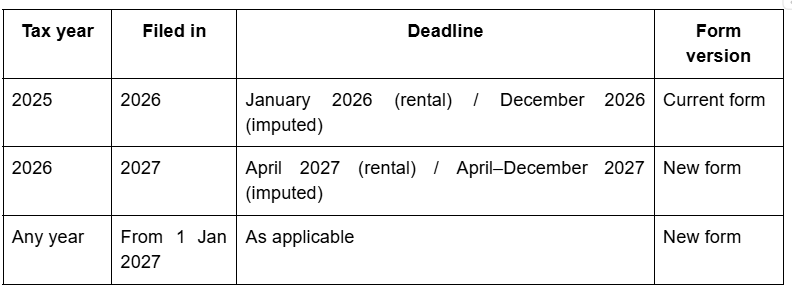
A simple way to think about it:
- 2025 income (filed in 2026): old rules still apply. Rental income is due in January 2026, imputed income by 31 December 2026, and the current version of the form is used throughout.
- 2026 income (filed in 2027): the new deadlines apply. Rental income moves to April 2027, and the imputed income window opens from 1 April 2027.
- Any return filed from 1 January 2027: uses the new version of the Modelo 210, even if it covers an earlier tax year.
Common mistakes to avoid
- Assuming the old form is still valid after 1 January 2027. From that date, all Modelo 210 submissions use the new version — even if the return relates to an earlier year.
- Missing the new direct debit windows. The payment windows have shifted in line with the new filing dates. Check the updated dates before setting up any automatic payments.
- Not keeping itemised expense records. From 2027, rental income returns must include a dedicated annex with expenses broken down into the specific categories Hacienda requires. A single total figure will no longer be accepted. If you file independently, be aware that the categories Hacienda specifies in the annex may not match the way you have been recording expenses — you will need to adapt your records accordingly.
If you file through IberianTax, this is handled for you: your expense information is mapped to the exact format of the annex before submission, eliminating the risk of a formal query from the Tax Office.
Frequently asked questions
Do I need a new form for my 2025 tax return?
Only if you file it on or after 1 January 2027. If you file your 2025 return in the standard window (January 2026), you use the current form. If you need to file or amend a 2025 return at any point from January 2027, you must use the new version.
Does the April deadline apply to my 2025 rental return?
No. The new April deadline applies only from the 2026 tax year onwards. For rental income earned in 2025, the filing deadline remains the first 20 days of January 2026 — the old rules apply in full.
What new information will the form ask for?
The main additions are: the number of days the property was at your disposal or rented out, your ownership percentage, a cadastral reference indicator, and — for landlords — an itemised breakdown of deductible rental expenses.
Do these changes affect capital gains tax?
No. The deadline for declaring a property sale (within four months of the sale date) and the related process involving Modelo 211 are unchanged.
Will IberianTax handle these changes automatically?
Yes. IberianTax is updating its platform to incorporate the new form, the new fields, and the new deadlines. If you file through IberianTax, your reminders will show the correct dates and your return will be prepared using the correct version of the form. You do not need to take any action.
What you need to do
If you file with IberianTax, the answer is simple: nothing. The platform will be updated to reflect the new deadlines and the new form automatically.
If you file independently, you should:
- Note the new April deadline for rental income returns from the 2026 tax year
- Note that the imputed income filing window now opens on 1 April 2027 for the 2026 tax year
- Start recording your rental expenses by category now and individually calculate the corresponding deductible amount per category, ready for the itemised annex
- Use the new version of the Modelo 210 for any return submitted from 1 January 2027
Have a question about how these changes affect your specific situation? Our team specialises in non-resident property tax in Spain — Contact our team of experts, and we will make sure you file on the right form, by the right date.