VAT invoices for holiday rentals in Spain: a guide for non-residents
November 18, 2026
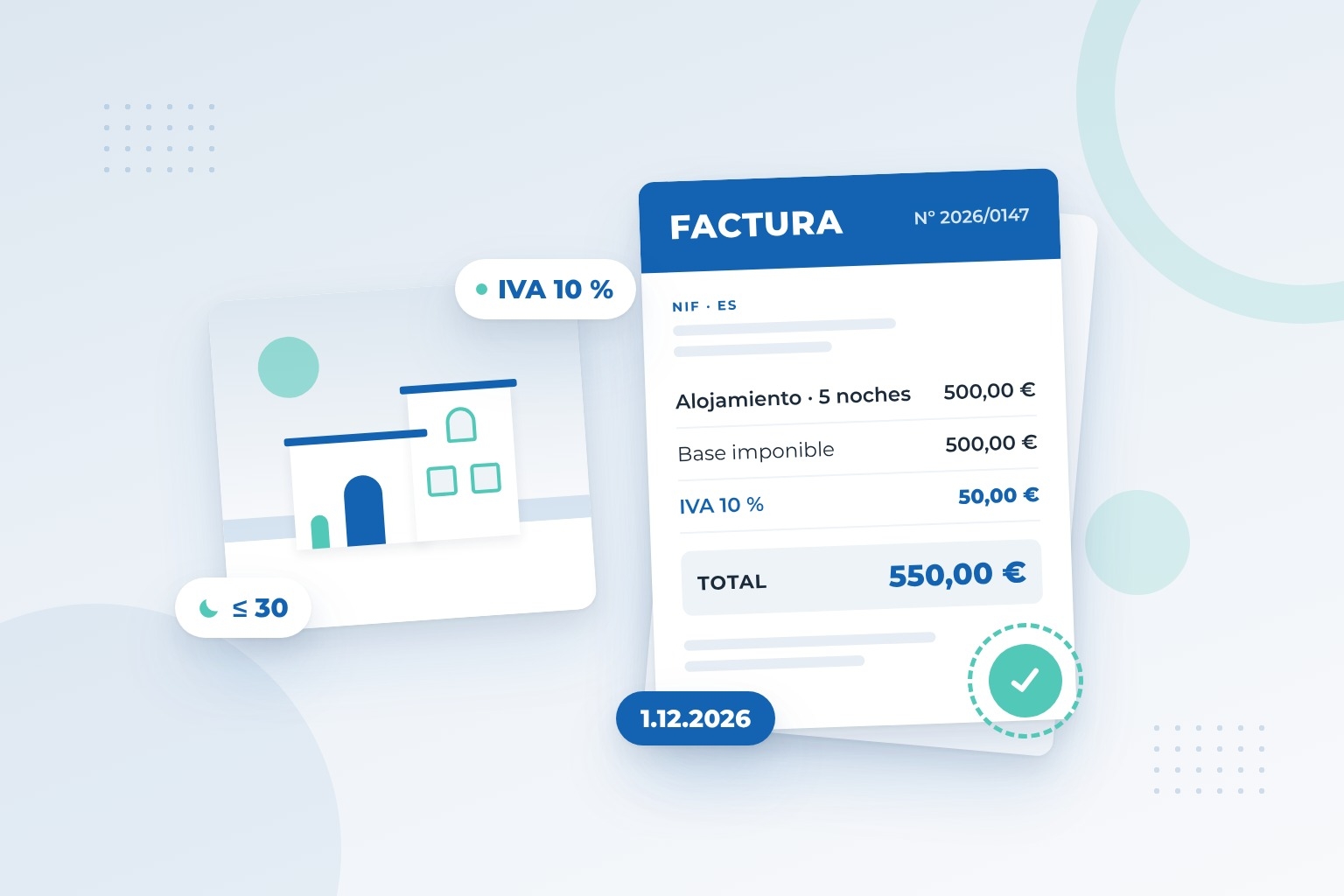
From 1 December 2026, if you are a non-resident owner renting out your property in Spain for stays of 30 nights or fewer (for example, through Airbnb or Booking), you must charge 10% VAT and issue an invoice for every stay. It makes no difference whether the guest is a private individual or a company, or that you have no office or staff in Spain.
The change comes from Royal Decree-law 29/2026, which amends the Spanish VAT Act. Until now, this type of rental was exempt from VAT. From December, short stays in a property that is not your main home become taxable.
Who is affected, how to register and which returns to file are covered in our guide to VAT on holiday rentals from 1 December 2026. Here we focus only on invoices: when to issue them, what they must include and how long to keep them.
The legal framework
These are the three rules worth knowing:
| Rule | What it covers |
|---|---|
| Royal Decree-law 29/2026 | Makes short-term rentals subject to 10% VAT from 1 December 2026 |
| VAT Act (Law 37/1992) | Who pays the VAT and the obligation to issue an invoice |
| Invoicing Regulation (RD 1619/2012) | When, how and with what details an invoice must be issued |
The new decree does not include any special invoicing rules, so the general rules apply.
Why do you have to invoice if you don't live in Spain?
If you don't live in Spain and have no staff here managing the rental, the Spanish Tax Agency treats you as a "non-established" business. For many services, when the supplier is not established and the customer is a Spanish company, it is the company that deals with the VAT. But that rule does not apply to property rentals. In short:
- You are the one who charges the VAT and issues the invoice.
- You always add 10% VAT, including when the guest is a Spanish company.
- The Spanish invoicing rules apply.
If you live outside the European Union, you may need to appoint a tax representative in Spain. If you live in the United Kingdom, it is worth checking this before you register.
When an invoice must be issued
You must issue an invoice for every stay, even if the guest is a private individual who doesn't ask for one.
- Deadline: the invoice is issued at the time of the rental. If the guest is a business, you have until the 16th of the following month.
- Which date counts: the date of the stay or, if the guest pays in advance, the date of payment. Not the date on which the platform pays you.
- One invoice per guest and stay: grouping several stays on a single invoice is almost never possible in holiday rentals.
- Stays of more than 30 nights: these remain VAT-free, but they must still be invoiced, stating that they are exempt.
Bookings paid before 1 December. There are no transitional rules. The most reasonable approach is to look at each payment by its date: what was received before 1 December would be outside VAT, and what is received afterwards would carry VAT. The Tax Agency has not yet published its view, so we recommend listing these bookings with the date and amount of each payment and reviewing them one by one.
Full or simplified invoice
There are two types of invoice. A simplified invoice (similar to a receipt) can only be used if the stay costs 400 euros or less, VAT included. If it costs more, you must issue a full invoice. The 3,000-euro limit that applies to other businesses, such as restaurants or shops, does not apply to accommodation.
| Detail | Full invoice | Simplified invoice |
|---|---|---|
| When to use it | Any amount | Up to €400 VAT included |
| Consecutive number and series | Yes | Yes |
| Date of the invoice and of the stay | Yes | Yes |
| Your name and Spanish tax ID (NIF) | Yes | Yes |
| Your address | Yes | No |
| Guest's name and address | Yes | Only if a business asks for it |
| Guest's tax ID | Not required | Only if a business asks for it |
| Description | Accommodation, dates and number of nights | Type of service |
| Taxable base, rate (10%) and VAT shown separately | Yes | Rate and total (VAT breakdown only if a business asks for it) |
A few details worth getting right:
- Your tax ID is the Spanish one. The invoice must show the number you registered with the Tax Agency (your NIE if you are an individual), not the tax number from your home country.
- The guest's tax ID is not required, but on a full invoice their name and address must appear.
- The tourist tax is part of the VAT base. In other words, the 10% is calculated on the price of the accommodation plus the tourist tax. In the Balearic Islands, the tourist tax must also be shown separately on the invoice.
- If you combine items with and without VAT on the same invoice, show each one separately.
If the guest is a company
You invoice exactly as you would a private guest: with 10% VAT. Do not write "reverse charge" on the invoice. What changes is this:
- A full invoice is best, even below 400 euros: the company will need your details and the VAT shown separately in order to deduct it, and it can require this from you.
- More time: you have until the 16th of the following month.
- E-invoicing later on: invoices to Spanish businesses will have to be electronic from October 2028 (October 2027 for those invoicing more than 8 million euros a year). Simplified invoices are not affected.
If, instead of renting to guests, you let the whole property to a management company that rents it out on its own account, you invoice the management company, not the guests. That is a different situation and should be looked at separately.
Platforms and agents: who can issue the invoice
The invoice to the guest is always yours, even if someone else prepares it. A platform, a management company or an adviser can issue it on your behalf if:
- You have agreed this in writing beforehand.
- You have a way to review and accept each invoice.
- You receive a copy.
- The invoice carries your name, your Spanish tax ID and your own numbering.
Even if someone else issues it, you remain responsible for making sure it is correct.
Don't confuse these two documents:
- The receipt or confirmation the platform sends to the guest. This is not your invoice, unless the platform expressly issues it on your behalf under an agreement like the one above.
- The invoice the platform or management company issues to you for its commission. It carries 21% Spanish VAT, even if the platform is foreign (Airbnb, Booking). You can deduct that VAT in your Modelo 303.
A tip: if your contract with the management company calculates the commission on "the booking amount", from December that amount includes VAT. Agree in writing that the commission is calculated on the amount excluding VAT.
Cancellations, language and keeping invoices
- Cancellations and mistakes: if you refund money, give a discount afterwards or make a mistake on an invoice, you must issue a corrective invoice that amends the original. It can be a simplified invoice, whatever the amount.
- Language and currency: the invoice can be in any language and currency, but the VAT must be shown in euros.
- Record-keeping: keep all invoices (issued and received) for at least four years. If you keep them outside Spain, they must be stored electronically with online access for the Tax Agency, and you must notify the Tax Agency beforehand.
- VAT records: all invoices are entered in the VAT record books, which are the basis for the quarterly Modelo 303.
- Veri*factu: in principle, the new mandatory invoicing software system does not apply to a non-resident individual with no establishment in Spain. If you rent through a "comunidad de bienes" with other co-owners, it is worth checking.
Common mistakes
- Using a simplified invoice above 400 euros.
- Not invoicing because "the platform already sends a receipt".
- Showing your home-country tax number instead of the Spanish tax ID.
- Not charging VAT when the guest is a company.
- Leaving the tourist tax out of the VAT calculation.
- Dating the invoice on the day the platform pays you instead of the day of the stay or payment.
- Not issuing a corrective invoice for cancellations with a refund.
- Not invoicing stays of more than 30 nights because they are exempt.
Checklist before your first invoice
- VAT registration done and Spanish tax ID available.
- Tax representative appointed, if you live outside the EU and it is required.
- Your own consecutive numbering, with a separate series for corrective invoices.
- Full invoice template with all the details from the table above.
- Internal rule: simplified invoices only up to 400 euros VAT included.
- Written agreement if the management company or platform invoices on your behalf.
- Bookings paid before 1 December identified and reviewed.
- A system for keeping invoices electronically (and notification to the Tax Agency if they are kept outside Spain).
Questions about registration, Modelo 303, deductible expenses or co-ownership? We answer them in our FAQ on VAT for holiday rentals in Spain.
This article is for information only and does not replace an analysis of each specific case.