Spain Could Introduce 10% VAT on All Tourist Rentals: What Non-Resident Property Owners Need to Know
October 9, 2026

Important (update, 9 October 2026): this measure has now been approved. Real Decreto-ley 29/2026 applies 10% VAT from 1 December 2026 to furnished rentals of up to 30 nights per guest (not to all tourist rentals). Find out what changes for you in our article Spain's new housing decree: what changes for non-resident owners.
Spain is preparing a tax change that could affect thousands of owners who rent out their property to tourists. The Government is working on a reform under which 10% VAT would apply to all tourist rentals, including those that don't currently offer any hotel-type services.
The initiative is part of a wider package of measures aimed at limiting the growth of tourist accommodation and protecting the residential housing supply, although its passage through Parliament is currently on hold.
Either way, this would be a major shift from the current system, under which many private landlords operate without VAT at all. Here's what's known so far, what it actually means for you as a non-resident property owner, and why you shouldn't confuse this new VAT with the Modelo 210 you already file every year.
Quick answer
- The Spanish Government is working on a reform that would tax any tourist rental at 10% VAT, treating it as an economic activity.
It isn't law yet. It's a proposal within a wider housing package, and its passage has been put on hold due to a lack of political support. - Today, tourist rentals without hotel-type services are VAT-exempt, and the 10% rate only applies if services such as cleaning or reception are included during the stay. Under the reform, the 10% VAT would apply to all tourist rentals, whether or not they offer additional services.
- This VAT is separate from Modelo 210 (the non-resident income tax return). These are two separate obligations, and both can apply to you at the same time.
- Until the reform is approved, you should keep filing exactly as before, including your Modelo 210.
What has the Government actually announced?
Spain's Ministry of Housing has confirmed it is drafting legislation that would treat short-term tourist rentals (stays under 30 nights) as an economic activity, subject to the reduced VAT rate of 10%. This would apply to all tourist rentals, regardless of whether they offer hotel-type services or not. The measure is part of a wider package of housing reforms the Government has been rolling out during 2026, alongside other measures such as higher taxes on property purchases by non-EU non-residents and tougher penalties for platforms that publish listings without a valid tourist licence.
The Government's stated aim is to reduce the profitability of tourist rentals relative to long-term residential lets, against a backdrop of housing shortages in Spain's main cities and tourist hotspots.
The timeline matters here: the proposal has been under discussion since 2025 and the housing package was presented in 2026, but no entry-into-force date has been confirmed. Until Congress passes a definitive law, there is no new VAT obligation for property owners.
How does VAT on tourist rentals work today?
To understand the impact of the reform, it helps to first understand how the current system, set out by the Spanish Tax Agency (AEAT), works:
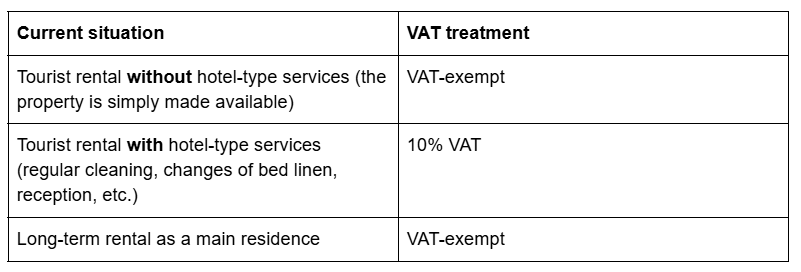
What does the Spanish Tax Agency consider "hotel-type services"? According to AEAT criteria, these must be services similar to those of the hotel industry provided throughout the guest's stay, not just at check-in or check-out. For example:
- Ongoing reception and guest assistance
- Regular cleaning of the interior of the property (not only on arrival or departure)
- Regular changes of bed linen and towels
- Additional services such as laundry, luggage storage or catering
By contrast, a single clean at check-in and check-out, or the upkeep of communal areas of the building, does not turn the rental into a hotel-type activity for VAT purposes.
What would change under the reform?
If the proposal is approved as currently drafted, the existing system would disappear, replaced by a much simpler rule, although a more costly one for most owners:
- All tourist rentals under 30 nights would become subject to 10% VAT, regardless of whether hotel-type services are offered or not.
- The current exemption for rentals without hotel-type services would be removed. The 10% rate, which today only applies when hotel-type services are provided, would extend to every tourist rental.
- For VAT purposes, owners would be treated as running a business activity, with all that implies: registering as a self-employed taxpayer (Modelo 036), issuing invoices, filing periodic VAT returns (Modelo 303), and keeping records for at least 4 years.
- In return, owners would be able to deduct the VAT paid on expenses directly related to the activity (utilities, management, maintenance, etc.).
In practice, this would mean a tourist apartment would be taxed at the same VAT rate as a hotel (10%), even if it offers no services beyond the accommodation itself.
Why is it so important to tell VAT and Modelo 210 apart?
This is probably the point that causes the most confusion among non-resident owners, and also the reason to read this news calmly.
VAT and Modelo 210 are two completely different taxes, and both can apply to you at the same time:
- VAT is an indirect tax on the accommodation service itself. If the reform is approved, the owner would need to charge the 10% on the price paid by the guest and pay it over to the Spanish Tax Agency.
- Modelo 210 is the direct tax you already pay today as a non-resident on the profit made from renting out your property in Spain (imputed income if you don't rent it out, or rental income if you do).
In other words: even if you had to charge VAT to your guests in future, you would still need to declare your rental income via Modelo 210 every year, exactly as you do now. One does not replace the other.
Real-life example
Let's imagine Sarah, who is resident in Germany and owns an apartment on the Costa del Sol that she lists on Airbnb all year round, without offering cleaning during the stay itself (only at check-in and check-out).
Current situation (before the reform):
- Her rental is VAT-exempt, because she doesn't provide hotel-type services.
- Every year, she must declare her rental income via Modelo 210, paying tax at 19% on the net profit (as an EU resident, she can deduct expenses such as utilities, community fees, IBI or management costs).
- If the property was not rented out for the whole year and there were vacant periods, Sarah must also declare imputed income for the days it wasn't rented, via a separate Modelo 210, based on the property's cadastral value.
Future situation (if the reform is approved):
- Sarah would need to register as a business for VAT purposes and charge an additional 10% on the price of each stay, even though she doesn't offer any hotel-type services. For example, if her rate was €100 per night, she would need to invoice €110 per night (or absorb part of that increase to stay competitive against other accommodation).
- She would need to file quarterly VAT returns (Modelo 303) and an annual summary return, as well as issuing an invoice for each booking.
- She would still file her Modelo 210 returns every year, exactly as before, since the reform doesn't remove this obligation: it simply adds VAT as an extra layer on top.
This example shows why it's so important to understand that these are two separate, cumulative obligations.
Common mistakes to avoid
- Assuming the reform is already in force. As things stand, it remains a legislative proposal; there is no new VAT obligation for tourist rentals today.
- Confusing VAT with Modelo 210. These are different taxes, managed differently, and both can apply at once.
- Stopping your imputed income or rental income declarations because "a change is being discussed". Until a new law is passed, your current obligations remain unchanged.
- Not checking whether you already provide hotel-type services. If you currently offer regular cleaning, changes of bed linen or reception, you may already need to apply the 10% VAT rate today. The reform would extend that same 10% rate to all tourist rentals, including those without these services.
What should you do in the meantime?
- Keep filing your Modelo 210 as normal, whether for imputed income or rental income, depending on your current situation.
- Check whether your rental includes hotel-type services, to work out whether you should already be applying 10% VAT today.
- Don't make drastic decisions yet (such as raising prices or changing your business model) until there is a definitive legal text and a confirmed entry-into-force date.
- Speak to a specialist once the reform progresses, to understand how to charge VAT and how it affects your specific profitability.
Frequently asked questions
Is the 10% VAT on all tourist rentals already in force?
No. It's a Government proposal within a wider housing reform package, and no entry-into-force date has been confirmed. Today, the 10% rate only applies to tourist rentals that provide hotel-type services.
What's the difference between VAT and Modelo 210?
VAT is charged on the accommodation service and paid by the guest (the owner simply collects it and pays it over). Modelo 210 taxes the profit you make as a non-resident owner, and you pay it directly every year. They are separate, compatible obligations.
Should I start charging VAT to my guests now?
No, unless you're already providing hotel-type services (regular cleaning, changes of bed linen, reception), in which case the 10% VAT rate already applies under current rules. If the reform is approved, the 10% would apply to all tourist rentals, with or without these services.
Does this reform affect long-term rentals?
No. The proposal is focused on short stays (tourist rentals), generally under 30 nights. Renting out a property as a main residence remains VAT-exempt.
If the reform is approved, will I stop having to file Modelo 210?
No. Modelo 210 will remain compulsory for declaring your rental income or imputed income as a non-resident, regardless of whether you also have to manage VAT.
Don't miss any changes to the taxation of your tourist rental
This reform is still at proposal stage, but it's worth following closely, as it could change the profitability of your tourist rental in Spain. In the meantime, the most important thing is to stay on top of your current obligations: Modelo 210 and its annual filing.
At IberianTax, we help you file your Modelo 210 simply and without surprises, and we'll keep you updated on this VAT reform as it develops. Create your free account and leave your non-resident tax obligations in good hands.