Spain's new housing decree: what changes for non-resident owners
October 9, 2026
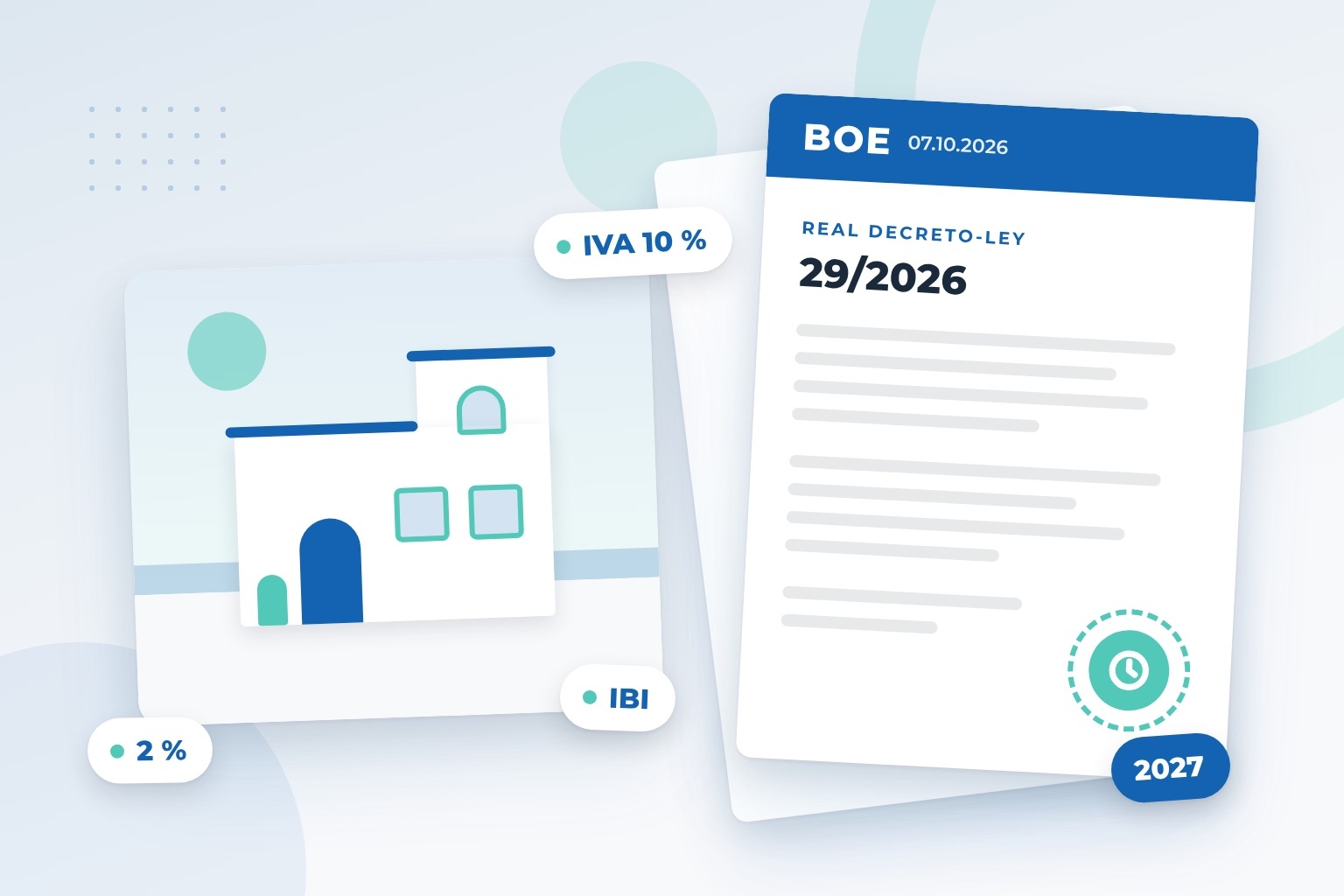
On 6 October 2026 the Spanish Government approved a new housing decree, Real Decreto-ley 29/2026, published in the BOE on 7 October and in force since 8 October. It brings 10% VAT on short-term holiday lets, possible IBI surcharges on tourist and empty homes, a 2% cap on rent increases and a change to how imputed income will be calculated from 2027. It still needs to be ratified by Congress, which is expected to happen in the coming weeks. In this article we explain, in plain language, what it means for you as a non-resident property owner in Spain.
How does the decree affect non-residents?
- Rules linked to the property (rental contracts, VAT on holiday lets, IBI surcharges, plusvalía municipal) apply to every owner, whether they live in Spain or not.
- Imputed income: the IRNR calculates imputed income by applying article 85 of the IRPF law. As the decree amends that article, the new scale also applies to your Modelo 210 for imputed income from fiscal year 2027 (see below).
- What does not apply to you: the IRPF incentives (reductions of up to 100% for landlords who lower the rent and the new 10% deduction for tenants) are only for Spanish tax residents. You will keep filing your Modelo 210 for imputed income or rental income as until now.
What changes depending on how you use your property
If you rent out to tourists (stays of up to 30 nights)
This is the group most affected. From 1 December 2026, renting out a furnished apartment or house to the same guest for 30 nights or fewer will no longer be VAT-exempt and will be taxed at 10% VAT. Until now, these lets were only subject to VAT if you offered hotel-type services such as daily cleaning or meals. The owner's own habitual residence is excluded.
What this means for you in practice:
- You will need to register as a self-employed business (empresario) for VAT purposes with the Agencia Tributaria, charge 10% VAT to your guests (or absorb it in your price) and file the Modelo 303 VAT return every quarter.
- At IberianTax we are already working on a new service to help you file these VAT returns.
- Check how your booking platform or management company will handle the invoicing from December.
- You will still file your Modelo 210 for rental income. The VAT you collect from guests is not part of your rental income.
- In areas declared as stressed housing markets (zonas tensionadas), your town hall may also add an IBI surcharge on tourist homes: up to 50%, up to 100% if you own two or more, and up to 150% if you own four or more. It is not automatic: each town hall must approve it in its tax bylaws.
If you rent out for a few months (seasonal lets)
Seasonal contracts (more than 31 days and, in general, no more than 12 months) must now state a real, justified reason for the temporary stay, such as studies, temporary work or medical treatment. If the reason is not justified, or if more than two seasonal contracts are chained, the contract will be treated as a long-term residential lease, with all the tenant protections that come with it (duration, extensions and rent limits).
If you rent out long-term
- Rent increases capped at 2% until 31 December 2027, unless you agree otherwise with the tenant. If the rent is already above the official reference index, it cannot be increased at all.
- Extraordinary extension: tenants whose contract ends before 31 December 2028 can ask to extend it for up to two years, on the same terms, provided they are up to date with the rent. You can only refuse if you need the home for yourself or close family.
- Room rentals: the total rent of all rooms cannot exceed what the whole property would be rented for.
- Evictions: evictions of vulnerable tenants without alternative housing can be suspended until 31 December 2030, with the regional government covering unpaid rent.
- Tax incentives: the new IRPF reductions of up to 100% for landlords who lower the rent do not apply to the Modelo 210. If you live in the EU or EEA, you can still deduct your expenses and pay 19% on the net income. Our rental income tax calculator gives you an estimate.
If your property is empty or for your own use
Town halls will be able to apply an IBI surcharge to homes that are permanently unoccupied, meaning empty continuously and without justified cause for more than two years. Outside stressed areas, it only affects owners of four or more residential properties (up to 50%, or up to 100% if the home has been empty for more than three years). In stressed areas it can apply to any owner (up to 50%, and up to 100% or more for owners of four or more homes). In all cases, your town hall must approve it in its tax bylaws. Good news for most of our clients: the decree expressly treats use as a second home as a justified cause, up to a maximum of four years of continuous vacancy, so a holiday home that you use should not be considered empty. Homes offered for sale (up to one year) or for rent (up to six months) at market conditions are also covered.
The most relevant change for most of our clients is in imputed income. From 1 January 2027, the IRPF replaces the current flat rate (2% of the valor catastral, or 1.1% if it has been revised) with a progressive scale applied by brackets to the sum of the cadastral values of your properties (excluding your main home): 1.1% up to €100,000, 1.5% from €100,000 to €500,000, 2% from €500,000 to €1,000,000 and 3% above €1,000,000. Since the IRNR applies article 85 of the IRPF law to calculate imputed income, this scale also applies to your Modelo 210. In practice, owners whose cadastral value has been revised (1.1% today) will pay more on the part above €100,000, while those whose value has not been revised (2% today) will generally pay less. Although the new scale enters into force on 1 January 2027, it will have no effect until the return for fiscal year 2027, which is filed in 2028. Your imputed income returns for 2025 and 2026 are calculated exactly as before. You can check your current figure with our annual non-resident tax calculator.
If you are thinking of selling
- From 1 December 2026 the maximum coefficients used to calculate the plusvalía municipal are updated.
- Until 31 December 2030, investment funds and large landlords (more than 10 homes) are restricted from buying homes below 70% of their market value. This mainly affects discounted portfolio sales, not a normal sale at market price.
- Your Modelo 210 for capital gains and the 3% withholding when you sell do not change.
Summary at a glance
| Your situation | What changes | From when |
|---|---|---|
| Holiday let (up to 30 nights) | 10% VAT; possible IBI surcharge in stressed areas | 1 December 2026 (VAT); IBI only if the town hall approves it |
| Seasonal let | Must justify the temporary reason, otherwise treated as a long-term lease | 8 October 2026 |
| Long-term let | 2% cap on increases; extension of up to 2 years at the tenant's request | Until 31 December 2027 (cap); contracts ending before 31 December 2028 (extension) |
| Empty home | Possible IBI surcharge | Only if the town hall approves it |
| Own use / holiday home | New progressive imputed income scale, also applicable to the Modelo 210 | Fiscal year 2027 (filed in 2028) |
| Sale | Updated plusvalía municipal coefficients | 1 December 2026 |
What we recommend
- If you rent to tourists, prepare now for VAT from 1 December: talk to your platform or manager about invoicing and plan your VAT registration and quarterly Modelo 303 returns. We will soon be able to help you with them.
- Keep an eye on your town hall. IBI surcharges require a local bylaw. If you want your IBI and other local taxes paid on time without worrying, we can set up direct debit for your local taxes.
- Keep filing your Modelo 210 as usual. Your obligations for 2025 and 2026 do not change because of this decree.
We will update this article if there are any further developments.
This article is for general information only and is based on Real Decreto-ley 29/2026 as published in the BOE on 7 October 2026. The decree must be validated by Congress and its content may change. It does not replace personalised tax advice. You can read the official text in the BOE.