Spanish Tax Deadlines 2026 for Non-Resident Property Owners
September 24, 2026

If you own property in Spain but live abroad, missing a Modelo 210 deadline can be costly. Surcharges, penalties, and lost deductions are easy to avoid once you know exactly when to file. This guide breaks down every key date for the 2025 tax year (filed in 2026), explains which deadlines apply to your situation, and shows you how to stay compliant throughout the process.
Quick answer: Modelo 210 deadlines for the 2025 tax year
- Rental income: 1–20 January 2026 for the full 2025 tax year.
- Imputed income (notional income on second homes): 1 January–31 December 2026 (by 23 December if paying by direct debit)
- Capital gains tax (property sold in 2025 or 2026): within 4 months of the sale date
- Other incomes (dividends, employment, interest, etc.): generally within 20 days after the end of the quarter in which the income was earned
If you're already an IberianTax customer, you don't need to memorise all these dates. We send you email reminders for key dates.
What is the Modelo 210 and who must file it?
The Modelo 210 is the official Spanish tax form used by non-residents to declare income earned in Spain. In general, you are treated as a Spanish tax resident if you spend more than 183 days in Spain during the calendar year, or if your main economic or family interests are located in Spain. If none of these criteria apply and you own property or earn income in Spain, you will usually be taxed as a non-resident.
You must file a Modelo 210 in 2026 if, during 2025, you:
- Owned a second home or holiday property in Spain (even if unused)
- Rented out a Spanish property (short-term or long-term)
- Sold a property in Spain — even if you only owned it for part of the year
- Earned Spanish-source income such as dividends, interest, or employment income
- Held any other type of taxable asset or income linked to Spain
In short: if you're a non-resident with any economic link to Spain, the Modelo 210 likely applies to you.
Key deadlines for the 2025 Tax Year (to be filed in 2026)
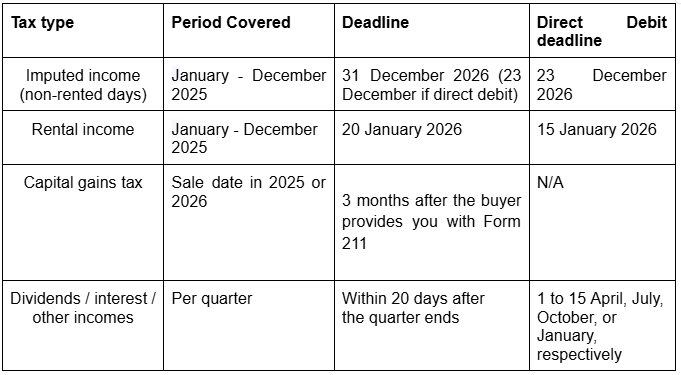
Important: Taxes for the 2026 tax year (imputed income and rental income) are to be declared in 2027, but the deadlines differ from those set out in this article. Under Order HAC/623/2026, rental income for 2026 must be filed between 1 and 20 April 2027 (not in January), and the filing period for imputed income begins on 1 April 2027 (not 1 January). Please check the new deadlines for 2026 before filing.
Types of Modelo 210 and their deadlines in 2026 explained
Imputed income tax: annually, by 31 December 2026
Even if you don't rent out your Spanish property, the Tax Office assumes it generates a notional income called “Renta imputada”. This must be declared annually using the Modelo 210.
- Taxable base: 1.1% of the cadastral value if the municipality has had a general collective revision in the last ten years; 2% otherwise.
- Tax rate: 19% for EU/EEA residents, 24% for non-EU/EEA residents.
- Deadline for the 2025 tax year: 31 December 2026 (or 23 December 2026 if you pay by direct debit).
Rental income tax: annually, between 1–20 January 2026.
Important update: Since the 2024 tax year, rental income from Spanish property is declared once a year, not quarterly. The previous quarterly system no longer applies.
- All non-residents (EU/EEA and non-EU/EEA): one annual filing covering the entire 2026 tax year.
- Deadline: 1–20 January 2026.
- EU/EEA residents can still deduct rental expenses (IBI, community fees, mortgage interest, utilities, insurance).
- Non-EU/EEA residents cannot deduct expenses under current rules (see updates section below).
Have you forgotten to file your 2025 income tax returns? We recommend doing so before receiving a notification from the Spanish Tax Agency, as this may result in significantly higher surcharges and penalties than if you file voluntarily. Click here to start.
Important: please note that taxes relating to the 2026 tax year (imputed income and rental income) must be declared in 2027, but the deadlines differ from those set out in this article. Under Order HAC/623/2026, rental income for 2026 must be filed between 1 and 20 April 2027 (not in January), and the filing period for imputed income begins on 1 April 2027 (not 1 January). Please check the new deadlines for 2026 before filing. If you are registered with IberianTax, you will receive a reminder so that you do not forget to submit these returns each year.
Capital gains tax: within 4 months of the sale
When you sell a Spanish property as a non-resident, any profit is taxed via the Capital gains Tax Return (Modelo 210). The buyer must withhold 3% of the sale price (Modelo 211), which is offset against your final tax liability.
- Deadline: within 3 months from the date the buyer provides you with Form 211. The buyer has 1 month to deliver Form 211 after the purchase date.
- Tax rate: 19% flat for both EU/EEA and non-EU/EEA residents.
- If the 3% withholding exceeds your final tax bill (for example, when selling at a loss), you can claim a refund.
Important: Selling the property in 2025 did not end your tax obligations for that year. You were still required to declare imputed income (or rental income, if the property was rented) for the period during 2025 in which you owned the property, on a pro-rata basis. For example, if the property was sold on 30 June 2025, imputed income had to be declared for the period from 1 January to 30 June 2025 (to be filed by 31 December 2026), in addition to the capital gains tax return (to be filed within three months following the submission of Form 211).
Other Spanish-source income: dividends, interest, employment income
The Modelo 210 also applies to other types of income earned in Spain by non-residents. The general rule:
Income subject to withholding at source: if the withholding correctly applied your final tax rate — including any reduced rate under the Double Taxation Agreement (DTA) between Spain and your country of residence — no Modelo 210 filing is required. The Spanish payer has already settled your tax obligation.
When a Modelo 210 is required for these income types?
- The payer didn't apply the correct withholding (for example, the standard 19% or 24% rate was applied instead of the reduced DTA rate).
- You want to claim a refund of excess withholding.
- The income was not subject to withholding but should have been declared (for instance, certain employment income or royalties paid by a non-withholder).
- Capital gains from selling Spanish shares or financial assets (these are not subject to withholding and must be declared).
Deadlines for these cases:
- Returns with tax to pay: within the first 20 days of April, July, October, or January, for income earned in the previous calendar quarter.
- Direct debit option: 1 to 15 April, July, October, or January, respectively.
- Refund claims: can be filed from 1 February of the year following the income, and remain open for up to 4 years.
Because each situation depends on the Double Taxation Agreement between Spain and your country of residence, we recommend checking the treaty carefully — or asking us for guidance — before deciding whether you need to file.
Key updates affecting your 2026 filings
A few important developments to keep in mind for the 2025 tax year.
Imputed income tax: the obligation still applies
The European Commission has formally challenged Spain over its imputed income tax, arguing that taxing non-residents on a property they don't rent out — while exempting Spanish residents on their primary home — breaches EU free movement rules. You can read more about the dispute here.
However, the obligation has not changed. Until the EU Court of Justice issues a final ruling, non-residents must continue filing the Modelo 210 for imputed income every year. Ignoring the obligation today won't help your case tomorrow; it will simply result in surcharges and penalties.
Rental expense deductions for non-EU/EEA residents: still pending
In July 2025, the Spanish National Court ruled that denying rental expense deductions to non-EU/EEA residents is discriminatory. The case is currently before the Supreme Court, and a final decision is still pending.
What this means for your 2026 filings:
- The current rule still applies: non-EU/EEA residents cannot yet deduct rental expenses when filing their Modelo 210.
- The obligation to file remains unchanged. Returns must be submitted on time as usual.
- You can already prepare a refund claim. IberianTax offers a Rental Expenses Reclaim service for tax years from 2022 onwards. Since Spanish tax claims expire 4 years after the filing deadline, the earliest 2022 rental periods are already starting to prescribe (the Q1 2022 rental return prescribed on 20 April 2026; Q4 2022 will prescribe on 20 January 2027). Acting now is the only way to protect those years before they're lost for good.
Real examples: how the 2026 deadlines apply in practice
Example 1: Anna — rented and personal use during 2025
Anna, a German tax resident, owns a flat in Valencia. In 2025 she rented it out for 6 months and used it personally for the rest of the year.
Her 2026 filing calendar:
- Rental income for 2025 (6 rented months): filed in a single annual Modelo 210 between 1–20 January 2026, with deductible expenses applied (Anna is an EU resident).
- Imputed income for the 6 months of personal use in 2025: filed by 31 December 2026 (or 23 December if paying by direct debit).
That's two filings during 2026. Although the imputed income deadline doesn't expire until 31 December, we strongly recommend filing it as early as possible — most owners who wait until the last weeks of December end up either forgetting, missing the direct debit cut-off (23 December), or scrambling at year-end. Filing earlier in the year means one less thing on your mind.
Example 2: James — sold his Spanish property mid-2025
James, a UK tax resident, owned a villa in Málaga. He didn't rent it out and sold the property on 30 October 2025.
His filing obligations:
- Capital gains tax (sale): Modelo 210 had to be filed within 4 months of the sale date (i.e. by the end of February 2026). The buyer withheld 3% of the sale price via Modelo 211, which James could offset against his final capital gains tax liability.
- Imputed income for the days he owned the property in 2025: Although the property was sold during 2025, James was still required to declare imputed income for the period from 1 January to 30 October 2025, calculated on a pro-rata basis according to the period of ownership. This return had to be filed by 31 December 2026.
Many owners forget the second filing. Selling the property doesn't cancel the imputed income obligation for the days you were still the legal owner.
Common mistakes non-residents make with Modelo 210 deadlines
Even careful owners often slip up on the same issues. Watch out for these:
- Assuming an empty property means no tax. Imputed income tax still applies. This is the most common — and most expensive — mistake.
- Still trying to file rental income quarterly. Since 2024, rental income is annual only. Don't split your year into four returns.
- Forgetting imputed income after selling. If you sold mid-year, you still owe imputed income for the days you were the owner in 2025.
- Forgetting the 4-month capital gains deadline. Selling a property and waiting until the next tax season is far too late.
- Missing the direct debit cut-off. For direct debit payments, the filing deadlines are earlier than the standard window: 23 December for imputed income and 15 April for rental income (from the 2026 tax year onwards). Don't assume the final deadline applies to your payment method.
- Filing one Modelo 210 for several properties. Each cadastral reference (each property, garage, or storage unit) requires its own return.
- Misunderstanding the 4-year claim window. The 4-year prescription doesn't run from the tax year — it runs from the end of its voluntary filing deadline. So an imputed income return for 2022 (deadline 31 December 2023) actually prescribes on 31 December 2027, not 2026. Plenty of time is often still available when owners assume it's gone.
What happens if you miss a Modelo 210 deadline?
Missing a Spanish tax deadline triggers automatic consequences:
- Voluntary late filing (before any Tax Office notice): 1% surcharge for the first month, plus 1% per additional month, up to 15% after 12 months. Interest only accrues after one year.
- After a Tax Office notice: penalties of 50% to 100% of the tax due, plus interest. Repeated or serious cases can lead to criminal action.
- Other consequences: blocked refunds, denied deductions, and increased scrutiny of future filings.
You can read more about this in our article: Modelo 210 Filed Late
The good news: with proper planning — or automation — none of this should ever apply to you.
Never miss a deadline again: email reminders and automatic filing
The simplest way to stay compliant is to let IberianTax track every deadline for you.
- Free email reminders. Every IberianTax account includes free, automatic email reminders before each deadline — Modelo 210 imputed income, annual rental return, NRA declaration, or any other obligation tied to your profile.
- Set an Automatic Filing for your Imputed Income Tax Return. With our automatic filing option, your Modelo 210 for imputed income is prepared, calculated, and submitted to the Spanish Tax Office every year, on time, with no action required from you. It's the safest way to forget about deadlines without losing compliance.
You stay informed, in control, and protected from surcharges — all from your dashboard, in English, German, French, or Spanish.
FAQ — Spanish tax deadlines 2026 for non-residents
When is the deadline to file the Modelo 210 for the 2025 tax year?
It depends on the type of income. Imputed income is filed by 31 December 2026. Annual rental income is filed between 1–20 January 2026. Capital gains for property sold in 2025 or 2026 must be filed within 4 months of the sale date.
Is rental income still filed quarterly?
No. Since the 2024 tax year, rental income from Spanish property is declared once a year. For the 2025 tax year, the filing window is 1 to 20 January 2026. From the 2026 tax year onwards, the deadline moves to 1–20 April of the following year — or 1–20 January if the result is nil or negative. The previous quarterly system no longer applies.
Do I still need to file imputed income if the EU has challenged the law?
Yes. The obligation remains fully in force. Until a final ruling is issued, non-residents must continue filing the Modelo 210 every year to avoid penalties.
I sold my Spanish property in 2026. Do I still owe imputed income tax?
Yes — for the days you were the owner. If you sold on, say, 30 June 2026, you must declare imputed income pro-rata for 1 January–30 June 2026, plus the capital gains return within 4 months of the sale.
Can non-EU residents deduct rental expenses?
Not yet. The Spanish Supreme Court is still reviewing the issue. The current obligation remains unchanged, but you can already submit a Rental Expenses Reclaim through IberianTax for tax years from 2022 onwards before they prescribe.
How do email reminders and automatic filing work?
Once you create a free IberianTax account, you'll automatically receive email reminders before each of your deadlines. If you enable automatic filing, we'll prepare and submit your return every year without you having to log in.
Please note: Automatic filing is currently available only for imputed income tax (Modelo 210 for deemed income on second homes).
Why isn't automatic filing available for rental income?
Rental income changes every year — rented months, deductible expenses (for EU/EEA residents), tenants, and periods of personal use. Because these figures need to be reviewed annually, rental returns are prepared with your input rather than fully automated. Imputed income, by contrast, is based on stable data (cadastral value, ownership period), which makes it ideal for automation.
The good news: filling in your rental income return with IberianTax takes no more than 10 minutes. Our platform guides you through every step, applies the correct calculations automatically, and submits the return directly to the Spanish Tax Office.
File your Modelo 210 the easy way
Spanish tax deadlines don't have to be stressful. With IberianTax, you can:
- File any Modelo 210 (imputed income, rental income, capital gains, or other income) online in minutes from anywhere.
- Pay from just €34.95 per filing, instead of €200+ at a traditional gestoría.
- Receive automatic email reminders before every deadline.
- Activate Set Automatic Filing and let us submit your return every year on your behalf.
- Get expert support in English, German, French, or Spanish whenever you need it.
Create your free IberianTax account and take Spanish tax deadlines off your to-do list — for good.