Modelo 210 Filed Late: Surcharges, Penalties and How to Regularise
September 24, 2026
Owning a property in Spain as a non-resident — even if you don't rent it out — comes with a clear tax obligation: filing the Modelo 210.
Many non-resident owners are unaware of this requirement or simply forget it, which can lead to surcharges, penalties and problems with the Spanish Tax Office.
This article explains what happens if you don't file the Modelo 210, how much it can actually cost you, and what steps to take to regularise your situation before the Tax Office comes to you.
You'll learn:
- What the Modelo 210 is and when you must file it
- What happens if you don't file or file late
- How much you could end up paying in surcharges or penalties
- How to regularise your situation step by step
- How to avoid these problems in the future
Who Must File the Modelo 210?
The Modelo 210 is the official declaration for the Non-Resident Income Tax (IRNR) in Spain. You are required to file it if you are not a tax resident in Spain and you fall into any of these situations:
- You are the owner, usufructuary or bare owner of a property in Spain, whether you rent it out or not.
- You have sold a property in Spain during the tax year.
Tax residency in Spain is mainly determined by spending more than 183 days per year in Spanish territory or having your main economic interests here. If you habitually live outside Spain, you are a non-resident for tax purposes and this obligation applies to you.
Nationality is irrelevant. A German, French, British or even Spanish citizen who is not a tax resident in Spain but owns a property there must file the Modelo 210 every year.
The obligation is also individual and per property: if you share a property with someone else, each co-owner files their own Modelo 210. If you own several properties with different cadastral references, you file one Modelo 210 per property.
Filing Deadlines
Deadlines depend on the type of declaration: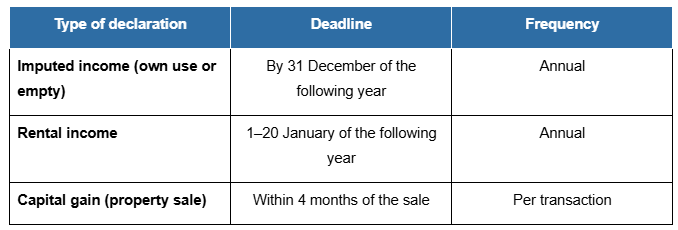
Important: Pursuant to Order HAC/623/2026, the examples in this table do not reflect the 2026 tax year: rental income for 2026 is reported between 1 and 20 April 2027 (not in January), and imputed income for 2026 is reported from 1 April 2027 (not from 1 January). Please refer to the updated guide to 2026 deadlines before applying these examples to 2026 and beyond.
Practical examples:
- Property not rented during 2025 → file Modelo 210 between 1 January and 31 December 2026
- Property rented during 2026 → file Modelo 210 between 1–20 January 2027
- Property rented for 6 months and empty for 6 months in 2026 → file two forms (imputed income by 31 December 2027 and rental income between 1–20 January 2027)
- Property sold on 5 March 2026 → file Modelo 210 (capital gain) before 5 July 2026
Since 2024, rental income is no longer declared quarterly. If you previously filed four Modelo 210 forms per year for rental income, you now only file one between 1–20 January of the following year.
What Happens If You Don't File the Modelo 210?
The consequences depend on whether you regularise the situation yourself or whether the Tax Office contacts you first. The financial gap between the two scenarios can be substantial.
Voluntary Late Filing (Without a Tax Office Request)
If you catch the mistake and file voluntarily, late filing surcharges apply — not penalties. The system is progressive:
- Up to 1 month late: 1% of the tax due.
- Between 1 and 12 months: 1% + an additional 1% for each full month of delay (maximum 12%).
- More than 12 months: 15% of the tax due, plus late payment interest from the day after the 12-month mark.
Once you file and pay, the Tax Office will notify you of the surcharge separately: first a proposal, then a final settlement with payment instructions. No penalty will be applied, as long as you act before receiving any formal request.
Formal Request From the Tax Office
If the Tax Office detects the unpaid tax and issues a formal request before you file, the picture changes entirely. In this case, penalties apply:
- Minimum penalty: 50% of the unpaid tax
- Serious infringement: between 50% and 100%
- Very serious infringement (concealment or fraud): up to 150%
In all cases, late payment interest is also charged on the outstanding amount. These penalties can accumulate quickly, significantly increasing the total amount due.
Summary Table: Surcharges and Penalties for Late Filing
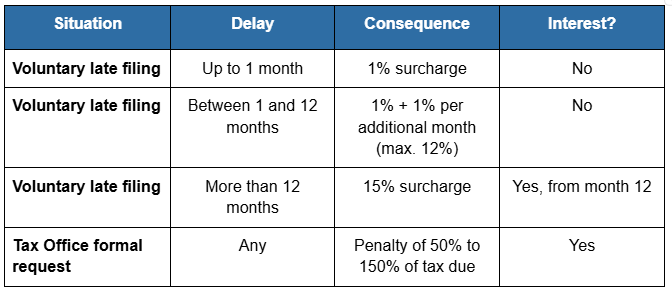
The sooner you act, the lower the cost.
How Much Can It Really Cost You?
Here are two real-life examples to understand the actual financial impact.
Example 1: Rental Income Declaration Filed Late
Ana owns an apartment in Alicante that she rents out all year. Her 2024 rental income generated a tax bill of €480. The filing deadline was 20 January 2025, but she didn't find out in time and voluntarily filed on 20 May 2025 — 4 months late.
- Applicable surcharge: 4% (1% per month of delay)
- Surcharge amount: €480 × 4% = €19.20
- Total paid with the self-assessment: €480
- Surcharge notified later by the Tax Office: €19.20
- Penalties: none (voluntary filing, no prior request)
Example 2: Several Years of Imputed Income Not Declared
Hans has owned a second home in Mallorca since 2019. He has never rented it out and, unaware of the obligation, has never filed the Modelo 210. In March 2026, he discovers the situation and decides to regularise voluntarily. He has the declarations for 2021, 2022, 2023, 2024 and 2025 outstanding (2019 and 2020 have already been prescribed). His annual imputed income tax is €320.
- Outstanding declarations: 5 years × €320 = €1,600 total
- Surcharges vary depending on how late each year is:
- 2021, 2022 and 2023: 15% plus late payment interest
- 2024: 3%, no interest
- 2025: no surcharge, as the filing deadline runs until 31 December 2026
- Estimated total surcharge: €153.60 + interest (notified later by the Tax Office)
- Penalties: none, as he regularises before any formal request
The most important point in Hans's case: acting before the Tax Office detects the situation is the difference between paying a moderate surcharge and facing penalties that could double the debt.
How to Regularise the Modelo 210 If You've Missed the Deadline
If you've realised you haven't filed the Modelo 210 on time — even if you've never filed it before — you can regularise your situation in a few steps. Always remember: it is far better to regularise voluntarily than to wait for a formal request.
- Step 1: Identify which declarations are missing: check which tax years and which type of income (imputed, rental or capital gain) you still need to file. The Tax Office accepts late declarations for the last four years. If you have years pending from 2021 onwards, you can still regularise them.
- Step 2: File and pay as soon as possible, without waiting for the Tax Office to contact you: acting voluntarily is essential. The sooner you file and pay, the lower the surcharge — and you avoid it turning into a penalty. You can do this through the Spanish Tax Office electronic portal (you will need a digital certificate or Cl@ve, plus a good understanding of Spanish and tax regulations) or with the help of a registered tax office collaborator like IberianTax.
- Step 3: Make the payment: along with the declaration, you will need to pay the tax due. The surcharge is not paid at this stage.
- Step 4: Keep the documentation: keep the filing confirmation and payment receipt as proof of compliance.
When Is the Surcharge Paid?
The surcharge is not paid when you file. Once you have paid the tax, you must wait for the Tax Office to notify you of the exact amount via a settlement letter. What you pay voluntarily is the tax itself; the surcharge is managed and collected by the Tax Office separately.
Common Mistakes That Lead to Not Filing the Modelo 210
These are the most frequent errors among non-resident property owners:
- "I don't rent the property, so I don't need to declare anything": incorrect. Even if the property is empty or used for personal use, you are still required to declare imputed income annually.
- "I already paid the IBI, that's enough": the IBI is a local municipal tax, completely separate from the Non-Resident Income Tax, which is a national tax declared via the Modelo 210. They are independent obligations.
- "A gestoría was handling it and I don't know if they filed it": it's worth checking whether you have filing confirmations from previous years. You can also check your filing history using a digital certificate.
- "I only own a parking space, not a flat": any property with its own cadastral reference generates the obligation to declare. You must file one Modelo 210 per property with a unique cadastral reference.
- "I've only owned it for a few years and didn't know it was compulsory": not knowing about the obligation does not exempt you from penalties. The obligation exists from the first year of ownership.
How to Avoid This Problem in the Future
The best way to avoid surcharges and penalties is to stay on top of your tax obligations. Some practical tips:
- Note the deadlines in your calendar at least one month in advance.
- If you rent out the property, keep a record of the income received throughout the year.
- Consider delegating your tax management to a solution like IberianTax, which offers an automatic filing option so you don't have to worry every year.
Frequently Asked Questions
How long do I have to regularise the Modelo 210 if I didn't file it?
You can file late declarations for the last four years. If the debt is more than four years old, it prescribes and the Tax Office can no longer claim it. The best approach is to review the last four closed tax years and regularise as soon as possible.
What happens if the Tax Office claims a debt covering several years?
If the Tax Office issues a formal request, penalties (not surcharges) will apply to each outstanding year, plus late payment interest. The total amount can be significant. That's why it's always better to regularise before receiving any notification.
Can I file the Modelo 210 myself even if I've missed the deadline?
Yes. You can do it through the Spanish Tax Office website. However, as the process is not very intuitive and is only available in Spanish, many non-resident property owners opt for specialist services like IberianTax to avoid mistakes and manage the filing more easily.
Does the Modelo 210 also apply to properties that aren't homes?
Yes. The obligation applies to any property with its own cadastral reference: homes, parking spaces, storage rooms, commercial premises, plots or warehouses. Each property with an independent cadastral reference requires its own declaration.
Not sure how this applies to your case? Visit our FAQ page or get in touch with our specialist support team. We're here to help.
Do you have outstanding declarations or want to make sure you're meeting your obligations?
At IberianTax we help you file the Modelo 210 simply, from any country and in your language.
- From €34.95 per declaration
- Online filing in minutes
- Automatic deadline reminders
- Specialist support in English, French, Spanish and German