How to Recover the Withholding Tax on Your Commercial Property Rental in Spain
September 24, 2026

If you rent out a commercial property in Spain as a non-resident, your tenant may be required to withhold part of the rent and pay it directly to the Agencia Tributaria (Spanish Tax Agency) on your behalf. As a result, the amount you receive in your bank account may be lower than the rent agreed in the contract.
The good news is that this withholding is not necessarily your final tax bill. In many cases, it's simply an advance payment, and once you calculate your actual tax through the Modelo 210, you may be entitled to a full or partial refund.
This guide explains why the withholding works, how much it usually is, and how you can claim back what you're owed.
Quick Answer:
- If your tenant is a company or a professional, they must withhold part of your rental income and pay it to the Agencia Tributaria on your behalf.
- The withholding rate is usually 19% for EU/EEA residents and 24% for residents of other countries.
- This withholding is only a payment on account, not your final tax.
- Your real tax is calculated later through the Modelo 210, and if the withholding was higher than the tax actually due, you can request a tax refund.
- EU/EEA residents can deduct rental-related expenses; non-EU/EEA residents cannot.
Why does the tenant withhold tax from your rental income?
As a non-resident property owner in Spain, you must declare the income you receive from renting out your Spanish property and pay Non-Resident Income Tax (IRNR) on that income.
When a commercial property is rented to a company or self-employed professional, the tenant generally acts as a withholding agent. Instead of paying you the full rent, they withhold part of it and pay that amount directly to the Agencia Tributaria on your behalf. You receive the remaining amount.
How much is the withholding tax on commercial properties rentals?
The percentage withheld depends on where you're a tax resident:
- 19%, if you're a tax resident in another EU or European Economic Area (EEA) country that has an effective exchange of tax information with Spain.
- 24%, if you're a tax resident in a country outside the EU/EEA.
For example: on a 20,000 € annual rent, an EU resident would see 3,800 € withheld and paid to the Tax Agency (19%), while a non-EU resident would see 4,800 € withheld (24%). Either way, that money doesn't disappear. It's credited against whatever tax you actually owe.
The withholding is not always your final tax
Here's the key issue: your tenant's withholding is calculated on the gross rental income, the full amount agreed in the contract, before any expenses. But if you're an EU/EEA resident, your actual tax is calculated on your net rental income, after deducting expenses like IBI, community fees, or repairs.
That mismatch is exactly where the refund comes from. The tenant withholds a percentage of the full rent, while the Tax Agency only asks you to pay tax on what's left after expenses. The bigger your deductible expenses, the bigger the gap between what was withheld and what you actually owe, and the higher your potential refund.
If you're outside the EU/EEA, this gap usually does not arise, since your tax is also calculated on the gross rental income, with no deductions applied. We'll go through both cases below.
If You Live in the European Union
If you're a tax resident in the EU or EEA, you're allowed to pay tax on your net rental profit, not on the full rental income. In other words:
Taxable income = Rental income − Deductible expenses
Some expenses commonly linked to renting out a commercial property include:
- IBI (the local property tax)
- Community fees
- Repairs and maintenance
- Real estate agency fees
- Insurance
- Depreciation costs
- Other expenses directly related to the rental
If you want to learn more about what expenses are deductible, visit our article: Deductible Rental Expenses in Spain for Non-Residents: Full Guide
What matters here is the outcome: because your tax is calculated on the net profit, and your tenant withheld a percentage of the gross rent, there's often a difference between what was withheld and what you actually owe.
If You Live Outside the European Union
If you are a tax resident outside the EU/EEA, the current rule is stricter. As a general rule, rental expenses cannot be deducted, and your tax is calculated on your gross rental income at the applicable 24% rate.
This issue is currently under review following a recent National Court ruling that recognized the possibility for non-EU/EEA residents to deduct rental expenses. However, the decision has been appealed before the Supreme Court, and until a final ruling is issued, the Spanish Tax Agency continues to apply the current rules.
You can find more detailed information about this ongoing legal development in our article: National Court ruling: deduction of rental expenses in Spain for non-EU owners
Even without deductions, it is still worth reviewing your situation, as refunds may be possible in certain cases, for example when the wrong tax rate has been applied or when the tax was calculated on an incorrect amount.
When can you recover the withholding tax?
Once you calculate your Modelo 210, one of two things can happen:
- The withholding retained by your tenant is higher than the tax you actually owe, or
- Your tax liability turns out to be zero (this is more common for EU/EEA residents with high deductible expenses).
In either case, the Spanish Tax Agency owes you the difference, and you're entitled to a tax refund.
It's important to understand that this refund is not automatic. Nobody at the Tax Agency reviews your file and sends you a check. You have to actively claim it, by filing your Modelo 210 showing a result "a devolver" (to be refunded).
A numerical example
Let's build on our earlier example of a commercial property rented for 20,000 € a year, this time assuming Michael -the owner- lives in Germany and is an EU resident:
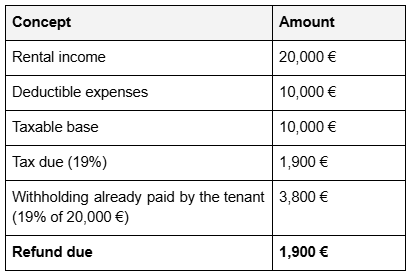
In this case, the tenant withheld 3,800 € over the year and paid it to the Tax Agency on Michael’s behalf. But once Michael deducts his allowable expenses, his actual tax liability is only 1,900 €. This means that 1,900 € of the amount already withheld exceeds the tax actually due, and Michael can request a refund of this difference by filing the Modelo 210.
Deadline to request your tax refund
This is where a lot of confusion happens, so let's separate the two situations clearly:
- If the return results in tax due: If, after calculating your Modelo 210, you still owe additional tax on top of what was withheld, the return must be filed between April 1 and April 20 of the year following the tax year being declared (from 2027 onwards).
- If the return results in a refund: If your calculation shows that you're owed a refund, you don't have to wait for the April deadline. You can file your Modelo 210 from February 1 of the year following the tax year being declared.
On top of that, you're not limited to a short window. You have four years from the end of the tax year to request your refund.
Common mistakes non-resident owners make
- Assuming the withholding is the final tax. Many owners think that because the tenant already withheld and paid a percentage to the Agencia Tributaria, their tax obligation is settled. It isn't. The Modelo 210 is what determines the real amount due.
- Not filing the Modelo 210. Having tax withheld by the tenant does not remove the obligation to file the return. Failing to file may also mean losing a refund you would otherwise be entitled to claim.
- Forgetting to deduct allowable expenses (EU/EEA residents). If you're entitled to deduct expenses like IBI, community fees, or repairs, and you don't, you'll end up paying more tax than necessary, or missing out on a refund you were entitled to.
- Letting the four-year deadline expire. Because the refund window feels generous, some owners put off filing and eventually lose their right to claim it altogether.
How to claim your tax refund with IberianTax
Claiming your refund through IberianTax is quick and fully online:
- Create a free IberianTax account
- Start a new Modelo 210 and select the “Rental income” option.
- Complete the information requested in the form. The first time usually takes no more than 10 minutes.
- Enter your rental income, deductible expenses and withholding information. Our platform will automatically calculate the estimated refund amount you may be entitled to receive.
- Review the information, make the payment, and file your Modelo 210 with IberianTax.
You will also need to provide a tax residence certificate for the relevant tax year, a bank account ownership certificate for the account where the refund should be paid, and the withholding tax certificate issued by your tenant. The withholding certificate confirms the amounts withheld and paid to the Spanish Tax Agency on your behalf.
Frequently Asked Questions
Does the withholding tax my tenant applies count as my final tax payment?
No. It's only a payment on account. Your actual tax liability is calculated when you file your Modelo 210, and any excess withheld is refundable.
Can I get back the full amount withheld?
It depends on your final tax liability. . If the amount withheld exceeds the tax due, you can claim the difference. In some cases, this may result in a full refund of the withholding.
Do I need to file the Modelo 210 even if I think I don't owe any extra tax?
Yes. If you don't file it, you won't get your refund, and you also won't have formally reported the rental income, which is a legal obligation regardless of the outcome.
I'm a non-EU resident. Can I deduct anything at all?
Under the rules currently applied by the Spanish Tax Agency, non-EU/EEA residents are generally taxed on gross rental income without deducting expenses. As explained above, this position is currently subject to ongoing legal proceedings.
What happens if I let the four-year deadline pass?
Once the applicable four-year period has expired, you generally lose the right to claim the refund.
In short
If tax has been withheld from the rent on your commercial property in Spain, the amount withheld may be higher than your final tax liability. Filing the Modelo 210 allows you to calculate the correct tax and claim any excess withholding as a refund.
With IberianTax, you can complete the process online in your own language. We calculate your tax liability, identify any refund due and prepare and file your Modelo 210 with the Spanish Tax Agency.