I've Received a Letter from Hacienda as a Non-Resident: What It Means and What to Do
July 24, 2026
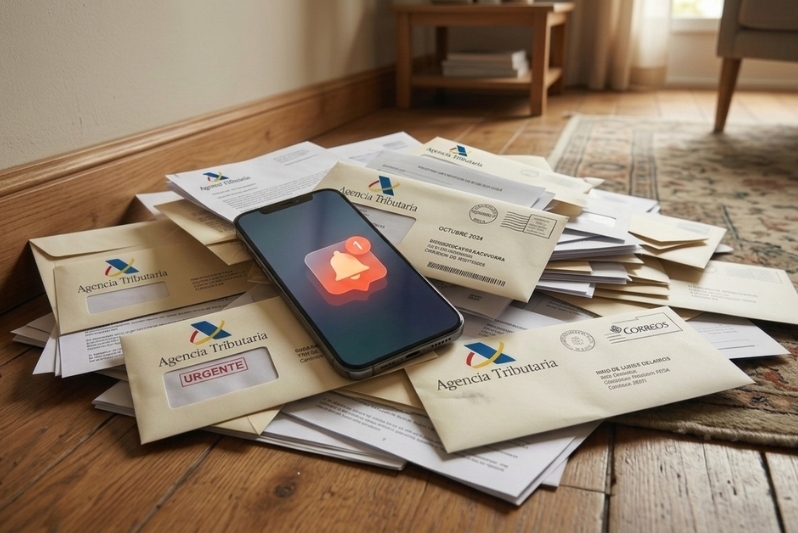
You own a property in Spain, you live abroad, and one day a letter from the Agencia Tributaria (Spain's Tax Agency) appears in your Spanish postbox - or someone you trust lets you know it has arrived. It is in Spanish, full of complex tax terminology and references to legal articles, and you have no idea whether it is a routine notice or the beginning of a serious problem.
The good news: most situations can be resolved without too much hassle, as long as you act within the deadline. The bad news: the greatest risk for a non-resident is usually not the letter itself, but failing to see it in time. This guide explains what types of communications Hacienda can send you, how long you have to respond to each, and what steps to take - whether you already have the letter in front of you or you simply want to make sure you never miss one.
This is a general information guide on non-resident income tax (IRNR) and Modelo 210. It does not replace individual tax advice: each letter specifies its own deadlines and reasons, and it is worth reviewing your specific situation.
The Problem Nobody Tells You About: You May Never Even See It
This is the key point - and the one that causes the most distress.
Hacienda sends many of its communications to non-residents by post to the address registered in Spain, usually your own property. If you live in the UK, Germany, France, the Netherlands, or the Nordic countries, that letter can sit in a postbox you do not check for weeks.
And this is where the legal trap lies: when the postman attempts delivery twice without success, the law allows Hacienda to notify you by public announcement. In practice, this means your notice is published in the Tablón Edictal Único (Spain's official state gazette, the BOE), and if you do not come forward within 15 calendar days, the notification is deemed served - even if you never saw it. From that point, the deadline to respond or pay begins to run, without you knowing.
The typical outcome: a property owner who believed they were fully up to date finds out months later, by which point the voluntary period has passed and what arrives next is a providencia de apremio (enforcement notice) with surcharges added. Not because they did anything wrong, but simply because the post never arrived in time.
This is precisely the problem that having an authorised electronic recipient for your notifications solves - something we return to at the end of this guide.
The Types of Letter Hacienda Might Send You
Not all communications are the same, and confusing them is what leads to the wrong response. The table below summarises the most common ones for a non-resident property owner, their typical deadlines, and what to do.
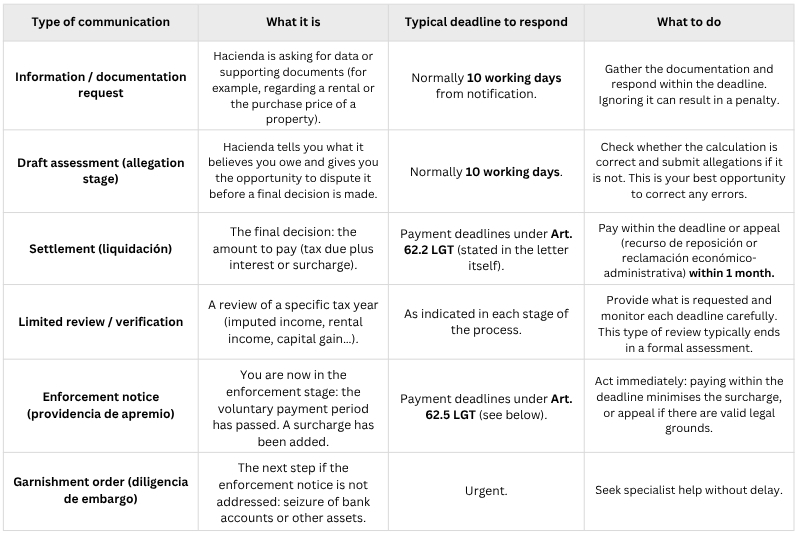
One piece of advice that applies to all of these: the actual deadline and the reason are always stated in the letter itself. Before anything else, locate the notification date and the time you have been given to respond.
Why Timing Changes Everything: Surcharge vs. Penalty
This is the distinction that saves - or costs - the most money, and it depends on one thing: whether you regularise your position voluntarily before Hacienda demands it, or afterwards.
If you act voluntarily, without a prior request from Hacienda (Art. 27 LGT): There is no penalty - only a late filing surcharge:
- 1% plus an additional 1% for each full month of delay, up to 12 months (a maximum of 12% per year)
- After 12 months: 15% plus late payment interest
- That surcharge can also be reduced by 25% if payment is made within the deadline.
If Hacienda acts first (sends a request or initiates a formal procedure), you move from surcharges to penalties - which typically start at 50% of the unpaid tax and can escalate in more serious cases.
The practical conclusion is simple: acting first is always cheaper. If you know you have outstanding tax years, regularising them before receiving a letter is almost always the most cost-effective decision.
If You Have Already Received an Enforcement Notice
This is the most common scenario among non-residents, precisely because of the postal problem described above. Here, the clock is running and the surcharge depends on when you pay (Art. 28 LGT):
- 5% (enforcement surcharge): if you pay the full debt before the enforcement notice is formally served to you
- 10% (reduced enforcement surcharge): if you pay the debt and the surcharge within the deadline stated in the notice
- 20% (standard enforcement surcharge) plus interest: if you do not pay within that deadline
Payment deadlines after receiving the notice (Art. 62.5 LGT):
- Notice received between the 1st and 15th of the month → pay by the 20th of that same month
- Notice received between the 16th and the end of the month → pay by the 5th of the following month
- If the final day falls on a non-working day, it moves to the next working day
In plain terms: paying quickly can reduce the surcharge from 20% to 10% - or even to 5% if you are still in time. It is worth checking the notification date today.
What NOT to Do
- Ignore it. The deadline runs regardless, and silence turns a small surcharge into a significant penalty.
- Pay blindly. Sometimes Hacienda's calculation is improvable - or outright incorrect - and the allegation stage exists precisely for that reason.
- Assume it is a scam without checking. Fraudulent emails and text messages imitating the Agencia Tributaria do circulate. Hacienda does not request payments by SMS or by email with links, and does not ask for bank details through those channels. If in doubt, always verify through the official electronic office at sede.agenciatributaria.gob.es - never from a received link.
What to Do, Step by Step
- Identify the type of letter using the table above. Look at the title of the document.
- Locate the notification date and the deadline. Both are stated in the document. Mark it in your calendar.
- Verify it is genuine through the official electronic office - not from external links.
- Gather your documentation for the affected tax year: Modelo 210 receipts, payment confirmations, rental contracts, title deed, IBI receipts…
- Respond or regularise within the deadline. If the calculation does not add up, submit allegations. If you have outstanding years, regularise them before the situation escalates.
- Keep all receipts and records. You may need them if there are further reviews.
How to Make Sure This Never Happens Again
Everything above stems from the same underlying problem: relying on a paper letter arriving in time to a Spanish address you cannot monitor from abroad. The way to close that gap is to stop depending on postal delivery.
In Spain, you can authorise a representative to receive your official notifications electronically (through the Apodera register of the Agencia Tributaria). From that point, your communications arrive electronically and reliably, rather than by post to a postbox you are not checking.
This is exactly what IberianTax's Tax Notification Service does. We register as your authorised notification recipient, receive your official Agencia Tributaria communications on your behalf, and forward each one to you with a clear summary in your language (English, Spanish, German, or French), the actions required, and the applicable deadline - with enough time to respond comfortably. No digital certificate required on your part if you opt for the full configuration, and nothing to sign: just your passport or ID and your NIE.
As official social collaborators of the Agencia Tributaria, specialising in non-residents, we close the one gap that remained: not just filing your tax return, but making sure you never miss a Hacienda notification again.
Frequently Asked Questions
Can Hacienda send notifications to my personal email address?
Not directly. Hacienda does not send official notifications to your personal email. What does exist is a courtesy alert: if you subscribe voluntarily, the Agencia Tributaria can send you an email or SMS letting you know a notification is waiting in the electronic system (the DEHú, within the Carpeta Ciudadana), which you then access using Cl@ve (Spain's digital identity system) or a digital certificate. Two important caveats: the alert is voluntary and non-binding - if you never subscribed, or the alert fails, the notification is still legally valid, and the deadline runs regardless. Relying on "if it's important, an email will come" is precisely what causes many non-residents to miss a notification. As an individual, you are not obliged to use the electronic channel (you receive postal mail by default), but you can opt in to receive notifications electronically - either by subscribing yourself (requires Cl@ve or a digital certificate) or by appointing an authorised recipient to receive them on your behalf. The latter is what IberianTax's Tax Notification Service does: we receive each notification electronically and forward it to your inbox, explained in your language and with the deadline clearly marked.
In other words, yes - you can end up receiving them in your inbox, but only if you set it up that way. Hacienda will not do it for you. And remember: a genuine notification never arrives as an email asking you to pay or click a link - that is fraud.
Can Hacienda consider a letter served that I never actually received?
Yes. After two failed postal delivery attempts, your notice is published in the Tablón Edictal Único (BOE), and if you do not come forward within 15 calendar days, the notification is legally deemed served — even if you never saw it.
How many years back can Hacienda claim from me?
As a general rule, the Agencia Tributaria can review and claim for the last 4 years (the statute of limitations). Regularising as soon as possible limits the scope of any claim.
I received the letter late because of postal delays. Can I do anything?
It depends on the case and the type of communication. In some situations it is possible to appeal by citing defects in the notification process, but this is complex territory. The most effective solution is to prevent the problem in the first place by receiving your notifications electronically.
We are two owners of the property. Does this affect both of us?
Yes. Notifications are issued per taxpayer, not per property - so each owner may receive their own independently.
I haven't received any letter. Should I be worried?
Not necessarily, but bear in mind that "not having received anything" does not always mean "not having been notified." If you own a property in Spain and do not check your Spanish postbox, that is precisely the situation of risk.
Don't let a letter from Hacienda catch you too late. With IberianTax's Tax Notification Service, you receive every official communication explained in your language, with the actions and deadlines clearly set out. Protect your peace of mind today →