Modelo 210 filed: what goes into your German tax return next
October 22, 2026
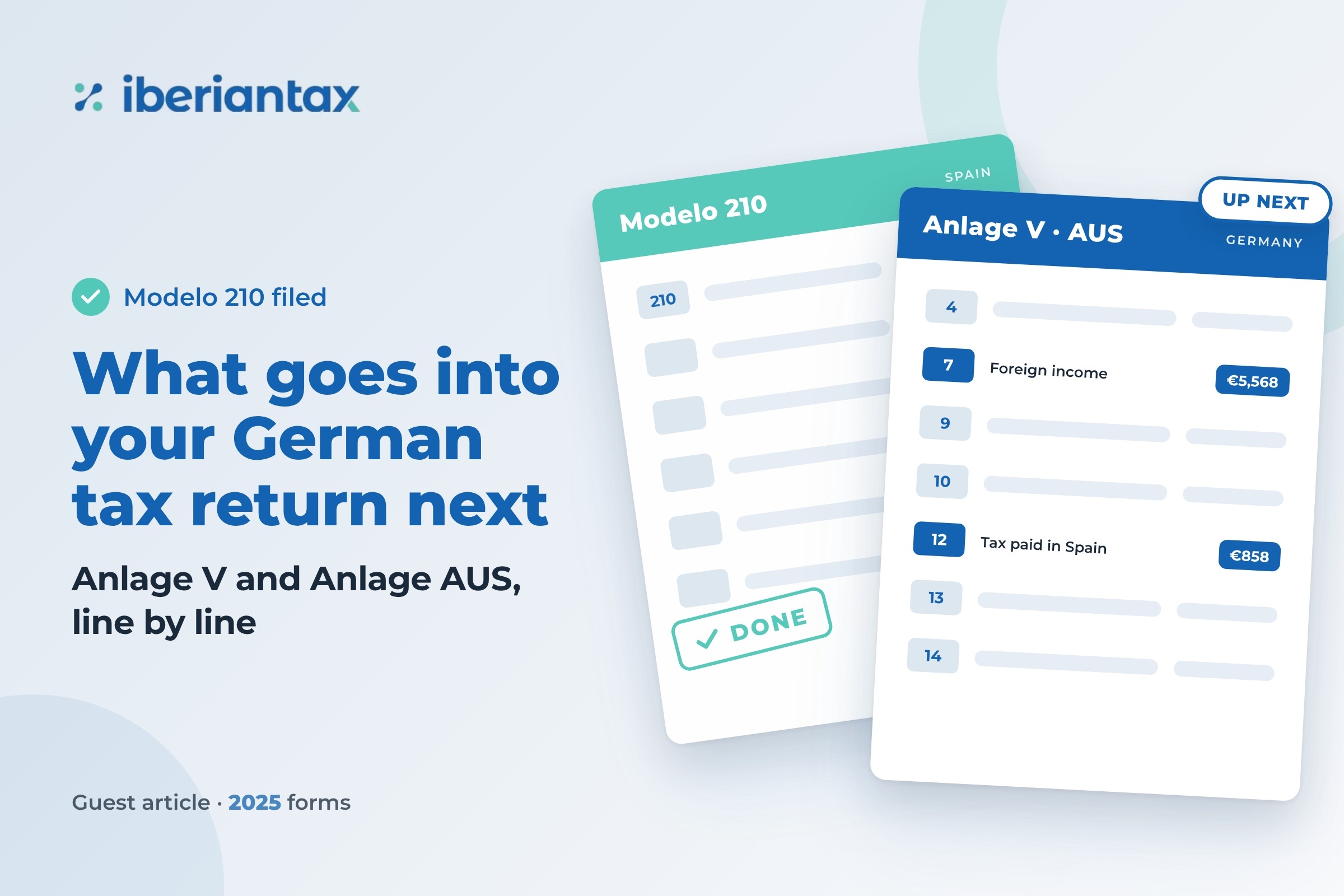
Last updated: October 2026 · applies to the 2025 German income tax return
If you live in Germany and let out a flat in Spain, the rental income also has to be declared in your German income tax return. The Modelo 210 only takes care of the Spanish side. In Germany you enter the income in the Anlage V and the tax paid in Spain in the Anlage AUS. The Finanzamt then deducts the Spanish tax from your German tax, so you do not pay twice.
This article shows which figures you need, which lines they go into and what the most common mistake looks like.
Who this applies to
Anyone who is fully tax resident in Germany (that is, has their home there) and files the Modelo 210 for rental income in Spain as a non-resident. Whether you let long-term or to holiday guests makes no difference. For holiday lets a third form is added, the Anlage V-FeWo (see below).
Why Germany taxes the income at all
Spain taxes the rent because the property is located there. Germany taxes it as well because you live there, and then deducts the Spanish tax from the German one. That is what the double taxation treaty between Germany and Spain, in force since 2013, provides.
With most other countries, such as France or Austria, foreign rental income is exempt from tax in Germany. Until 2012 that was also the case for Spain. Many guides, forums and tax software packages therefore still describe the old rule.
The typical mistake
The Spanish income ends up in the Anlage AUS in lines 36 to 40 on page 3 (codes 810 to 814). That block is meant for "income exempt under a tax treaty and subject to the progression clause". For Spain it is wrong.
This is what the mistake looks like, using the worked example below: the €5,568 are entered in the Anlage AUS in the block of lines 36 to 40 instead of in line 7, and line 12 is left empty. The Finanzamt then treats the rent as tax-exempt. You have under-declared your income, and the €858 you have already paid in Spain are not credited. If this comes to light later, you have to correct the return.
Three other mistakes that come up often:
- Copying the Spanish figures. The result in the Modelo 210 is calculated under Spanish law. The German return needs the result under German law. The depreciation alone is different (see the worked example).
- Deducting the Spanish tax as an expense. The tax from the Modelo 210 belongs in the Anlage AUS. If you enter it in the Anlage V as an expense, you lose the credit. The only exception is a loss year (see below).
- Leaving out the Anlage AUS. Then the Finanzamt knows nothing about the Spanish tax and credits nothing.
Which figures you need
Before you start, have the following to hand:
- The rental income for 2025: bank statements or the statements from Airbnb, Booking or your agency.
- The expenses, with receipts: IBI, community fees (comunidad), insurance, electricity, water, internet, management, cleaning, platform fees, repairs, interest on a loan.
- The purchase deed (escritura) with the purchase price and date, the purchase costs (transfer tax, notary, land registry, estate agent) and the latest IBI bill with the cadastral value (valor catastral) and the share attributable to the building (valor de construcción).
- The Modelo 210 for 2025 with proof of payment.
- For holiday lets: the number of days let, the days you stayed there yourself and the days the property was empty.
Step 1: The result under German law
The income is the same as in Spain. Almost all the expenses are deducted in the same way. The biggest difference is the depreciation of the building (AfA):
| Spain (Modelo 210) | Germany (Anlage V) | |
|---|---|---|
| Rate | 3% | 2% for buildings completed 1925 to 2022, 3% from 2023, 2.5% before 1925 |
| Basis | the higher of acquisition cost and cadastral value, building share only in both cases | acquisition cost including purchase costs, building share only |
| Land | not depreciable | not depreciable |
In practice the building share is usually worked out from the ratio of valor de construcción to valor catastral on the IBI bill. The German Finanzamt may ask for a different method of apportionment.
Two further differences: furniture and appliances up to €800 net are deducted in full in Germany in the year of purchase. And interest and repairs are not capped at the amount of the income in Germany, as they are in Spain.
If you also used the flat yourself, the costs that relate to both uses are split by days: interest, IBI, community fees, insurance, repairs and depreciation. Platform commission, final cleaning after guests and the holiday rental licence, on the other hand, are deducted in full, because they arise only from the letting.
Step 2: The Anlage V
You complete a separate Anlage V for each property. The most important lines in the 2025 form:
| Line | What goes in |
|---|---|
| 4 and 5 | address of the property, with "Spanien" |
| 7 | date of purchase (transfer of ownership) |
| 15 (code 01) | rental income from residential property |
| 35 (code 30) | depreciation of the building, under German law |
| 45 (code 60) | depreciation of furniture and appliances over €800 |
| 48 (code 33) | loan interest, not repayments of principal |
| 55 (code 36) | repairs and maintenance |
| 78 (code 48) | running costs you do not pass on to tenants: IBI, community fees, insurance, water, electricity, gas, management, bank charges |
| 82 (code 49) | other: platform fees, cleaning, internet, trips to the property, small items up to €800 |
| 85 | surplus: income minus expenses |
Lines 73 to 75 ("costs passed on") are only for costs you have passed on to your tenants and recovered from them. With a Spanish holiday flat that is hardly ever the case.
If the property belongs to you and your spouse jointly and you are assessed together, you complete one joint Anlage V and split the surplus in line 86: code 20 for person A, code 21 for person B. If the property belongs to several people who are not assessed together, the Finanzamt will usually require a separate partnership return (Feststellungserklärung).
Amounts are entered in whole euros and rounded in your favour, so income down and expenses up.
Step 3: The Anlage V-FeWo (holiday lets only)
If you let to changing holiday guests, enter a 1 in line 10 of the Anlage V under "Ferienwohnung" (code 61) or "kurzfristig vermietet" (code 63). The Anlage V-FeWo then has to be attached. Income and expenses stay in the Anlage V; the Anlage V-FeWo only asks about use:
| Line | What goes in |
|---|---|
| 8 | Did you use the property yourself in 2025, or reserve the right to do so? |
| 9 | days of own use, days let, days empty |
| 10 | customary local letting days (only for pure holiday lets) |
| 11 | letting through an independent agency with own use excluded? |
The days in line 9 together add up to the days you owned the property in 2025. A week's holiday in your own flat counts as own use, and so does a visit by friends who pay nothing.
If you can use the flat yourself at any time, the empty days are also split, in the ratio of days used yourself to days let. With 120 days let and 30 days of own use, you deduct 80 percent of the mixed costs. Only if your own use is contractually limited to fixed weeks, for example under a contract with an agency, do the remaining empty days count as letting.
Step 4: The Anlage AUS
This is where you connect the Anlage V with the Spanish tax. Spouses each complete their own Anlage AUS, with their amount from line 86 and their share of the Spanish tax.
| Line | What goes in |
|---|---|
| 4 | Spanien |
| 5 | source of income, e.g. "Vermietung Wohnung, Calle ..., Almería" |
| 6 | where the income is shown: "Anlage V, Zeile 85" |
| 7 (code 107) | foreign income: the surplus from the Anlage V, line 85, for your share |
| 12 (code 109) | the tax paid in Spain according to the Modelo 210, for your share |
So line 7 contains the German result from step 1, not the base imponible from the Modelo 210.
Worked example: a let flat in Almería
A flat built in 2005, bought in June 2018 for €160,000 plus €16,000 in purchase costs. According to the IBI bill the valor catastral is €70,000, of which €42,000 is valor de construcción, so the building accounts for 60%. The flat is let for the whole of 2025 on a long-term contract at €750 a month. Running costs: IBI €380, community fees €720, insurance €220. No loan, one owner, resident in Germany.
| Spain (Modelo 210) | Germany (Anlage V) | |
|---|---|---|
| Rental income | €9,000 | €9,000 |
| Running costs | − €1,320 | − €1,320 |
| Building depreciation | − €3,168 (3% of €105,600) | − €2,112 (2% of €105,600) |
| Result | €4,512 | €5,568 |
| Tax | 19% = €857.28 |
The depreciation base is the same in both countries here: 60% of €176,000 is €105,600. In Spain the higher of this amount and the building share of the cadastral value (€42,000) counts. The difference lies only in the rate.
The entries are:
| Form | Line | Amount |
|---|---|---|
| Anlage V | 15 (code 01) | €9,000 |
| Anlage V | 32 (total income) | €9,000 |
| Anlage V | 35 (code 30) | €2,112 |
| Anlage V | 78 (code 48) | €1,320 |
| Anlage V | 83 (total expenses) | €3,432 |
| Anlage V | 85 | €5,568 |
| Anlage AUS | 7 (code 107) | €5,568 |
| Anlage AUS | 12 (code 109) | €858 |
The €857.28 from the Modelo 210 is rounded up in your favour to €858 in line 12.
How much is credited
At most, the German tax attributable to the Spanish income is credited. The Finanzamt calculates:
Maximum credit = German income tax × Spanish income ÷ total income
In the example the owner has total income of €60,000 and income tax under the tariff of €14,000. The maximum is €14,000 × €5,568 ÷ €60,000 = €1,299.20. The €858 from Spain is below that and is deducted in full.
If the Spanish tax is higher than the maximum, the excess is lost. If it is lower, you only pay the difference on the Spanish rent in Germany. The Finanzamt does this calculation itself; you only fill in the two lines of the Anlage AUS.
In a loss year under German law there is nothing to credit. You can then deduct the Spanish tax from the income instead. You enter it in the Anlage V as an expense under other costs (line 82), so that the loss in line 85 and in Anlage AUS line 7 becomes larger, and state the amount in Anlage AUS line 10 (code 113). Line 12 is then left empty.
Which amount from the Modelo 210 counts
- The tax actually paid on the rental income for 2025, that is the cuota you transferred to the Agencia Tributaria. Not the base imponible.
- The year of the income counts, not the payment date. Since the 2024 income year, rental income is grouped annually in the Modelo 210 and declared by 20 January of the following year. So you paid the tax for 2025 in January 2026, but it still belongs in the 2025 return. If you were still filing quarterly, make sure not to mix quarters from two different years.
- Only your share. Each co-owner files their own Modelo 210 in Spain and credits their own tax in Germany.
- Not the tax on your own use. For the days the property was not let, you pay tax on the imputed income (renta imputada) with a separate Modelo 210 in Spain. That tax does not belong in the Anlage AUS: in Germany your own use is not income, so there is nothing it could be credited against.
Keep the Modelo 210 and the proof of payment. The Finanzamt can ask for both.
Deadlines
| Deadline | |
|---|---|
| Modelo 210 for 2025 rental income | 1 to 20 January 2026 |
| German income tax return 2025 | 31 July 2026 (passed); 1 March 2027 if filed through a tax adviser |
| Modelo 210 for 2026 rental income, with payment | 1 to 20 April 2027; by direct debit until 15 April (new) |
If you are required to file, have not yet submitted the 2025 return and do not use a tax adviser, you are already late. File as soon as possible: the Finanzamt can impose a late-filing surcharge that increases with every month or part of a month.
If you did it differently in previous years
If you declared the Spanish rental income as tax-exempt in earlier years, or left it out altogether, the return is incorrect. You must correct it as soon as you notice. In doing so you also claim the credit for the Spanish tax retrospectively, so the additional payment is often lower than feared. For several years or larger amounts, a tax adviser is worth it here.
The line numbers apply to the 2025 forms. They change from year to year. The new forms apply to the 2026 return. This article is general information and not tax advice for individual cases.
About the author: Tim Hattendorf is a software developer in Munich and himself owns a let flat in Almería. Because he could not find any guidance for his own German return that was correct for Spain, he built FincaSteuer: the calculation aid works out the result under German law and assigns each amount to its line in the Anlage V and Anlage AUS. FincaSteuer is a partner of IberianTax.
Editor's note: this guest article covers the German side of the taxation. The information on the German forms comes from the author; IberianTax takes care of the Spanish side, that is preparing and filing the Modelo 210.
As an IberianTax customer you get €10 off the FincaSteuer report with the code IBERIANTAX. You will find this and other partner offers in the Benefits section of your IberianTax dashboard.