Dutch Property Owners in Spain: Your Complete Tax Guide
September 24, 2026

Are you a Dutch resident with a property in Spain and unsure about your tax obligations? You're not alone. Many owners from the Netherlands assume that paying taxes at home is enough, but Spain has its own rules for non-resident property owners. This guide will walk you through exactly which Spanish taxes apply to you, how they compare to the Dutch system, and how to stay fully compliant without stress.
Quick Answer
- Yes, as a Dutch resident with property in Spain, you must file taxes in Spain as a non-resident.
- There are 3 main property taxes that may apply: imputed income, rental income, and capital gains.
- Spain has the primary right to tax any income or gains from Spanish real estate, even if you live in the Netherlands.
- You may also need to report the property in the Netherlands, but the Spain–Netherlands double taxation treaty prevents you from paying tax twice.
Do Dutch Property Owners Need to Pay Tax in Spain?
Yes. If you live in the Netherlands and own a property in Spain, Spain has the right to tax that property because it is located on Spanish territory. This is a basic principle in international tax law and is confirmed by the double taxation treaty between Spain and the Netherlands.
It doesn't matter whether your home in Spain is a holiday villa, an apartment, or a country house. As long as you are a Dutch tax resident (a binnenlands belastingplichtige) and you own real estate in Spain, you are considered a non-resident taxpayer in Spain and must file the Modelo 210.
In simple terms: the Belastingdienst taxes you on your worldwide assets, but the Spanish Agencia Tributaria taxes you on what you own and earn inside Spain.
Main Taxes for Dutch Residents with Property in Spain
There are three main taxes you should know about. All of them are declared through a single form: the Modelo 210, although separate returns may be required depending on the type of income, property, owner and period.
Imputed Income Tax
This is probably one of the most surprising for Dutch owners. Even if your Spanish property is empty, used only for holidays, or not generating any rental income, the Spanish Tax Office assumes that it produces a notional income. This is called Imputed Income or "Renta Imputada", and must be declared annually through the Modelo 210 form.
- The taxable base is 1.1% or 2% of the valor catastral (the cadastral value of the property).
- A flat 19% tax rate applies for EU residents, including Dutch taxpayers.
- The deadline is December 31 of the year following the tax year.
A quick note on the cadastral value: it's the official property value assigned by the Spanish cadastre and is typically well below the market value (often 40%–60% lower). It plays a similar role to the Dutch WOZ-waarde, but it's usually much more favourable for the taxpayer.
If you're familiar with Box 3 in the Dutch system, you'll find some similarities, but also key differences:
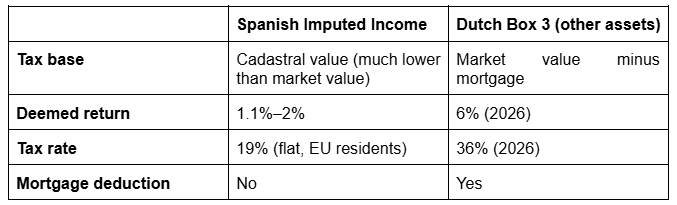
So while both systems tax a "fictitious" return on property, the Spanish system is generally much lighter for holiday-home owners — and unlike Box 3, it applies only to the property, not to your overall savings or investment portfolio.
Rental Income Tax
If you rent out your Spanish property (whether long-term or short-term through platforms like Airbnb or Booking.com), you must declare that rental income in Spain.
- The tax rate is 19% for Dutch residents.
- From the 2024 tax year onwards, rental income is declared annually (no longer quarterly). The filing window is January 1 to January 20 of the year following the tax year.
- Good news: as an EU-resident, you can deduct most rental-related expenses.
- If you rent out the property only for part of the year, you must also file an imputed income return for the days it was not rented.
Important: from the 2026 tax year (to be filed in 2027), this deadline will change again: it will shift from 1–20 January to 1–20 April, and the imputed income period begins on 1 April rather than 1 January., in accordance with Order HAC/623/2026. Please refer to the updated guide to deadlines for 2026.
Capital Gains Tax
When you sell your Spanish property, any profit is taxed in Spain at 19%. The buyer is legally required to withhold 3% of the sale price and pay it to the Spanish Tax Office as an advance payment on your behalf (this is done through the Modelo 211). Then, you can offset or reclaim that amount when you file your own Modelo 210.
How can Dutch residents deduct rental expenses?
This is one of the most important advantages for Dutch property owners. Because the Netherlands is part of the European Union, you are entitled to deduct most of the expenses related to renting out your property in Spain.
This means you only pay tax on your net rental profit, not on the gross income.
Deductible expenses typically include:
- IBI (the local property tax, equivalent to the Dutch OZB - Onroerendezaakbelasting)
- Community fees
- Property insurance
- Maintenance and repairs
- Mortgage interest (proportional to the rental period)
- Utilities paid by the landlord (water, electricity, internet)
- Depreciation of the property (3% of the construction value)
- Agency or property management fees
You can read more about this in our article: Deductible rental expenses Blog
Double Taxation Between Spain and the Netherlands
A common worry is: "If I pay tax in Spain, do I also pay tax in the Netherlands on the same property?"
The short answer: you won't be taxed twice, thanks to the Convention for the Avoidance of Double Taxation between Spain and the Netherlands (signed in 1971 and updated in 2006).
Here's how it works in practice:
- Spain taxes. Under article 6 of the treaty, income derived from immovable property may be taxed in the country where the property is located. Therefore, Spain has the right to tax imputed income, rental income, and capital gains arising from Spanish real estate through the Modelo 210.
- Spanish non-resident income tax rules effectively apply to these types of income, regardless of whether the property is rented out or kept for private use.
- The Netherlands also requires you to declare the property in your annual aangifte inkomstenbelasting, typically in Box 3 (savings and investments). The market value as of January 1 must be reported, minus any related mortgage debt.
- To avoid double taxation, the Netherlands applies the exemption-with-progression method ("vrijstellingsmethode met progressievoorbehoud"), as set out in Article 25 of the Spain–Netherlands tax treaty. This means that your Spanish property is taken into account when determining your total Dutch tax base in Box 3, but relief is then granted through a proportional exemption corresponding to the portion of income or assets that Spain has the right to tax.
- The result: your Spanish property must still be reported in the Netherlands, but the Dutch tax authorities apply double taxation relief for the part attributable to the Spanish real estate, so you should not be taxed twice on the same asset.
Important to know:
- You cannot deduct the Spanish IBI or the tax paid in Spain (IRNR/Modelo 210) as an expense in your Dutch Box 3 calculation. The treaty relief comes through the exemption method, not through expense deduction.
- Following the Dutch Supreme Court ruling of June 2024, taxpayers may request a correction of their Box 3 assessment if they can demonstrate that their actual return is lower than the notional return applied under the Box 3 system. This relief applies to the Dutch tax assessment only and does not affect Spanish tax obligations.
- A new Dutch Box 3 system based on actual returns is expected to apply from 2028 (Wet werkelijk rendement).
Always keep your Spanish tax receipts and Modelo 210 confirmations as proof — both for Spanish records and for your Dutch declaration.
Example Scenario
Case 1: Anna from Utrecht, holiday home in Marbella
Anna lives in Utrecht and owns a small apartment in Marbella that she uses only during summer holidays. She doesn't rent it out. The cadastral value is €120,000.
- Anna must file one Modelo 210 per year for imputed income.
- Taxable base: €120,000 × 1.1% = €1,320
- Tax due: €1,320 × 19% = €250.80 per year
- Deadline: December 31 of the following year.
In her Dutch tax return, Anna also declares the property in Box 3, but receives an exemption to avoid double taxation.
Case 2: Pieter from Amsterdam, rented apartment in Valencia
Pieter rents out his Valencia apartment year-round and earns €12,000 in gross rental income. He has €3,500 in deductible expenses (IBI, community fees, insurance, repairs).
- Net rental income: €12,000 − €3,500 = €8,500
- Tax due: €8,500 × 19% = €1,615 per year
- He files Modelo 210 annually, between January 1 and January 20 of the following year.
Pieter also reports the property in his Dutch aangifte in Box 3, declaring the market value minus mortgage as of 1 January. Although the Spanish property is included when calculating his total Box 3 base, the Spain–Netherlands tax treaty grants a proportional exemption for the portion attributable to the Spanish property.
The result: Pieter pays the rental income tax in Spain, and the Netherlands exempts that same property from Dutch tax — so he is not taxed twice.
How to Stay Compliant
Staying on the right side of the Agencia Tributaria (Spain's equivalent of the Belastingdienst) is much simpler than it seems. Here's what you need to do:
- File the Modelo 210 every year, even if the property is empty.
- Respect the deadlines:
- Imputed income: by December 31 of the following year.
- Rental income: annually, between January 1 and January 20 of the following year (from the 2024 tax year onwards).
- Capital gains: within 4 months of the property sale.
- Keep your records (invoices, IBI receipts, rental contracts) for at least 4 years.
- Avoid penalties: missing a deadline can lead to surcharges of 1% to 15% plus interest, and formal notifications from the Tax Office can result in higher fines.
Common Mistakes Dutch Property Owners Make
- Thinking that paying tax in the Netherlands is enough. Spain always has the primary right to tax your Spanish property.
- Not declaring a property that is empty or only used for holidays. Imputed income tax still applies.
- Assuming the rental declaration is still quarterly. From the 2024 tax year onwards, rental income is filed annually in January, not every three months.
- Forgetting the partial-year imputed income. If you rent out the property only for part of the year, you must also file an imputed income return for the unrented days.
- Confusing deductions. Some owners deduct expenses without keeping invoices or proportional calculations, which can trigger an audit.
- Filing one joint return instead of separate ones. Co-owners must each file their own Modelo 210.
- Forgetting to report the property in the Dutch tax return. Even though you receive an exemption, the property still needs to appear in Box 3.
- Trying to deduct Spanish taxes from Box 3. The IBI and the tax paid in Spain cannot be deducted in Box 3; relief comes through the treaty exemption, not through expenses.
File Your Modelo 210 with IberianTax
If you are a Dutch property owner in Spain, you can easily file your tax return online in just a few minutes, without paperwork, Spanish forms, or expensive gestoría fees. IberianTax is built for non-residents like you: clear, affordable, and available in English with full support whenever you need it.
FAQ
Do Dutch residents need to file Modelo 210?
Yes. Any Dutch resident who owns property in Spain must file the Modelo 210, whether the property is rented, used personally, or kept empty.
Do I pay tax in both Spain and the Netherlands?
You may need to declare the property in both countries, but you will not be taxed twice on the same income or asset. The Dutch tax system applies the exemption with progression method (vrijstellingsmethode met progressievoorbehoud) to eliminate double taxation in accordance with Article 25 of the Spain–Netherlands tax treaty.
Can I deduct rental expenses as a Dutch resident?
Yes. Because the Netherlands is part of the EU, you can deduct most rental-related expenses on your Modelo 210 (IBI, insurance, repairs, mortgage interest, community fees) and pay tax only on your net rental profit.
What happens if I don't file my Modelo 210?
You may face surcharges from 1% to 15%, late-payment interest, and formal penalties if the Tax Office contacts you first. Filing voluntarily, even late, significantly reduces these costs. Read our full guide to more information.
Is the Spanish imputed income similar to Dutch Box 3?
Conceptually they're similar — both tax a notional return on property ownership — but in practice they're quite different. Spanish imputed income is calculated on the cadastral value (much lower than market value) at 1.1%–2%, taxed at 19%. Dutch Box 3 uses the market value minus mortgage, applies a 6.04% deemed return, and taxes it at 36% (2026 rates).
Can I deduct the Spanish tax I paid (IBI, Modelo 210) from my Dutch Box 3 calculation?
No. Spanish taxes cannot be deducted as expenses in Box 3. Instead, double taxation is avoided through the exemption method under the Spain–Netherlands tax treaty: the Dutch tax authorities exempt the portion of your Box 3 wealth attributable to the Spanish property.
My spouse and I own the property jointly. Do we both have to file?
Yes. Each co-owner must file an independent Modelo 210 for their share of the property, not a joint return.