What is the NRC in Spain and what is it for? Everything you need to know as a non-resident
September 24, 2026
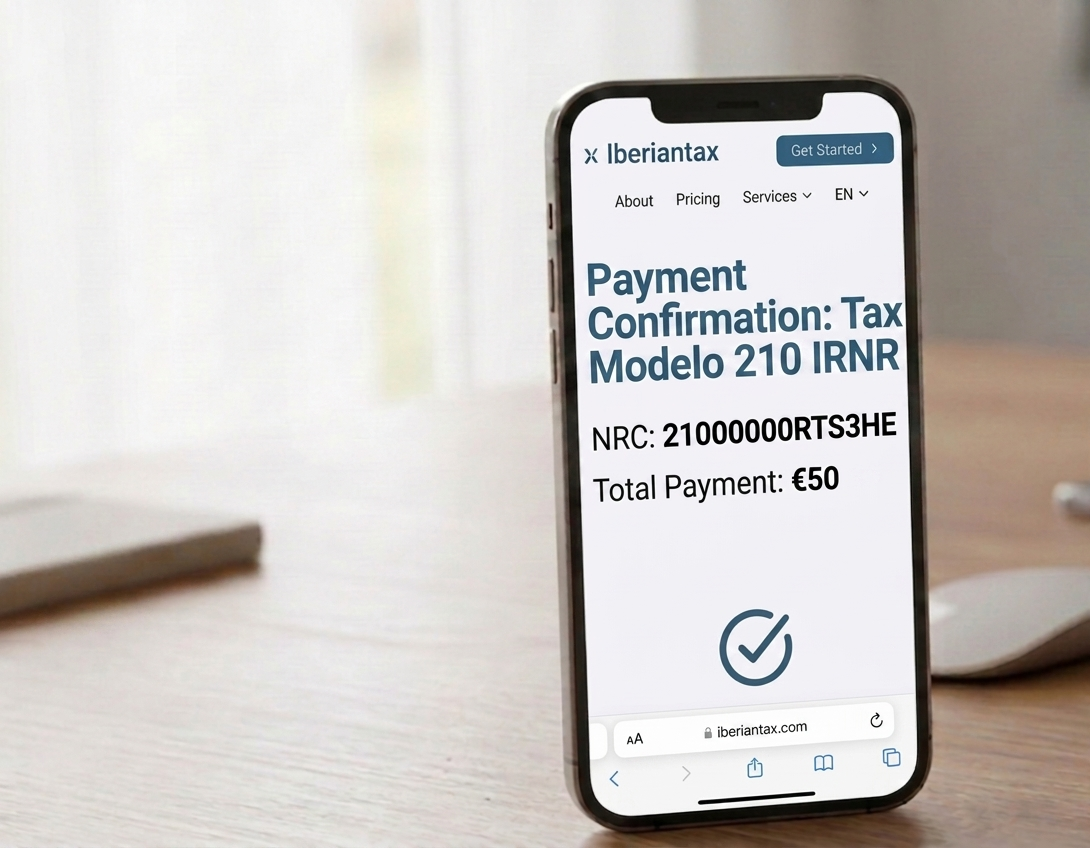
If you are not a resident in Spain and file your tax return using Form 210 (IRNR), you have most likely heard of the NRC.
But what exactly is it? What is it for? When do you need it?
In this article, we explain clearly what the NRC (Full Reference Number) is and why it is essential when paying tax in Spain.
What is the NRC?
The NRC (Full Reference Number) is a 22-character alphanumeric code generated by a bank working in partnership with the AEAT when a tax payment is made. It serves as electronic proof that the payment has been made and is correctly linked to your tax return.
Without an NRC, the Tax Agency cannot identify the payment as having been made.
What is the purpose of the NRC?
The NRC fulfils three essential functions:
- It confirms that the payment has been made.
- It identifies the tax form (for example, Form 210).
- It links the payment to the taxpayer’s NIF/NIE and the relevant tax year.
In other words: it prevents errors in the allocation of the payment.
When does a non-resident need an NRC?
You need an NRC (Full Reference Number) from the Tax Agency whenever you submit a tax return or self-assessment showing a balance due (to be paid) and you have not selected direct debit as your payment method, for example:
- Form 210 for the allocation of property income or rent.
- Form 211 (withholding tax on the sale of property).
- Any self-assessment return showing a positive balance.
If the return results in a refund or a zero balance, no NRC is generated.
Is an NRC required to submit Form 210?
It depends on the payment method you choose. An NRC is required when you pay via:
- Charge to account (i.e. payment made through online banking where the bank processes the transaction and issues an NRC as proof of payment — this is not the same as AEAT “direct debit”). Important: Not to be confused with direct debit, which is a separate banking procedure whereby payments are collected automatically according to a schedule set by the AEAT
- Card payment.
- Bizum.
However, an NRC is not required if:
- You set up a direct debit (where the deadline and type of tax allow).
- You pay by international bank transfer (‘reconocimiento de deuda y pago por transferencia’).
In this case, the AEAT does not require an NRC, but rather a Payment Identifier, which must be included in the transfer reference.
If you submit Form 210 online and pay at the same time by direct debit, card or Bizum, the system generates the NRC automatically. If you pay at the bank first and then submit the form, you will need to enter the NRC manually on the return.
Who generates the NRC?
The NRC is generated by the bank at the time the tax payment is made.
It can be obtained:
- Via online banking (if you have an account with a participating bank in Spain).
- Through an authorised tax adviser, such as IberianTax.
- By payment from bank account within the Spanish Tax Agency (AEAT) online filing process (so-called “payment with charge to account”), where the AEAT sends the payment request to your bank and the bank returns the NRC instantly once the charge is completed.
The NRC contains an encrypted version of the taxpayer’s NIF/NIE, the tax form, the tax year, the amount and the financial institution’s code.
Each NRC is unique and cannot be duplicated.
What happens if the NRC is incorrect?
If the NRC does not correspond exactly to the amount declared, the form, the tax year or the taxpayer’s NIF/NIE, the Tax Agency may consider that the payment is not correctly linked and that the return has not been paid, which may result in surcharges and interest.
NRC and non-residents: common errors
In our experience working with non-residents, the most common errors are:
- Paying using the representative’s tax identification number (NIF) instead of the taxpayer’s.
- Generating an NRC with an amount different from the one declared.
- Mistaking the tax year.
- Attempting to submit the tax return without first generating the NRC (when the payment method requires it).
Proper coordination between the payment and the submission is essential.
Can I pay without having a bank account in Spain?
Yes. If you are a non-resident and do not have a bank account in Spain, you can pay by international bank transfer using the Payment Identifier provided by the AEAT, without needing to generate an NRC.
At IberianTax, we handle this process for you: we receive the relevant amount and ensure that the payment is correctly linked to your tax return with the AEAT, thereby avoiding the most common errors in this procedure.
Does the NRC replace the bank receipt?
Not exactly. The NRC is the valid proof for the AEAT that the payment has been correctly recorded. The bank receipt, on the other hand, is simply proof of the financial transaction. For tax purposes, what matters is the NRC (or, where applicable, the Payment Identifier when paying by international bank transfer).
Conclusion
If you are a non-resident and pay tax in Spain, the NRC (or the Payment Identifier, depending on the method chosen) is what guarantees that your tax has been correctly paid and linked to your tax return. Without it, the payment cannot be identified by the Tax Agency.
At IberianTax, we help non-residents to:
- Submit Form 210 correctly.
- Manage the payment without errors, whether or not you have a bank account in Spain.
- Avoid surcharges and problems with the AEAT.