Spanish Wealth Tax for Non-Residents in 2026: Do You Need to File Modelo 714?
September 24, 2026

If you own a property in Spain but live abroad, you are probably already familiar with Modelo 210, the annual non-resident income tax return. What far fewer owners know is that Spain has a second, separate tax that can apply to the same property: Wealth Tax, declared through Modelo 714.
Here is the good news first. Most non-residents with a single holiday home never pay Wealth Tax, because a generous allowance keeps them well below the threshold. But if you own a high-value property, several properties, valuable Spanish investments, or you hold your property with little or no mortgage, it is worth checking your position carefully, because the rules — and the amount at stake — change significantly depending on the region.
This guide explains exactly how Spanish Wealth Tax works for non-residents:
- Which assets count.
- How the €700,000 allowance works.
- When regional rules apply (and why they can be a trap as well as a benefit).
- The deadlines for 2026.
What Is Spanish Wealth Tax?
Spanish Wealth Tax (Impuesto sobre el Patrimonio) is an annual tax on the net value of your assets — what you own, minus the debts connected to it.
For Spanish tax residents, it can reach worldwide assets. For non-residents, the scope is much narrower: you are taxed only on assets and rights located in Spain. For most foreign owners, that means one thing above all — Spanish real estate, whether it is a holiday home, a rental apartment, a villa, a garage or a plot of land.
The tax is calculated on a progressive scale (broadly from 0.2% up to around 3.5% under the state rules), so even when it does apply, the first euros above your allowance are taxed lightly. Wealth Tax is reported using Modelo 714.
Does Spanish Wealth Tax Apply to Non-Residents?
Yes — but only above certain thresholds, and only on Spanish assets.
As a non-resident, the assets that count are those located in, or exercisable in, Spain:
- Property located in Spain.
- Spanish bank accounts.
- Shares or investments held in Spain.
- Rights connected to Spanish assets.
Anything you own outside Spain is normally excluded. This is the key distinction that reassures most owners: a resident of the UK, Germany, France, the Netherlands or a Nordic country who owns a Spanish property does not declare their worldwide wealth in Spain. The only question that matters is the value of their Spanish assets.
The €700,000 Allowance: Why Most Owners Pay Nothing
Non-residents taxed on their Spanish assets benefit from a €700,000 exempt minimum per person.
Two features of this allowance matter:
- It applies per person, not per property. If a couple owns a Spanish property jointly, each owner is assessed separately on their share, and each gets their own €700,000 allowance.
- It is measured on the net value. For a property held 50/50, you halve the value before comparing it to the allowance.
For example, a married couple owns a Spanish property worth €1,200,000 in equal shares. Each owner's share is €600,000 — below the €700,000 allowance. In a straightforward case, neither owner has Wealth Tax to pay. This is exactly why most non-resident owners are not affected.
Whether you stay below the line, however, depends on the property value, the ownership split, any mortgage attached to the property, and — crucially — whether state or regional rules apply.
Is There an Extra €300,000 Main Home Exemption?
Spain does offer an additional exemption of up to €300,000 — but only for the taxpayer's habitual residence.
For a typical non-resident, the Spanish property is a holiday home, second home or rental, not a main residence. So in most cases this exemption does not apply, and you should not assume you have both a €700,000 allowance and a €300,000 main-home exemption on top.
The practical starting point for a non-resident owner is the €700,000 general allowance, plus any regional rules that may improve on it.
What Assets Are Included?
For non-residents, only Spanish assets count. By far the most common is real estate, which includes: apartments, villas, holiday homes, rental properties, garages, storage rooms, land and commercial premises.
Other Spanish assets — bank accounts, securities, investments and rights linked to Spanish territory — are also included where they exist.
Can You Deduct a Mortgage?
Yes, in most cases. Debts connected to the Spanish asset can be deducted from its value. The classic example is the mortgage used to buy the property.
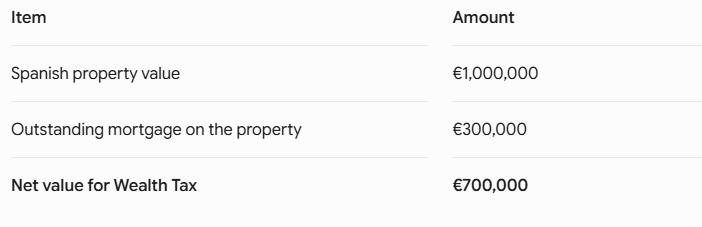
The condition is that the debt is genuinely linked to the Spanish asset. A general personal loan, or a mortgage taken out abroad, should be reviewed before assuming it can be deducted.
How Is Spanish Property Valued for Wealth Tax?
This is the single most important — and most misunderstood — point for non-resident owners.
For Wealth Tax, your property is valued at the highest of these three figures:
- The cadastral value shown on your IBI receipt.
- The value determined or verified by the tax authorities for other taxes.
- The purchase price (acquisition value).
In other words, the Wealth Tax value is not automatically the cadastral value, and it is not necessarily the current market value. If your purchase price was higher than the cadastral value, the purchase price is what counts.
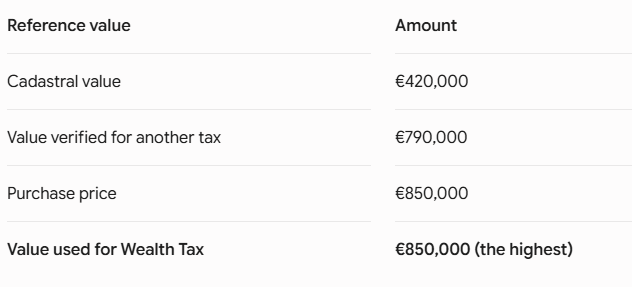
This is why owners who look only at their cadastral value often underestimate their position.
Regional Rules: The Same Property, a Very Different Result
Wealth Tax is a national tax, but Spain's autonomous communities can set their own allowances, scales and bonuses. The result is that the tax on an identical property can vary enormously depending on where it is located.
Here is the part many owners miss: non-residents are entitled to apply the rules of the autonomous community where the largest value of their Spanish assets is located. You cannot pick any region you like — it is the region where your main Spanish asset sits. But you can compare that region's rules against the state rules and apply whichever is correct for your case.
As a reference for the current year (always confirm the figure for the relevant tax year, as regions update these regularly):
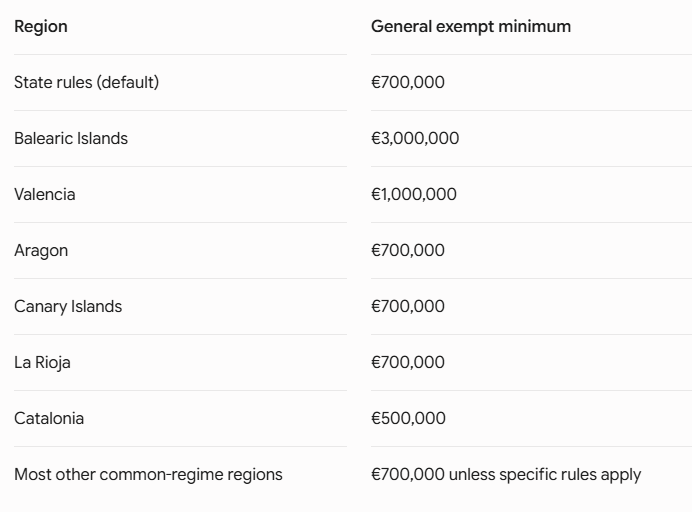
The takeaway is important and counterintuitive: applying regional rules is not always better. In the Balearic Islands, the €3,000,000 minimum means many high-value owners pay nothing. In Catalonia, the regional minimum is lower than the state allowance, so the state rules may be more favourable. When the gap is meaningful, both scenarios should be calculated before filing.
Some regions also offer special rules for taxpayers with disabilities or protected assets. These are very case-specific and should be reviewed separately.
Worked Examples
Example 1 — UK owner, property below the allowance
John is tax resident in the UK and owns a holiday apartment in Alicante.
Value for Wealth Tax: €620,000
- Mortgage: €0.
- Ownership: 100%.
John's Spanish net wealth is €620,000, below the €700,000 allowance, so he has no Wealth Tax to pay. He does, however, still need to file Modelo 210 for imputed income each year. This is the most common situation by far: no Wealth Tax, but an annual non-resident income tax return regardless.
Example 2 — German owner, high-value property in Mallorca
Anna is tax resident in Germany and owns a property in Mallorca.
Value for Wealth Tax: €2,400,000
- Mortgage: €0.
- Ownership: 100%.
Under the state €700,000 allowance, Anna's taxable base would be substantial. But because the property is in the Balearic Islands, where the regional minimum is €3,000,000, applying the regional rules likely removes the Wealth Tax altogether. Even so, she may still have to file Modelo 714 if her gross assets exceed the €2,000,000 filing threshold (more on this below).
Example 3 — Dutch couple, property in Catalonia
A Dutch couple owns a property in Catalonia.
Value for Wealth Tax: €1,400,000
- Mortgage: €200,000.
- Ownership: 50% each.
Per owner: gross share €700,000, mortgage share €100,000, net share €600,000. Under the state €700,000 allowance, each owner falls below the threshold. But Catalonia's regional minimum is lower (€500,000), so here the state rules are the better outcome. A perfect illustration of why "use the regional rules" is not a reliable rule of thumb.
When Must a Non-Resident File Modelo 714?
You must generally file Modelo 714 if either of these is true:
- Your Wealth Tax calculation results in tax payable, or
- The gross value of your Spanish assets and rights exceeds €2,000,000, even if no tax is ultimately due.
That second trigger is the one most owners overlook. You can owe nothing — after allowances, mortgage deductions or favourable regional rules — and still be obliged to file simply because your gross Spanish assets cross €2,000,000.
What Is the Deadline for Modelo 714?
Wealth Tax is assessed on the assets you held on 31 December of each year, and the return is filed the following year.
For the 2025 tax year, the filing period runs from 8 April to 30 June 2026. Modelo 714 must be submitted online. If your return results in tax to pay and you want to settle by direct debit, the practical deadline is a few days earlier — so it is best not to leave filing until the final week.
Wealth Tax vs Modelo 210: Not the Same Thing
This is a frequent source of confusion, so it is worth being clear:
- Modelo 210 is the non-resident income tax return. It covers imputed income on a property you don't rent out, rental income, and capital gains when you sell.
- Modelo 714 is the Wealth Tax return. It covers the net value of your assets.
A non-resident property owner typically needs Modelo 210 every year (even for an empty holiday home), but only needs Modelo 714 in the years their Spanish assets exceed the Wealth Tax thresholds. They are separate obligations with separate deadlines.
What About the Solidarity Tax on Large Fortunes?
Spain also levies a Temporary Solidarity Tax on Large Fortunes, a separate tax that generally applies to net wealth above €3,000,000 (after the same €700,000 allowance). It was designed largely to capture taxpayers in regions that have reduced or removed Wealth Tax — the Balearic Islands being the obvious example for property owners.
For most non-residents this is not a concern. But if your Spanish net wealth is very high — particularly if regional rules have eliminated your Wealth Tax — the Solidarity Tax should be reviewed as the next step.
Common Mistakes Non-Resident Owners Make
- Assuming Wealth Tax applies to everyone. It doesn't. Most non-resident owners are below the threshold — though they still need Modelo 210.
- Confusing Wealth Tax with IBI. IBI is a local property tax paid to the town hall. Wealth Tax is a national return filed through Modelo 714. Completely different obligations.
- Using only the cadastral value. Property is valued at the highest of cadastral value, verified value, or purchase price — often the purchase price.
- Forgetting to split ownership. Each owner is assessed individually on their share, with their own allowance.
- Ignoring regional rules — in both directions. They can save you tax, or cost you tax. Always compare.
- Assuming "no tax" means "no filing." If gross assets exceed €2,000,000, you may have to file even with nothing to pay.
What You'll Need to Check Your Position
To assess whether Modelo 714 applies, have these to hand:
- IBI receipt and cadastral value.
- Purchase deed, purchase price and acquisition costs.
- Ownership percentage.
- Mortgage balance as at 31 December.
- Details of any other Spanish assets.
- Your country of tax residence and the location of the Spanish assets.
- Any previous Wealth Tax filings.
For most owners, the IBI receipt and purchase deed are the natural starting point.
How IberianTax Can Help
IberianTax helps non-resident property owners handle their Spanish tax obligations online — clearly, correctly, and without the usual friction of dealing with the Spanish system from abroad.
We can help you confirm and file the returns that actually apply to you:
- Modelo 210: imputed income, rental income, and capital gains on a sale.
- Modelo 714: Wealth Tax, in the years it applies.
If you own a high-value property, hold property with other owners, or your property is in a region with its own Wealth Tax rules (such as the Balearic Islands, Valencia or Catalonia), the calculation deserves a careful look before you file — and that is exactly where getting it right saves you money and stress.
In Summary
Spanish Wealth Tax doesn't affect every non-resident, but it matters a great deal for owners of high-value Spanish assets. The essentials:
- Non-residents are taxed only on Spanish assets.
- The general state allowance is €700,000 per person.
- Mortgages and debts linked to the property reduce the taxable value.
- Regional rules can change the result dramatically — in either direction.
- Modelo 714 may be required even when no tax is payable, if gross assets exceed €2,000,000.
- Wealth Tax is separate from Modelo 210.
If you own property in Spain and live abroad — and especially if your Spanish assets are close to or above these thresholds — review your position before the 30 June 2026 deadline.
This article is general information, not personalised tax advice. Your final position depends on your assets, debts, region, ownership structure and the rules in force for the relevant tax year.
Frequently Asked Questions
Do all non-resident property owners in Spain pay Wealth Tax?
No. Most are below the threshold and pay nothing — but they still need to file Modelo 210 each year.
What is the general Wealth Tax allowance for non-residents?
€700,000 per person under the state rules.
Is the €700,000 allowance per property or per owner?
Per owner. Two joint owners each get their own €700,000 allowance on their share.
Do non-residents get the €300,000 main home exemption?
Usually not, because the exemption applies to your habitual residence — which for a non-resident is not the Spanish property.
Can a mortgage reduce Wealth Tax?
Yes, if the debt is connected to the Spanish asset — for example, the mortgage used to buy the property.
Which property value is used?
The highest of the cadastral value, the value verified by the authorities for another tax, and the purchase price.
Do regional rules apply to non-residents?
Yes. You apply the rules of the region where the highest value of your Spanish assets is located — and you should check whether those rules or the state rules are more favourable.
Can I choose the most favourable region?
No. The region is fixed by where your main Spanish asset is located; you cannot shop around.
Is Modelo 714 filed every year?
Only in years where the filing obligation applies, based on your assets at 31 December.
My assets are worth more than €2,000,000 but I owe no tax. Do I still file?
Yes — the €2,000,000 gross threshold triggers a filing obligation even when no tax is due.
Is Wealth Tax the same as Modelo 210?
No. Modelo 210 is income tax; Modelo 714 is Wealth Tax. Many owners need the first but not the second.
Can IberianTax check whether I need to file Wealth Tax?
Yes — we help non-resident owners review their position and file Modelo 714 where it applies.