Essential Annual Checklist for Non-Resident Property Taxes in Spain
September 24, 2026
At IberianTax, it’s been our mission since day one to make non-resident taxes simple and stress-free - which is exactly why we want to prepare you as much as possible before the upcoming deadlines this December.
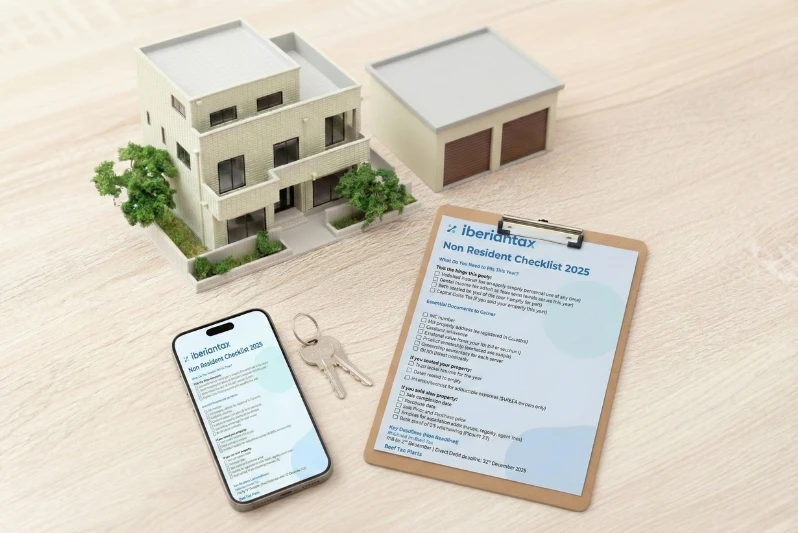
We've put together a simple checklist to help you gather all the right documents, understand which taxes apply to you and avoid last-minute mistakes. Download this free checklist and use it on your device or print it out - whichever works best for you!
Whether you own a holiday home, leave your property empty or rent it out during the year, this guide will walk you through everything you need to get ready to file your non-resident taxes in Spain.
Confirm What Non-Resident Tax You Need to Pay
First, you’ll need to identify exactly which tax applies to your situation:
Imputed Income Tax (For personal use/empty)
If your property remains empty all year, or if you use it only for personal use, you’ll need to file Imputed Income tax.
Rental Income Tax (short or long term rentals)
If you generate any income through short or long term rentals, you’ll need to file Rental Income tax for the days it was rented out.
If you only rented out the property partially, for example, you only rented during the summer months, you’ll need to file a Rental Income tax return for the rented days, and then Imputed Income tax return for the days that the property was empty.
If you have more than one property, you’ll need to file a return for each one.
Gather the Documents You’ll Need
Different taxes require slightly different documents. Here’s everything you’ll need:
Your Cadastral Reference/Cadastral Value
You can find this on your IBI (council tax) bill, on your deeds/escritura or on the Catastro website. If you need further assistance, feel free to contact our support team.
Your NIE number
This is your unique fiscal tax number required for all non-resident filings. This is usually on a white A4 sheet of paper.
Your full property address
You’ll need to detail the address, exactly as it’s registered in Spain’s Catastro.
Proof of ownership & ownership percentage
Deeds, escritura or nota simple (only needed in specific cases, but it’s useful to have). You’ll also need to know the property ownership percentage for each owner.
If you rent out your property
You’ll need to collect the following:
- Rental income totals for the year (if you use IberianTax’s Expenses Calculator, you can find this information in your dashboard)
- Dates rented and dates empty/occupied
- Receipts for deductible expenses (EU residents only), this includes:
- Utilities
- Insurance
- Community fees
- Repairs
- Marketing/agency costs
- Cleaning
- IBI tax
Please note that non-EU residents currently cannot deduct expenses for the 2025 non-resident tax season.
If you sold your property in 2023:
You’ll only need to file for the days you owned the property.
Double-Check Property and Ownership Details
You might want to consider:
- Is your cadastral reference correct? These values are updated periodically (usually around every 8-10 years)
- Did your property usage vary month to month? Have you made a note of this?
- Do you share the property with a spouse or other co-owner? Each owner must file separately.
This all avoids errors and corrections later.
Know Your Deadlines
The deadlines depend on what type of tax you’re filing:
- The Imputed Income Tax deadline is 31st December 2025, but you’ll need to file by 21st December if you want to pay by Direct Debit.
- The Rental Income filing window will open on 1st January 2026, and the final day to file is 20th January 2026. To pay by Direct Debit, you’ll need to file before 13th January 2026.
Mark these dates in your calendar, especially if you own multiple properties.
Double-Check Your Payment Method
You can pay via:
- Direct Debit
- Bank transfer
- Cash (to be paid in person at your Spanish bank)
If you want to pay by Direct Debit, remember that you’ll need to file before 21st December 2025 for Imputed Income tax, and 13th January 2026 for Rental Income tax.
Save Your Receipts
With IberianTax, your past returns and receipts are automatically stored within your dashboard for safekeeping. If you ever rent, sell, or undergo audits/checks by the Agencia Tributaria (Spanish tax authorities), these are extremely important to have at hand.
Stay Organised with Our Free Checklist
You can download this FREE checklist and reuse it every year as the filing deadlines approach. Simply tick off each box as you go - or print it out if you prefer a paper copy. It includes everything you need to stay organised, from required documents to key property details.
If you’re an IberianTax user, you can take convenience even further by enabling the Automatic Filing feature. Your information is securely saved for the following year, and once it’s set up, we’ll handle your Modelo 210 submission for you - every year. You can simply opt out at any time, giving you complete flexibility and control.
Ready To File?
You can calculate and file your taxes in minutes with IberianTax - the easiest and most affordable way for non-residents to stay compliant in Spain.
Our platform is designed for people just like you: foreign owners juggling life abroad, different time zones, and unfamiliar tax terminology. With IberianTax, there’s no paperwork, no guesswork and no need to navigate Spanish forms on your own.
Sign up for free today and calculate your tax in minutes, and let us take care of the rest. You’ll be fully compliant before the deadline, without the stress or the last-minute scramble.