Cost of Buying Property in Spain: Taxes and Fees for Non-Residents (2026)
September 24, 2026

The price on the listing is never the price you actually pay. Once you add taxes and fees, buying a property in Spain costs roughly 10% to 14% more than the headline price - and as a non-resident, a few of those costs work differently for you than for a local buyer.
This guide breaks down every cost to budget for: what each one is, who you pay, when, and how much. Most importantly, it explains the single distinction that decides your biggest tax bill - resale vs new build - and the annual taxes that begin the moment you own, even if you never rent the property out.
Important: This is general information, not personalised tax advice. Purchase-tax rates are set by each region (Comunidad Autónoma) and change from year to year, so always confirm the current rate where you are buying. IberianTax does not handle the purchase itself, but once you own a Spanish property, we make your annual non-resident tax filing simple. More on that below.
Resale or new build? The distinction that decides your tax bill
To begin with, workout which of these you're purchasing, as they are taxed under two completely separate systems - and you will never pay both:
- A resale (second-hand) property: one that has been owned before - is taxed with ITP (property transfer tax).
- A new build: bought directly from the developer as the first-ever sale - is taxed with IVA (VAT) plus AJD (stamp duty).
Most international buyers purchase resale properties, so ITP is usually the main event. Here's how the two compare:
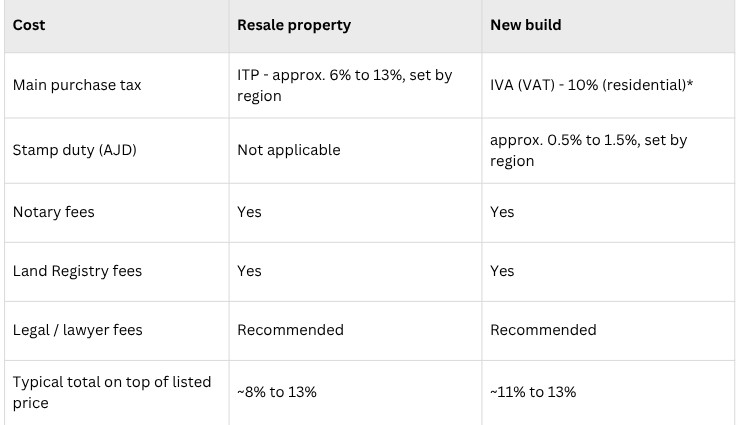
* In the Canary Islands, new builds are taxed with IGIC at 7% instead of IVA.
Buying a resale or second-hand property: ITP (property transfer tax)
For second-hand homes, the main cost beyond the listed price is the Impuesto sobre Transmisiones Patrimoniales (ITP).
- Who pays: the buyer.
- What it's calculated on: the tax base which is the higher of two amounts - your purchase price or the valor de referencia, which is an official property value set by Spain's Catastro (Land Registry). In most cases, buyers pay more than the valor de referencia figure, so the tax is calculated on the actual sale price. That said, it's worth checking in advance to avoid surprises.
- When and how to pay: within 30 days of signing the title deed (escritura) at the notary, using the Modelo 600, and before you can register the property in your name.
ITP rates by region in 2026
ITP is a regional tax, so the rate depends entirely on where the property is located - and the gap between regions is large enough to change your budget by tens of thousands of euros. These are the regions where international buyers most often purchase:
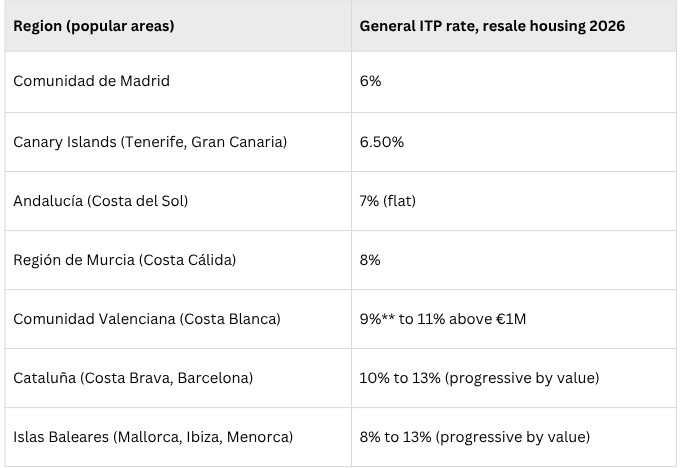
** The Comunidad Valenciana reduced its general rate from 10% to 9% in mid-2026; purchases above €1 million stay at 11%.
Across all 17 regions, the general rate ranges from around 6% (Madrid) to 13% (top brackets in the Balearics and Catalonia), with most regions sitting between 8% and 10%. Several regions - Catalonia, the Balearics, Aragón, Asturias and others - apply a progressive scale, so the more the property costs, the higher the applicable rate. These rates are being actively reviewed in 2026, so it's important to confirm the figure for your exact region and price band before budgeting.
A note for non-resident buyers
Many regions advertise reduced ITP rates for young buyers, large families, or first-time buyers as aids. These almost always require Spanish residency or a primary-residence purchase, so a non-resident buying a holiday home or investment property will generally pay the standard rate and won't qualify for the reduced rates. Budget accordingly.
For a deeper breakdown of how ITP is calculated and paid, see our dedicated guide to the Property Transfer Tax (ITP).
Buying a new build: IVA (VAT) + AJD (stamp duty)
If you buy directly from a developer, you don't pay ITP. Instead you pay two taxes together:
- IVA (VAT): 10% of the price for residential property on the mainland and the Balearics. In the Canary Islands this is replaced by IGIC at 7%.
- AJD (Impuesto sobre Actos Jurídicos Documentados): a stamp duty on the notarised deed, set by each region, typically 0.5%–1.5%. It also applies to the mortgage deed if you finance the purchase.
So a typical new build carries 10% IVA plus around 1% AJD - slightly more in tax than many resales (second-hand purchases), with the trade-off of a brand-new property and additional developer warranties. Unlike ITP, IVA is a national rate and doesn't change from region to region (only AJD does).
The costs everyone pays: resale or new build
On top of the purchase tax, budget for:
- Notary fees: for the public deed of sale. Roughly €600-€1,200, scaled to the price.
- Land Registry (Registro de la Propiedad) fees: to register you as legal owner. Usually costs a few hundred euros.
- Legal / lawyer fees: not mandatory, but strongly recommended for non-residents who don't speak or read Spanish. Typically around 1% of the total purchase price.
- Your NIE (Número de Identidad de Extranjero): your unique Spanish ID number - you cannot buy, pay taxes, or register the property without one. It's cheap but slow to obtain, so apply for it well in advance.
Financing with a mortgage? Add a valuation fee (tasación), the bank's arrangement fee, and AJD on the mortgage deed.
Transferring money from abroad? Factor in currency-exchange costs. On a six-figure purchase, the spread your bank charges can quietly cost more than the notary.
A worked example
A non-resident buys a €300,000 resale apartment on the Costa del Sol (Andalucía, 7% ITP):
- ITP (7%): €21,000
- Notary: ~€900
- Land Registry: ~€600
- Lawyer (≈1%): ~€3,000
- NIE and sundries: ~€200
Total extra cost: about €25,700 - roughly 8.6% on top of the price. The same purchase in a higher-rate region such as Catalonia or the Balearics could push the total well above 12%.
What you do not pay as a buyer
Two taxes are tied to the same sale but are paid by the seller, not you - and they often cause confusion:
- Plusvalía Municipal: a local tax on the increase in land value, owed by the seller.
- Capital Gains Tax and the 3% retention: the seller's tax on their profit. When buying from a non-resident seller, your only related duty is that 3% of the price is withheld and paid to the Agencia Tributaria via Modelo 211 on the seller's behalf.
Neither of these costs fall on your plate, so don't account for them in your buying budget.
The part most buyers miss: the taxes that start once you own
Here's what the estate agent rarely mentions. The moment the property is in your name, you take on annual obligations as a non-resident owner - whether or not you ever rent out your Spanish property
1. IBI: the annual local property tax (local taxes), paid to the town hall, based on your cadastral value.
2. Imputed income tax via Modelo 210: if you don't rent the property and only use it yourself (or leave it empty), Spain still taxes a notional "rental value" every year. This surprises almost every new owner. If you do rent it out, you also must declare the actual rental income separately via Modelo 210.
Buying is a one-off cost. Ownership creates a recurring filing (Modelo 210) you'll need to handle every year - and missing it leads to surcharges and penalties from the Agencia Tributaria, often arriving years later once significant interest has built up.
How IberianTax fits in
We don't handle the purchase, the ITP tax, or the conveyancing - that's your lawyer's job. What we do is simplify the recurring part that never goes away.
Once you own a Spanish property, IberianTax lets you:
- File your Modelo 210 online in minutes: imputed income, rental income, or capital gains - with no Spanish paperwork and no digital certificate required.
- Get automatic deadline reminders every year, so you never miss a filing deadline.
- Use our free tax calculators to know what you'll owe before you commit.
- Get multilingual support in English, German, French, or Spanish.
If you've just bought - or are about to - the smartest move is to understand your annual obligations now, before the first deadline arrives.
Frequently asked questions
How much does it cost to buy property in Spain?
Budget around 10% to 14% on top of the listed purchase price. The biggest single item is the purchase tax: ITP (about 6% to 13%, by region) on a resale, or 10% IVA plus stamp duty (AJD) on a new build. The rest covers notary, Land Registry, and legal fees.
Do foreigners pay more tax when buying property in Spain?
No. Non-residents pay the same ITP, IVA, and AJD rates as Spanish buyers. The practical differences are that you'll need an NIE, possibly translations and a power of attorney, and you generally won't qualify for the regional reductions reserved for residents.
Is it cheaper to buy a new build or a resale?
It depends on the region. A resale carries ITP (from ~6% to ~13%), while a new build carries 10% IVA plus AJD (~0.5% to 1.5%). In low-ITP regions like Madrid or Andalucía a resale is usually cheaper in tax terms; in high-ITP regions the gap narrows or reverses.
What is the valor de referencia?
A fiscal reference value set by the Catastro. Your purchase tax is calculated on the higher of two prices: the price you actually paid or this reference value, so check it before you sign.
Do I need an NIE to buy property in Spain?
Yes. You cannot complete a purchase, pay the taxes, or register ownership without an NIE, so apply for one as early as possible.
When do I start paying tax after buying?
IBI (local tax) applies from the year you start owning the property. Your first Modelo 210 (imputed or rental income) covers the year of purchase and is filed the following year - which is exactly when many new owners are caught out.