Your Complete Guide to Non-Resident Property Taxes in Spain 2025
September 24, 2026

Owning property in Spain while living abroad is a dream for many - sunshine, culture, and investment potential. But it also comes with tax obligations that every non-resident should understand.
If you’re unsure about Modelo 210, when to file it, or whether it applies to you, this guide will make it simple.
You’ll learn:
- What is Modelo 210 and who needs to file it?
- Types of Property Tax Returns: Imputed, Rental, and Capital Gains Tax?
- What are the different Modelo 210 deadlines?
- What happens if you miss a deadline?
- Can I file Modelo 210 myself or do I need help?
- Additional Topics for Non-Resident Property Owners in Spain
What is Modelo 210 and who needs to file it?
Modelo 210 is the official Spanish tax form for non-residents (meaning, anyone who lives outside Spain for more than 183 days a year) used to declare income or property ownership in Spain.
You need to file Modelo 210 if you:
- Own a holiday home or second residence
- Rent out your property, short-term or long-term
- Keep your property empty for part or all of the year
- Sell a property in Spain
In short, if you’re not a Spanish tax resident but own property in Spain, Modelo 210 applies to you.
Types of Property Tax Returns: What is Imputed, Rental, and Capital Gains Tax?
Many property owners are surprised to learn that Modelo 210 isn’t a single tax, it’s a form used in several situations where non-residents must file a return for their property in Spain. Specifically, it applies to three main property tax obligations:
Imputed Income Tax:
Even if you don’t rent out your Spanish property, the Tax Office assumes it generates income. This notional income tax must be declared annually using Modelo 210. It’s calculated from your cadastral value and is usually filed once per year by December 31.
- General rule: The taxable base is 2% of the cadastral value (as shown on the IBI receipt).
- Exception: If the municipality has undergone a General Collective Revision within the last 10 years (2014 onwards), the rate is reduced to 1.1%.
Rental Income Tax:
If you rent out your property - short-term or long-term - you must declare the income annually via the Modelo 210.
- EU/EEA residents can deduct rental expenses like insurance, maintenance, IBI tax, and utilities.
- Non-EU residents cannot currently deduct rental expenses, though this may change following EU discussions.
Capital Gains Tax:
When a non-resident sells a property in Spain, any profit is taxed via the Modelo 210. The buyer must submit Modelo 211, withholding 3% of the purchase price on your behalf. You can later claim a refund or offset this amount when filing your own Modelo 210. This must be done within four months of the sale date.
What counts as “property” for Spanish tax purposes?
The term “property” in Spain doesn’t just refer to a house or apartment. It also includes garages, storage rooms, commercial units, plots of land, or workshops. Essentially, any type of immovable asset located in Spain.
For tax purposes, what really matters is whether the property has its own cadastral reference number (referencia catastral).
- If it does, it will have a separate IBI receipt, which means it must be declared independently.
- In other words, each unique cadastral reference requires its own Modelo 210, even if the properties are in the same building or owned by the same person.
Real-Life Example
John Smith, a UK resident, owns a holiday home in Mijas and a separate garage (each with its own cadastral reference and IBI receipt). He spends 4 months a year at his Spanish home (personal use) and rents it out for the remaining 8 months of the year. He sold the garage recently and did not rent it before the sale.
What does John need to file?
John must submit separate Modelo 210 returns, because each tax concept and each property is handled independently:
1. Rental Income Tax Return (home) - Modelo 210
For the 8 rented months.
When to file: annually between January 1–20 for the previous year.
2. Imputed Income Tax Return (home) - Modelo 210
For the 4 months of personal use.
When to file: by December 31 of the following year (December 23 if paying by Direct Debit).
3. Imputed Income Tax Return (garage, up to the sale date) - Modelo 210
Because the garage was not rented, imputed income applies pro-rated up to the date of sale (only for the period John owned it and it was at his disposal).
When to file: by December 31 for the previous year (December 23 if paying by Direct Debit).
4. Capital Gains Tax Return (garage sale) - Modelo 210
Within 4 months of the sale date.
Modelo 211 (withholding tax): the buyer pays the 3% withholding tax. John can later offset or request a refund of that 3% in his capital gains tax return (Modelo 210).
Direct Debit from SEPA Accounts (Second Year in Use)
From 2024, non-residents could pay taxes by direct debit from SEPA (EU) bank accounts for the first time, providing an alternative to a Spanish bank account. However, the first year showed processing delays, with SEPA payments debited about 20 days later than those from Spanish accounts.
Key Takeaways:
- SEPA direct debit is a convenient option for those without a Spanish account.
- Taxpayers using this payment method should anticipate potential delays in payment processing.
When are the deadlines?
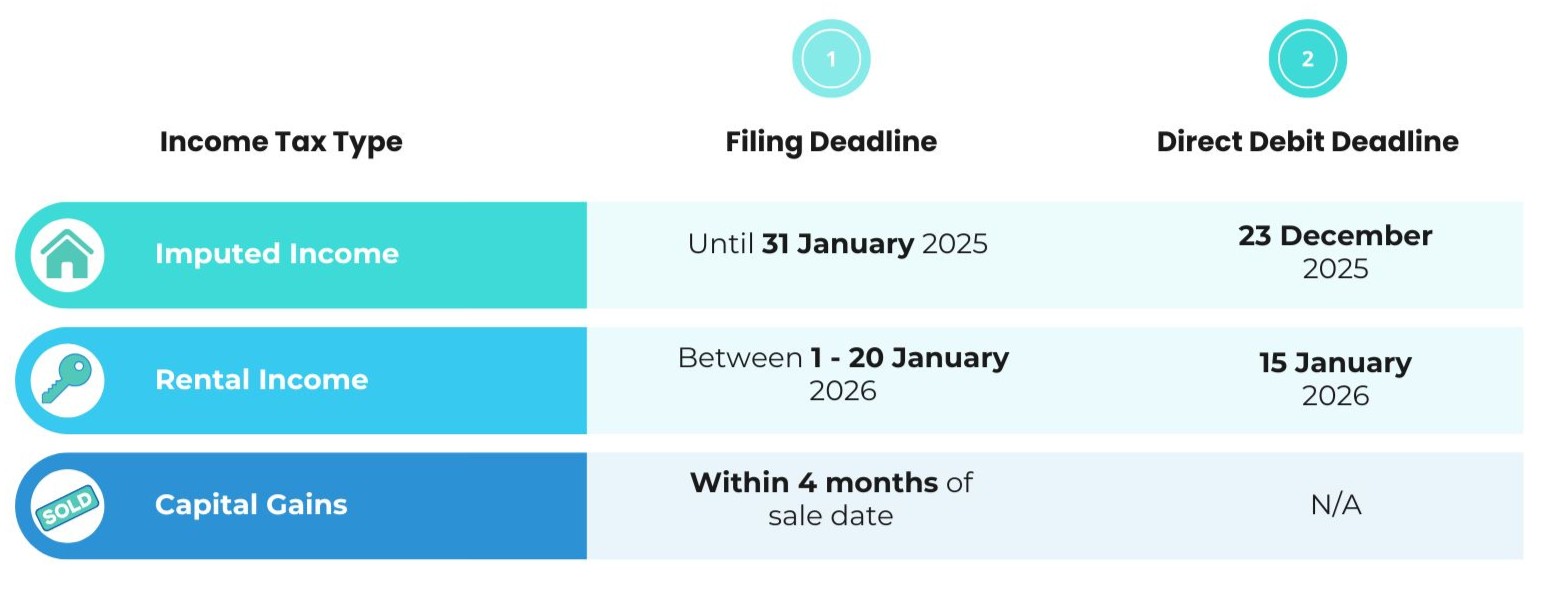
Even though tax rules can change slightly each year, the general deadlines for Modelo 210 usually remain consistent:
Important: this is no longer the case from the 2026 tax year (to be declared in 2027): the period for rental income shifts from 1–20 January to 1–20 April, and the imputed income period begins on 1 April instead of 1 January, in accordance with Order HAC/623/2026. See the updated guide to deadlines for 2026.
What happens if you miss a deadline?
Missing a Spanish tax deadline can lead to surcharges, interest, and penalties.
Surcharges for Late Voluntary Filing (Recargos por declaración extemporánea sin requerimiento)
If you file late but voluntarily (i.e., before the Tax Office sends you a notice), no penalties apply, just a surcharge:
- 1% if filed within the first month after the deadline, plus 1% for each full additional month
- After 12 months, the surcharge is 15% and late-payment interest only accrues from the day after the filing deadline.
Interest on Late Payment (Intereses de demora)
Applies when:
- You file voluntarily 12 months after the deadline (15% surcharge + interest from late payment), or
- The Tax Office has already issued a formal notice (in this case penalties apply, not surcharges).
Penalties (Multas)
- Serious delays or ignoring the rules can lead to hefty fines.
- If the tax office sends a formal notice, fines can be 50–100% of what you owe.
- For bigger amounts or repeated noncompliance, it could even lead to criminal charges, though that’s a rare case.
Other Problems
- You might lose or delay pending refunds.
- Denied deductions or expense claims.
- Increased scrutiny in future filings.
Can I file Modelo 210 myself or do I need help?
Technically, you can file it manually on the Agencia Tributaria website, but the process is not very intuitive and is available only in Spanish. That’s why so many non-resident property owners trust IberianTax to handle it for them.
With IberianTax, you can:
- File your Modelo 210 online in minutes from the comfort of your home.
- Save money: pay as little as €34.95 per filing, compared to traditional gestoría fees of €200 or more.
- Stay stress-free: know your non-resident property taxes are filed accurately, on time, and directly with the Spanish Tax Office.
- Receive automatic deadline reminders by email.
- Choose automatic filing to have your taxes submitted every year without lifting a finger.
- Calculate your taxes instantly and ensure everything is correct using our free tax calculators.
- Get expert support in English, German, French, or Spanish whenever you need it.
At IberianTax, we make filing your Modelo 210 simple, secure, and fully transparent, so you can focus on enjoying your property rather than worrying about taxes. Through imputed income, rental income and capital gains tax forms, we help thousands of non-residents each year meet their Spanish tax obligations without stress or surprises.
File in minutes with IberianTax.
Additional Topics for Non-Resident Property Owners in Spain
Tax Office Notifications
Live abroad? We can handle letters and notifications from the Spanish Tax Office on your behalf. Request this service directly through your dashboard.
Digital Certificate
We now offer a service to obtain a digital certificate for secure online transactions with the Spanish Tax Office. Request it here.
NRA requirement for short-term rental properties
From July 2, 2025, all short-term rental listings on online platforms (Booking, Airbnb, Vrbo, etc.) must display a valid rental registration number (NRA). Get yours now to ensure compliance and keep your listings active.
NEW: NRA annual declaration
From February 2026, all Spanish short-term rental owners must submit an annual declaration of rental activity - including guest numbers, stay dates, and purpose - to maintain a valid Rental Registration Number (NRA). Read our article for more details, and request this service directly through your dashboard.
NEW Rental Expenses Reclaim service for non-EU/EAA residents
Non-EU/EEA owners can now reclaim overpaid rental tax from the past four years, and IberianTax handles the entire process with the Spanish Tax Office on your behalf. Learn more here.
Rental Income Tracking & Expense Deduction Tool
Track rental income and deductible expenses directly in your IberianTax dashboard to simplify filings.
Nota Simple
Obtain the official extract from the Spanish Land Registry with up-to-date property information. Request this service here.
FAQs
For any questions you may have, please visit our FAQ page or don’t hesitate to contact us.