How to correct errors in Form 210: Supplementary and Amended Return
September 24, 2026

The submission of Form 210 is an unavoidable tax obligation for non-resident taxpayers in Spain who generate income within Spanish territory. However, it is common for errors, omissions, or changes to the declared information to be detected after the initial submission. In these cases, the Spanish Tax Agency allows the amendment of these returns through two specific procedures: the Supplementary Return and the Amended Return. Understanding the differences between the two and knowing when to apply each is crucial for correct compliance with your tax duties and avoiding penalties.
Summary of Tax Obligations for Non-Residents in Spain
What is Form 210?
Form 210 is the official return used by non-tax residents in Spain to declare and settle the Non-Resident Income Tax (IRNR). This tax levies income obtained in Spanish territory by individuals who do not have their tax residence in Spain (in other words, that reside in Spain for less than 183 days a year).
Types of Taxable Income
Non-residents must submit the Form 210 (Modelo 210) to declare the following types of income:
- Imputed Income: Applicable when you own a property in Spain that is not rented out but is for personal use or remains empty. A presumed income of 1.1% or 2% of the cadastral value is considered, depending on whether this value has been recently reviewed.
- Rental Income: Income derived from the letting of properties located in Spain. Non-residents from the EU/EEA can deduct certain property-related expenses, whereas non-EU/EEA residents are taxed on gross income.
- Capital Gains: Profits obtained from the sale or transfer of real estate in Spain.
Submission Deadlines
- Imputed Income: Annually, from the 1st January to the 31st December of the year following the fiscal year.
Example: Imputed income for 2024 is declared between the 1st January and the 31st December 2025.
- Rental Income: Annually, from January 1st to January 20th of the year following the fiscal year. Prior to 2024, the rental tax returns were submitted quarterly, within the first 20 calendar days of April, July, October, and January.
Example: Rental income for 2025 can be declared from 1st to 20th January 2026.
- Capital Gains: Within 4 months following the date of the transfer.
Example: If you sold a property on March 15th 2025, the Form 210 (Modelo 210) should have been submitted before July 15th 2025.
Supplementary Return: When and How to Submit It
What is a Supplementary Return?
A Supplementary Return is presented to correct errors or omissions in a previously-submitted tax return when the result is a higher payable amount or a lower refundable amount by the Tax Agency. In other words, when you realise you paid less tax than you owed.
Typical Cases for a Supplementary Return
- You forgot to declare additional rental income.
- You incorrectly applied unauthorised deductions or expenses, resulting in an underpayment.
- You declared a lower cadastral value than the actual one for imputed income.
- You failed to include all the properties you own.
Tax Implications
By voluntarily submitting a supplementary return (before the Tax Agency requests it):
- You must pay the difference between the amount initially paid and the correct amount due.
- Surcharges for late submission will be applied, which vary depending on the time elapsed.
Important: If you submit the supplementary return before the voluntary submission deadline expires, no surcharges or interest will be applied.
How to Submit a Supplementary Return
- Identify the error: Review the original return and determine exactly which information needs correction.
- Access the Form 210: You can do this via the AEAT electronic headquarters or by contacting IberianTax, who will guide you through the process easily and securely.
- Tick the "Supplementary Return" box: There is a specific box on the Form 210 you must tick to indicate that it is a supplementary return.
- Enter the reference number of the previous return: You must provide the reference number of the original return you are supplementing.
- Complete all the correct data: Include the complete and correct information, not just the difference. The new return will replace the previous one.
- Calculate and pay the difference: The system will calculate the difference to be paid.
- Submit and keep the proof: Once submitted, retain the proof of submission as a record.
Amended Return: When and How to Submit It
What is an Amended Return?
An amended return is submitted when you have paid more tax than you owed - that is, when the result of the correction is a lower payable amount or a higher refundable amount. It is also used to correct errors that do not have a financial impact but need to be amended (e.g., errors in identification details).
Typical Cases for an Amended Return
- You declared higher rental income than the actual amount.
- You failed to apply eligible deductions or deductible expenses (for EU/EEA residents).
- You declared a higher cadastral value than the correct one.
- You applied a tax rate of 24% when 19% was applicable because you are an EU resident, resulting in an overpayment.
- You included incorrect rental days or duplicated periods.
Tax Implications
The submission of an amended return:
- May result in a tax refund for overpaid taxes.
- Does not generate surcharges or penalties, as you are correcting an error that disadvantaged you, not the Tax Agency.
- Must be submitted within the statute of limitations: In Spain, the general period is 4 years from the day following the end of the original return's submission deadline.
- Generates late-payment interest in your favour: If the amended return results in a refund, you are entitled to late-payment interest from the date the undue payment was made until the date the refund payment is ordered.
- Requires justification: You must provide documentation that corroborates the error and the requested correction.
How to Submit an Amended Return
Unlike the supplementary return, the amended return is a more formal procedure:
- Gather the supporting documentation:
- Original return submitted.
- Documents proving the error (rental contracts, updated cadastral certificates, fiscal residence certificate, deductible expense invoices, etc.).
- Detailed calculation of the correction.
2. Complete a written application addressed to the Tax Agency, indicating:
- Taxpayer identification.
- Reference of the return to be rectified (reference number).
- Clear description of the error made.
- Calculation of the correct amount that should have been paid.
- The amount to be refunded.
- Attached documentation justifying the amended.
3. Submit the application to the Tax Agency:
- Electronically: Through their electronic headquarters (requires a digital certificate).
- Via a representative: IberianTax can manage this entire process for you.
4. Resolution
- If accepted: You will receive the refund via bank transfer.
- If denied: You will receive a notification with the reasons. You may file an administrative appeal or an economic-administrative claim.
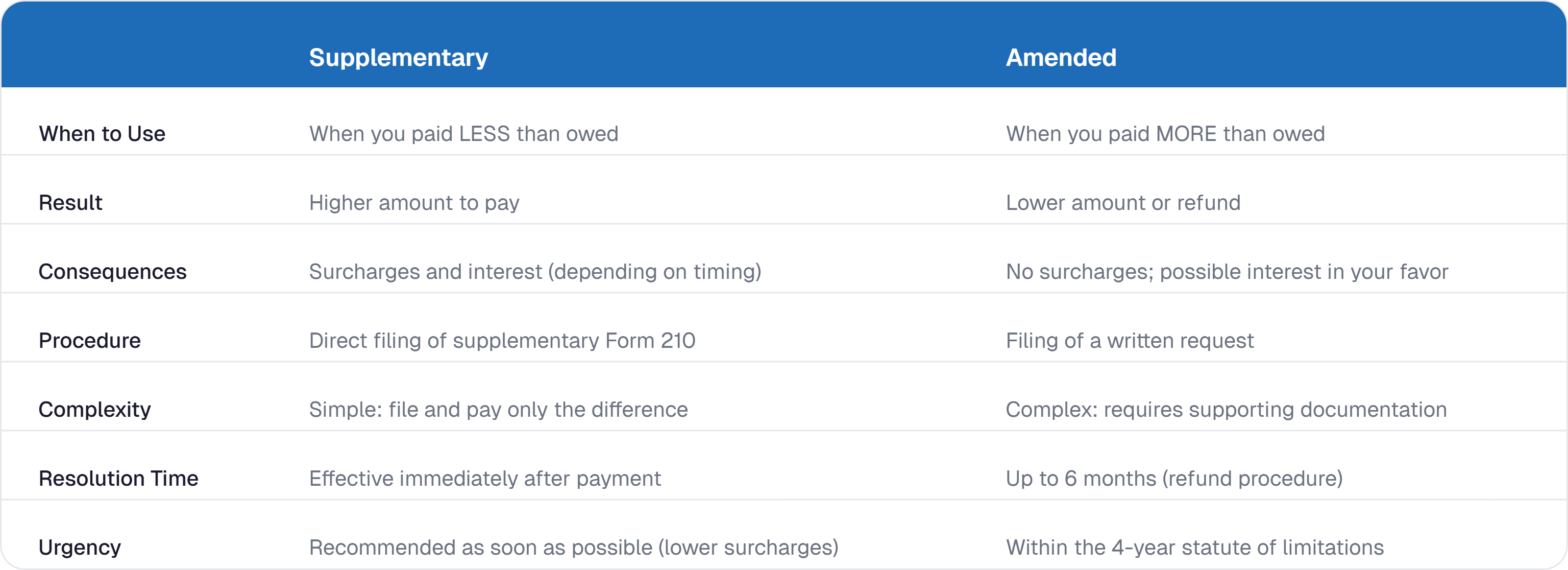
Key Differences: Supplementary vs. Amended
Practical Recommendations
To Avoid Errors
- Keep all documentation: Rental contracts, receipts, invoices, cadastral certificates, fiscal residence certificate, etc.
- Verify data before submitting: Carefully check the cadastral value, declared income, deductible expenses, and the applicable tax rate.
- Know your rights: If you are an EU/EEA resident, you have the right to deduct expenses from rental income and apply the 19% tax rate.
- Use reliable tools and consult professionals: Platforms like IberianTax automatically calculate the correct tax due, minimising errors, and have specialised tax advisors for non-residents.
If You Detect an Error
- Do not delay: The sooner you correct the error, the lower the consequences (surcharges in the case of supplementary returns).
- Analyse the impact: Determine whether you overpaid or underpaid to know which type of return to submit.
- Gather the documentation: Have all supporting documents ready before starting the process.
- Submit correctly: Ensure you correctly mark the type of return (Supplementary or Amended) and include the original return's reference number.
- Keep records: Retain all documentation from the correction process.
Conclusion
Amending the Form 210 is a right that all non-resident taxpayers have when they detect errors in their returns. The fundamental difference is clear: use the Supplementary Return when you need to pay more tax than initially declared, and the Amended Return when you have overpaid and are entitled to a refund.
Acting quickly with supplementary returns reduces applicable surcharges, while with amended returns, you have up to four years to claim overpaid amounts. In both cases, having complete and up-to-date documentation is essential to justify the corrections.
Fiscal management as a non-resident does not have to be complicated. IberianTax simplifies the entire Form 210 process, from initial submission to necessary amendments. With automatic calculations, deadline reminders, multi-language support, and assistance from specialised tax experts, you can comply with your tax obligations in Spain securely and without complications.
Register now and manage your non-resident taxes with the reassurance of having expert professionals on your side.